
Bubble Customer Success App Guide: Your 2026 Success Toolkit

Customer success is the secret weapon for startups and small businesses aiming for growth in 2026. With competition fiercer than ever, delivering a seamless customer journey is no longer optional.
This article is your practical, step-by-step toolkit to build a bubble customer success app, designed specifically for non-technical founders and product owners. You do not need to write code or have technical experience.
We will show you exactly what a customer success app is, the essential features you need, why Bubble.io is the ideal platform and where its limits are, plus a clear walkthrough of the entire build process. You will also learn about common mistakes, timelines, costs, and see real-world examples to inspire your next move.
Ready to take control of customer success? Let us get started.
What a Customer Success App Is
Customer success has rapidly evolved in recent years, especially as we move into 2026. It is no longer just about support, but about proactively managing relationships and driving outcomes for clients. Companies now see customer success as a core growth driver, with 72% of businesses increasing investment in customer success teams according to the Customer Success Survey 2025 Report. A bubble customer success app enables startups and service businesses to centralise and automate these efforts, making proactive engagement possible at scale.

Defining Customer Success in 2026
In 2026, customer success means actively guiding customers to achieve their goals, not just reacting to problems. With SaaS and digital services everywhere, businesses need to track engagement, predict churn, and deliver value consistently. Studies show that a 5% increase in retention can boost profits by up to 95%. A bubble customer success app gives non-technical founders the tools to stay ahead, using automation and data to build lasting customer relationships.
Core Functions of a Customer Success App
A bubble customer success app goes beyond basic support by offering a suite of integrated features:
- Centralised customer data tracking for a unified view of each client.
- Automated onboarding workflows to ensure smooth customer journeys.
- Health scoring and churn prediction based on real-time engagement data.
- Task management tools for customer success teams to stay organised.
- Communication modules and feedback collection for continuous improvement.
With these core functions, startups can manage customer lifecycles efficiently and deliver better experiences.
Benefits for Startups and SMBs
Startups and small businesses benefit most from using a bubble customer success app. The main advantages include higher customer retention, increased lifetime value, and streamlined processes that scale as the business grows. With built-in analytics, founders gain actionable insights to refine products and services. For example, a SaaS startup implemented a basic success app and reduced churn by 20% within six months, showing the clear ROI of these solutions.
Who Needs a Customer Success App?
A bubble customer success app is essential for founders, product owners, and teams who manage multiple customer relationships. If you are struggling with manual tracking, missed contract renewals, or lack of visibility into customer health, you are not alone. These common pain points signal it is time to adopt a scalable solution that centralises data, automates routine tasks, and provides clear insights to drive customer retention and business growth.
Core Features of a Customer Success App
Building a robust bubble customer success app starts with understanding the essential features every modern team needs. Each function below transforms how you manage customers, automate processes, and leverage data for growth.

Customer Database & Segmentation
A bubble customer success app needs a single source of truth for every customer. By centralising profiles, you unlock powerful segmentation. Group users by lifecycle stage, health score, or plan. For example, tag VIPs for white-glove support or flag at-risk customers for follow-up.
Segmentation lets you personalise outreach and prioritise workload. With Bubble.io, you can quickly build database views to filter by custom fields. Want proof this works? Real-world examples in the Top 10 Real-Life Apps Built with Bubble.io show how startups use similar segmentation to drive retention and growth.
Onboarding & Task Automation
Effective onboarding is crucial for any bubble customer success app. Automate welcome checklists so nothing falls through the cracks. Assign tasks to team members for each new signup, ensuring a consistent experience.
For instance, when a customer joins, your app triggers a workflow: sends a welcome email, assigns a CSM, and sets up a personalised checklist. This keeps your team focused and customers engaged from day one.
Health Scoring & Alerts
A bubble customer success app thrives on proactive management. Define health metrics such as product usage, engagement frequency, or NPS. The app can automatically calculate a health score for each customer.
When scores drop below a set threshold, trigger real-time alerts so your team can intervene fast. This system helps prevent churn, as at-risk accounts are spotted and supported before issues escalate.
Feedback Collection & Reporting
Continuous feedback is the backbone of improvement. Your bubble customer success app should collect in-app survey responses and NPS data directly from users. Display results on a dashboard for easy trend analysis.
Export reports for stakeholders with a single click. These insights guide product decisions and help you demonstrate the impact of customer success efforts with clear, actionable data.
Why Use Bubble.io for Customer Success Apps (and Its Limits)
Building a bubble customer success app is now a practical reality for non-technical founders. Bubble.io’s no-code platform offers a clear path to launch, scale, and manage a robust solution without needing traditional software development skills.
Bubble.io Strengths for Non-Technical Founders
Bubble.io empowers founders to create a bubble customer success app using a visual, drag and drop editor. You do not need to write code, which makes the build process accessible and fast. Rapid prototyping reduces time to market, with some teams reporting up to 80 percent faster build times compared to traditional development.
The built in database and workflow tools allow you to automate customer journeys and manage data with confidence. For a comparison of why Bubble.io outperforms other no code options for startups, see this Bubble vs Webflow for startups guide.
Cost-Effectiveness and Scalability
Choosing Bubble.io for your bubble customer success app keeps costs predictable. The platform offers affordable pricing tiers, making it ideal for startups and small businesses. You can launch an MVP, then scale up as your user base and feature needs grow.
Many founders start with a simple set of workflows and expand to support thousands of users. Upgrading plans and adding more complex features does not require a full rebuild, so your investment is future proof.
Security, Compliance, and Integrations
Security and data protection are critical for any bubble customer success app. Bubble.io supports GDPR ready hosting, letting you manage customer data responsibly. Privacy rules and role based access controls are built in.
The platform integrates with email, CRM, and analytics tools, so you can automate communications and pull data from other platforms. Following best practices for data privacy ensures your app meets compliance requirements as you grow.
Known Limitations and Workarounds
While Bubble.io is powerful, there are limits to what a bubble customer success app can do out of the box. Performance may slow down with very large datasets, and highly complex business logic or API integrations can require creative solutions.
If you need advanced features, consider using custom code plugins or connecting to external backends such as Xano. Regular testing and optimisation help maintain app speed and reliability as your customer base expands.
How Minimum Code Can Help
Minimum Code specialises in building and scaling bubble customer success app projects for non-technical founders. Their team manages everything from initial discovery to launch, with a focus on security, scalability, and compliance.
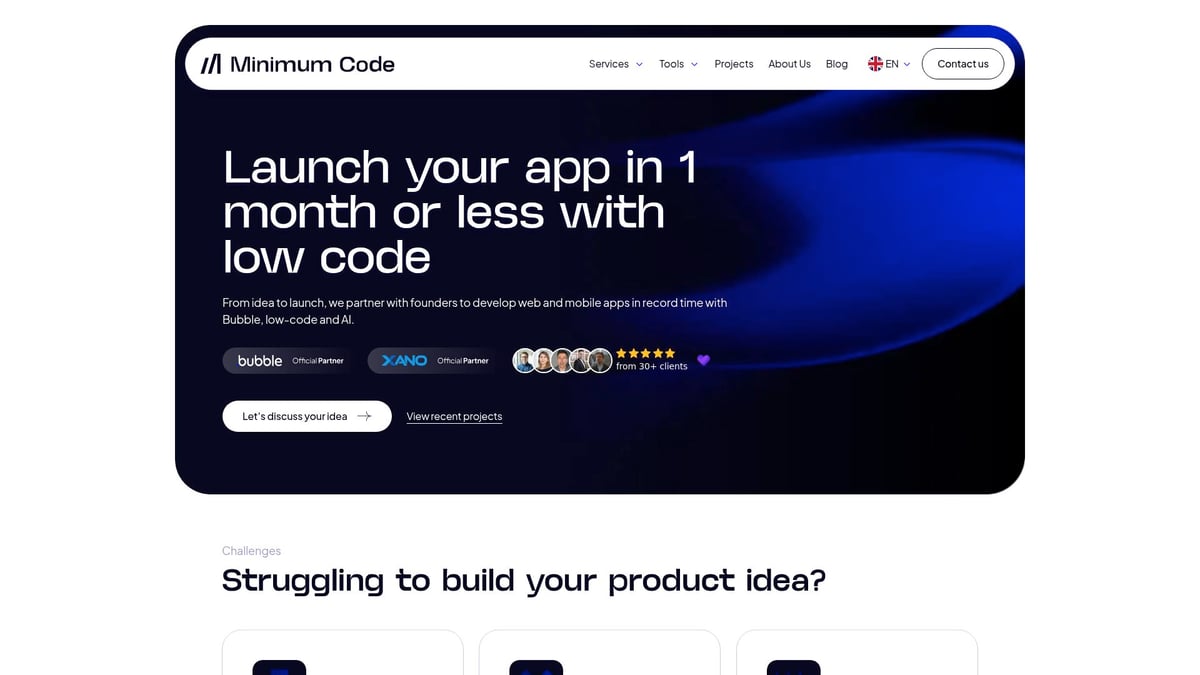
Clients benefit from expert workflow design, faster launches, and ongoing support. By partnering with Minimum Code, you reduce risk and ensure your customer success app is built to industry standards, ready for real world use.
How to Build a Customer Success App in Bubble.io: Step by Step Guide
Building a bubble customer success app in 2026 is more accessible than ever, even for non-technical founders. With the right approach, you can create a robust, scalable tool that drives retention and growth. This step-by-step guide breaks down the process, helping you avoid common pitfalls and deliver value fast.

Step 1: Plan Your App’s Core Workflows and Data Structure
Start by defining exactly what your bubble customer success app needs to achieve. Identify who will use it, such as:
- Customer Success Managers (CSMs)
- Admin users
- Customers themselves
Map out the customer journey, from onboarding to renewal. List the key data fields you need, like:
- Customer name, email, company
- Plan type and lifecycle stage
- Health score and feedback records
Sketch your workflows using mind maps or tools like Figma. Visualising user journeys helps clarify requirements and avoid wasted effort later.
Step 2: Set Up Your Bubble.io Project and Database
Create a new project in Bubble.io. The next step for your bubble customer success app is to design a solid database. Set up key data types:
- Customer: stores core info and status
- Task: links to customers, tracks assignments
- Health Score: monitors engagement and risk
- Feedback: collects survey/NPS responses
Define relationships between data types, such as connecting each Task to a Customer. This structure supports reporting, segmentation, and workflow automation.
Step 3: Build User Interfaces for Key Features
Design intuitive dashboards for your bubble customer success app users. Start with:
- CSM and admin dashboards showing customer lists, health scores, and tasks
- Customer profile pages with activity timelines and feedback history
- Onboarding checklists and to-do lists for team members
Consider both desktop and mobile layouts. Use Bubble’s drag-and-drop editor to create responsive, user-friendly interfaces.
For example, a CSM dashboard could have tabs for active customers, at-risk accounts, and upcoming renewals. A simple table can summarise customer segments:
| Segment | Health Score | Action Needed |
|---|---|---|
| VIP | 90+ | Monitor |
| At-Risk | <60 | Immediate |
Step 4: Create Workflows and Automations
Automate repetitive tasks in your bubble customer success app to boost efficiency. Use Bubble’s workflow editor to set up:
- Automated onboarding emails triggered after signup
- Task assignments when a customer changes status
- Health score calculations based on usage metrics
- Alerts for at-risk customers or missed renewals
Schedule follow-ups and feedback requests. Use conditional logic to trigger actions, such as sending reminders if a customer’s health score drops.
For step-by-step instructions, check out this comprehensive How to build an MVP app guide, which covers no-code workflow best practices.
Step 5: Integrate Communication and Feedback Tools
A great bubble customer success app keeps communication seamless. Integrate tools like SendGrid for email or Twilio for SMS notifications, so users never miss an update.
Embed in-app surveys and NPS pop-ups to gather feedback at key moments. Make it easy for CSMs to export responses to Google Sheets or a CRM for further analysis.
Set up automated triggers to prompt feedback after onboarding, renewal, or support interactions. This ensures you capture valuable insights across the customer lifecycle.
Step 6: Test, Iterate, and Launch
Before launching your bubble customer success app, run user acceptance testing with real data. Invite a small group of users to explore the app and provide feedback.
Refine features based on their input. Use Bubble’s version control to make safe changes. Complete a launch checklist:
- Security and privacy rules in place
- GDPR compliance confirmed
- Daily backups enabled
A smooth, well-tested launch builds trust and sets the stage for growth.
Step 7: Monitor, Maintain, and Scale
After launch, monitor how users interact with your bubble customer success app. Set up analytics dashboards to track:
- Active users and engagement trends
- Health score changes over time
- Task completion rates
Plan regular maintenance—review privacy settings, update workflows, and address bugs promptly. As your customer base grows, consider optimising your database and adding features.
Schedule quarterly reviews to prioritise updates and ensure your app continues to deliver value.
Building a bubble customer success app is an achievable goal for any founder. By following these steps, you can create a scalable tool that drives retention and growth.
Ready to bring your vision to life? Book a free, no-obligation discovery call with our founder Tom for expert guidance and tailored advice: https://www.minimum-code.com/contact
Common Mistakes When Building Customer Success Apps in Bubble.io
Building a bubble customer success app as a non-technical founder can be empowering, but it is easy to fall into common traps. By recognising these pitfalls early, you can save time, reduce frustration, and launch a better product.
Overcomplicating the MVP
One of the biggest mistakes in any bubble customer success app project is trying to build too much, too soon. Many founders want every possible feature from the start, but this often leads to delays, increased costs, and a confusing user experience.
- Focus on essential workflows first, such as tracking customer data and automating onboarding.
- Add more advanced features only after the basics are working smoothly.
- Keep the user interface clean and simple.
If you are new to no-code, this guide on building MVPs with no-code offers practical steps for prioritising features and launching faster. Remember, the goal is to validate your bubble customer success app quickly, then iterate based on feedback.
Poor Data Structure Planning
A poorly planned database is a common stumbling block for any bubble customer success app. Without the right data relationships, your app will be slow, unreliable, and hard to scale.
- Define key data types: Customer, Task, Health Score, Feedback.
- Link tasks directly to customer records for clear tracking.
- Use unique IDs and avoid storing redundant information.
Start by mapping out the customer journey and identifying what data you need at each stage. This will make your bubble customer success app easier to maintain and extend in the future.
Neglecting Security and Compliance
Security and data compliance should be at the heart of every bubble customer success app. Failing to set privacy rules or configure GDPR settings puts both your business and your customers at risk.
- Set up Bubble’s privacy rules for all customer data.
- Use secure workflows for sensitive information.
- Schedule regular security audits to check for vulnerabilities.
Always review Bubble’s security documentation and consult legal guidance if you handle personal or regulated data. Building trust is crucial for your bubble customer success app’s long-term success.
Ignoring Feedback and Iteration
Many founders skip user testing or wait too long to gather feedback on their bubble customer success app. This can result in missed opportunities and features that do not solve real problems.
- Invite early users to test core features and share honest feedback.
- Track feedback using in-app surveys or direct calls.
- Prioritise updates based on actual user needs, not assumptions.
Continuous iteration helps your bubble customer success app evolve with your customers. Make testing and learning a regular part of your process.
Timeline and Cost Ranges for Bubble Customer Success Apps
Understanding the timeline and costs involved in building a bubble customer success app is crucial for founders planning their next move. With the right approach, you can move from concept to launch efficiently and within budget. Here is what you can expect at each stage of the journey.
Typical Build Timeline for Startups
Most startups building a bubble customer success app can expect to launch a minimum viable product within 2 to 4 weeks. This short timeline is possible due to Bubble.io’s visual builder and ready-to-use components. For a fully featured solution, the process may extend to 1 or 2 months, especially if you plan to add advanced automations or integrations.
Factors that influence your development speed include how clear your requirements are, the complexity of your workflows, and the experience of your team. Teams with a solid plan and a focus on core features often progress faster. For inspiration, review the Bubble.io Case Study: La Mobilière, which showcases a real-world customer success app and its development journey.
Cost Factors and Ranges
The cost of launching a bubble customer success app varies based on your approach. If you choose the DIY route, your main expense will be the Bubble subscription, usually between £25 and £100 per month. This makes it accessible for early-stage founders.
Engaging freelancers typically starts from £2,000 and can climb to £7,000 for more advanced features. Working with a specialist agency may cost £10,000 to £15,000 or more but brings added expertise and polish. Remember to budget for ongoing maintenance, updates, and possible third-party services.
| Approach | Initial Cost | Ongoing Cost |
|---|---|---|
| DIY | £25-£100/month | £25-£100/month |
| Freelancer | £2,000-£7,000 | £50-£200/month |
| Agency | £10,000-£15,000+ | £100-£500/month |
Choosing the right path depends on your needs and resources.
How to Optimise for Budget and Speed
To build a bubble customer success app efficiently, prioritise your must-have features. Focus on the core workflows that deliver value to your users from day one. Using Bubble’s pre-built templates and components can also save time and money.
Regular check-ins with your team help avoid scope creep and keep the project on track. Break your project into clear milestones and review progress weekly. These steps ensure your app is both cost-effective and delivered on time.
- Prioritise essential features
- Use templates and reusable elements
- Schedule frequent progress reviews
This approach helps you stay agile and responsive to feedback.
When to Seek Expert Help
If your bubble customer success app requires complex integrations, handles sensitive customer data, or needs to scale quickly, it is wise to seek professional support. Signs that you may need expert help include recurring technical blockers, security concerns, or lack of internal resources.
Working with a specialist Bubble.io agency brings proven processes, secure data handling, and faster time to market. You can also learn from Successful startups built with Bubble, which highlights how experienced teams deliver robust solutions efficiently.
Partnering with experts often results in higher quality, reduced long-term costs, and smoother scaling as your business grows.
Examples of Customer Success Apps Built with Bubble.io
Customer success is evolving rapidly, and real-world examples help bring the potential of a bubble customer success app to life. Below are four scenarios where startups and SMBs have leveraged Bubble.io to create their own scalable customer success platforms. Each example demonstrates unique features, measurable results, and practical approaches that you can apply to your own business.
SaaS Startup Reducing Churn
A growing SaaS company needed a way to monitor onboarding and reduce customer churn. Using a bubble customer success app, they centralised user data, set up automated onboarding sequences, and implemented real-time health scoring. The app enabled customer success managers to track engagement via dashboards and receive immediate alerts when a user’s health score dropped.
By acting quickly on these alerts, the team improved communication with at-risk accounts. The result was a 20 percent reduction in churn within six months. This mirrors broader industry trends, as highlighted in the U.S. Customer Success Platforms Market Outlook, which shows increasing adoption of digital tools for proactive retention.
Agency Managing Client Success
A digital agency built a bubble customer success app to streamline client onboarding, project progress tracking, and feedback collection. Each client received a secure portal where they could view onboarding checklists, project milestones, and submit feedback directly.
The app’s task management and notification features ensured that no action items were missed, improving transparency and accountability. As a result, the agency saw a measurable boost in client satisfaction scores, with clients reporting smoother onboarding and better communication throughout the project lifecycle. This example demonstrates how a bubble customer success app can be tailored to fit service-based business needs.
Education Platform Supporting Student Success
An online education provider used a bubble customer success app to monitor student engagement and support interventions. The app tracked logins, course progress, and survey responses, calculating a health score for each student. Automated alerts notified staff when a student’s engagement dropped below a certain threshold.
Teachers could then reach out proactively, offering support or resources as needed. The platform also included feedback forms and analytics dashboards, enabling continuous improvement. This approach helped the provider increase course completion rates and deliver a more personalised experience, showcasing the adaptability of a bubble customer success app in the education sector.
E-commerce Store Enhancing Post-Sale Experience
An e-commerce brand developed a bubble customer success app to manage post-sale interactions and boost repeat purchases. The app automated follow-up emails, collected customer reviews, and tracked the status of returns or support requests. Team members could segment customers by purchase history and satisfaction levels, prioritising outreach for high-value or at-risk buyers.
By using the app’s reporting and feedback tools, the business identified common pain points and refined their post-sale processes. Over time, this led to a noticeable increase in repeat purchases and more positive reviews. The flexibility of the bubble customer success app allowed the store to grow its customer loyalty programme efficiently and cost-effectively.
You’ve now seen how a no code approach with Bubble io can turn your customer success vision into a scalable app—no technical background required. If you’re ready to take the next step or want clarity on how this could work for your startup’s unique needs, I invite you to have a chat with Tom, our founder. You’ll get honest advice tailored to your goals in a free no obligation session. It’s the perfect way to explore your options and see what’s possible with expert support.
Book a free discovery call
.avif)


Explore related articles


Ready to build your product?