
The Expert Guide to Bubble Logistics and Delivery Tracking App 2026


The logistics and delivery sector is experiencing rapid digital transformation, reshaping how goods move and how customers track every step. For non-technical founders, launching a modern logistics app can feel overwhelming, with technical barriers and complex workflows to navigate.
Fortunately, platforms like Bubble.io now make it possible to build a powerful, scalable bubble logistics and delivery tracking app without writing a single line of code.
In this expert-led guide, you will find a practical, step-by-step approach designed specifically for 2026. Learn about features, limitations, build process, costs, and real-world examples tailored for founders and product owners.
What a logistics and delivery tracking app is
A logistics and delivery tracking app is a digital solution designed to manage, monitor, and optimise the movement of goods from sender to recipient. The main goal is to streamline logistics processes, enabling businesses to oversee orders, coordinate drivers, and provide customers with real-time visibility. The bubble logistics and delivery tracking app empowers companies across e-commerce, retail, food delivery, and third-party logistics to scale operations without complex coding or legacy systems.

Key benefits and essential workflows
The bubble logistics and delivery tracking app delivers several core benefits. Real-time GPS tracking enhances transparency, letting customers view their parcel’s journey and estimated arrival. Automated notifications keep everyone updated about order status, delays, or successful deliveries.
Essential workflows include:
- Order placement and confirmation
- Automated or manual dispatch and driver assignment
- Route optimisation for efficiency
- Live status updates throughout the delivery
- Proof of delivery with digital signatures and photos
These workflows ensure that every stage, from pickup to drop-off, is tracked and documented within the app.
Stakeholders and market trends
A bubble logistics and delivery tracking app serves multiple stakeholders. Customers gain peace of mind through live tracking and notifications. Dispatchers oversee order flow and optimise resources. Drivers receive clear assignments and navigation support, while business owners access operational insights.
Market trends show rising demand for last-mile delivery, on-demand logistics, and contactless proof of delivery. The growth of e-commerce and consumer expectations for fast, transparent service are key drivers. This shift is pushing more companies to adopt digital tools like the bubble logistics and delivery tracking app to stay competitive.
Industry examples and data
Leading brands such as DPD and DHL rely on logistics and delivery tracking apps to improve efficiency and customer satisfaction. Their platforms enable real-time package visibility and seamless communication between all parties.
According to Global logistics market projected to reach $8.1 trillion by 2033, the global logistics market continues to expand rapidly, with digital tracking solutions emerging as a critical factor. This trend highlights why investing in a bubble logistics and delivery tracking app is becoming essential for businesses seeking to future-proof their operations.
Challenges in traditional logistics tracking
Traditional logistics relies on manual processes, paper records, and fragmented communication. These methods lead to missed deliveries, lack of visibility, and higher operational costs. Without a digital system like the bubble logistics and delivery tracking app, businesses struggle to provide timely updates or resolve disputes efficiently.
Digital transformation is no longer optional. Modern logistics apps are now the foundation for scalable, customer-centric delivery services.
Core features of a modern logistics and delivery tracking app
Delivering a successful bubble logistics and delivery tracking app begins with a clear understanding of the required features. Modern solutions must address complex workflows while remaining intuitive for every user role. Let us examine the essential components that power scalable, user-friendly apps in this sector.

User management and authentication
A robust bubble logistics and delivery tracking app must support multiple user roles, including customers, drivers, dispatchers, and administrators. Secure authentication is essential, with options for email, SMS, or SSO logins. GDPR compliance guides data privacy, ensuring only authorised users access sensitive information.
Key considerations:
- Multi-role access with granular permissions
- Secure registration and login workflows
- Compliance with privacy laws and user consent protocols
Order and delivery management
Effective order and delivery management sits at the heart of a bubble logistics and delivery tracking app. The system should allow easy creation, assignment, and live status updates for orders. Advanced features include automated dispatch and manual overrides, empowering dispatchers to maintain control.
Key features:
- Order creation and assignment workflows
- Automated and manual dispatch logic
- Route planning and optimisation tools
For practical steps on no-code feature setup, refer to the Building MVP with No-Code Guide.
Real-time tracking and notifications
Live GPS tracking transforms visibility for all stakeholders. A bubble logistics and delivery tracking app should show real-time driver and parcel locations, updating customers and staff with push, SMS, or email notifications. Accurate ETAs and delay alerts help manage expectations and drive satisfaction.
Key features:
- Live location tracking dashboards
- Instant notifications for status changes
- ETA calculations and delay alerts
Proof of delivery and feedback
Capturing proof of delivery is now standard in logistics. The app must offer digital signatures, photo capture, and automatic timestamping. Collecting customer feedback and ratings after delivery enables continuous service improvements and swift dispute resolution.
Feature highlights:
- Digital signature and photo upload
- Automated timestamping of deliveries
- Feedback and rating forms for customers
Analytics and reporting
Data-driven insights are critical for optimising logistics operations. A bubble logistics and delivery tracking app should generate reports on delivery times, success rates, and driver performance. Customisable dashboards and exportable reports support strategic decision-making.
Analytics essentials:
- Visual dashboards for key metrics
- Exportable CSV or PDF reports
- Performance tracking for drivers and orders
Integrations and scalability
Modern logistics apps must integrate with payment gateways, mapping APIs, and inventory or ERP systems. Scalability is vital as order volumes grow. The app should handle increased loads without performance issues, supporting business expansion.
Integration points:
- Payment processing and mapping services
- Inventory and ERP system connections
- Scalability for peak delivery periods
Security and compliance
Trust is built on rigorous security. The bubble logistics and delivery tracking app must encrypt data in transit and at rest, apply strict access controls, and maintain detailed audit trails. Meeting GDPR and data residency requirements is non-negotiable for businesses operating in the EU.
Security checklist:
- End-to-end encryption protocols
- GDPR-compliant data handling
- User access logs and audit trails
A well-designed feature set ensures a bubble logistics and delivery tracking app meets the demands of today’s logistics market, driving efficiency and customer satisfaction at scale.
Why use Bubble.io for logistics and delivery tracking apps, including limitations
Choosing the right platform is crucial when building a bubble logistics and delivery tracking app, especially for non-technical founders seeking rapid results. Bubble.io stands out as a leading choice, offering a blend of power, flexibility, and ease of use that makes it uniquely suited to modern logistics challenges.
Bubble.io strengths for logistics solutions
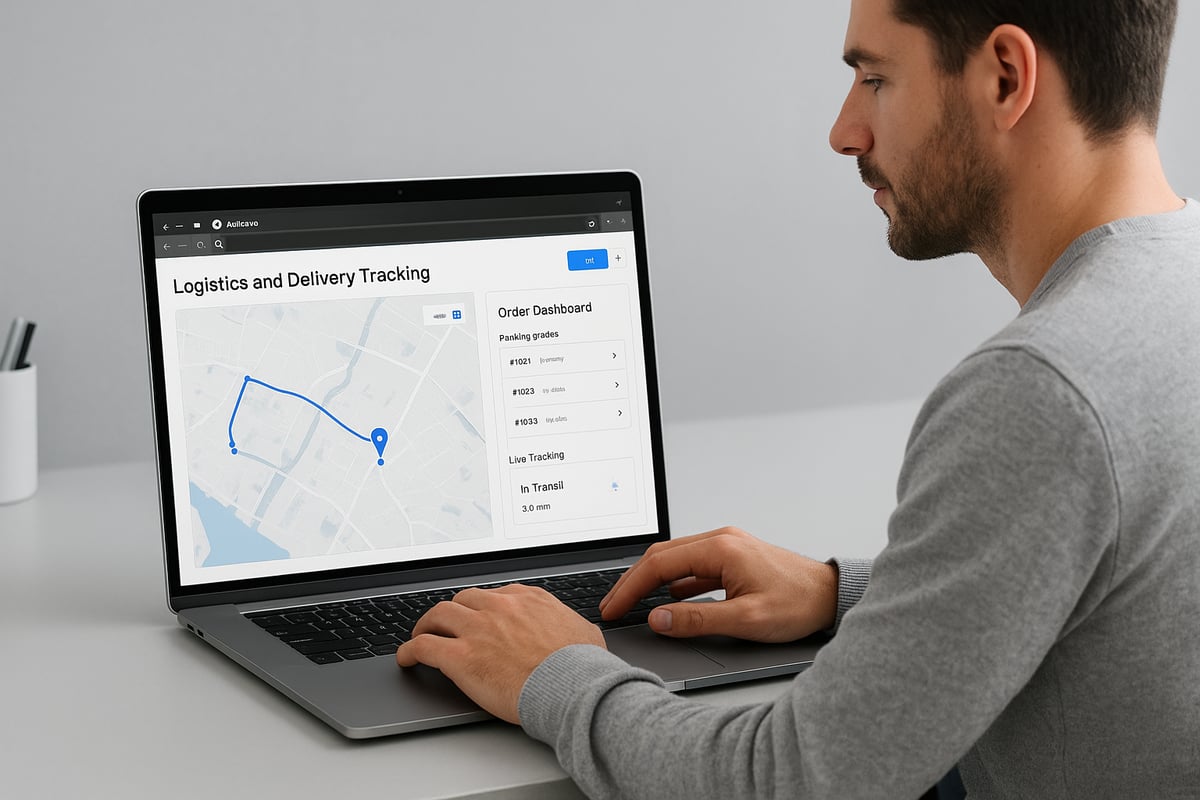
Bubble.io enables founders to build a bubble logistics and delivery tracking app without writing code. Its visual editor allows users to create complex workflows, automate dispatch, and design custom dashboards with simple drag and drop actions.
Rapid prototyping is a key advantage. With Bubble.io, you can launch an MVP in weeks instead of months, iterate quickly, and adapt features as your business grows. The platform integrates smoothly with payment gateways, mapping APIs, and SMS providers, ensuring your delivery tracking is connected and responsive.
Cost is another major benefit. Compared to traditional development, Bubble.io significantly reduces both upfront investment and ongoing maintenance. For a detailed comparison of no-code options for logistics, see Webflow vs Bubble for Startups. This resource highlights why Bubble is often the preferred platform for logistics innovators.
Limitations and considerations
Despite its strengths, Bubble.io has some limitations to consider for a bubble logistics and delivery tracking app. Real-time updates, such as live GPS tracking for multiple drivers, can challenge performance at scale. For high-frequency tracking, you may need to optimise workflows or explore backend add-ons.
The mobile experience is another factor. While Bubble.io supports responsive design, it is not a native mobile app builder. Wrapping your app or using third-party solutions can help deliver a better driver and customer experience.
Reliance on external APIs for mapping, SMS, and payments introduces dependencies. If your business scales rapidly or handles heavy data loads, integrating a backend service like Xano may be necessary for optimal performance. Security is essential in logistics, so always apply strict data privacy rules, especially for GDPR compliance.
Several logistics startups have successfully launched with Bubble.io, proving its potential for robust, scalable delivery apps with the right planning.
Why Choose Minimum Code for Your Bubble Logistics App
Building a bubble logistics and delivery tracking app with expert support can accelerate your success. Minimum Code specialises in secure, scalable, and GDPR-compliant Bubble.io solutions tailored to logistics needs.
Their team guides you through every stage, from initial discovery and UX design to launch and ongoing support. With a track record of delivering over 30 digital products for non-technical founders, Minimum Code offers a transparent process and clear communication at every step.
You can book a free discovery call to discuss your project, get practical advice, and see how expert no-code development can bring your logistics vision to life. Taking this step ensures your app is built for growth, compliance, and customer satisfaction.
How to build a logistics and delivery tracking app in Bubble.io: step by step guide
Building a bubble logistics and delivery tracking app does not require you to be a developer. With the right strategy, clear steps, and Bubble.io’s no-code platform, you can launch a robust solution tailored for logistics in 2026. Follow this step-by-step guide to turn your vision into a functional, scalable app, even if you have no technical background.
Step 1: Define your app’s scope and user journeys
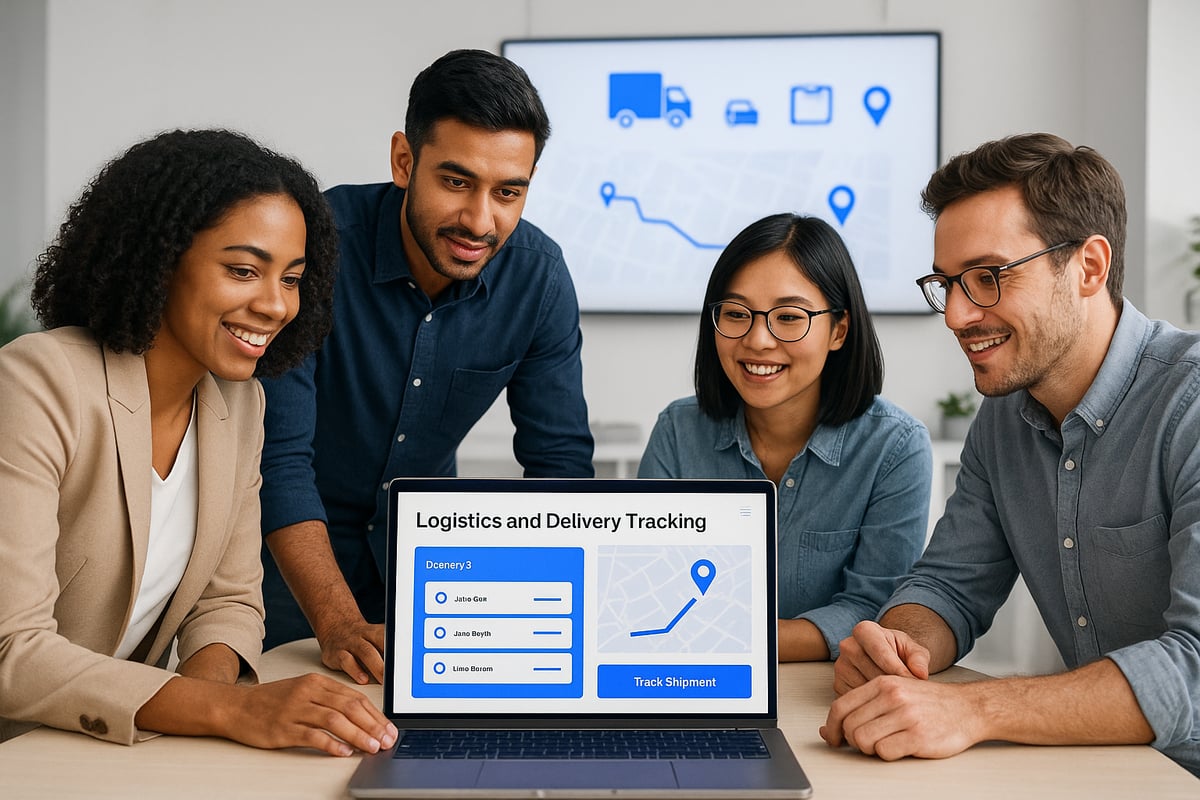
Start your bubble logistics and delivery tracking app project by outlining what you want to achieve. Identify the core workflows such as order placement, dispatching, driver assignment, real-time tracking, and proof of delivery.
List your user roles. Most logistics apps need at least four: customer, driver, dispatcher, and admin. For each role, map out what actions they need to perform and what information they must access.
Create user journey maps for each role. For example, a customer journey might include placing an order, tracking its delivery, and confirming receipt. This process ensures your bubble logistics and delivery tracking app will serve real-world needs and clarify which features are must-haves versus nice-to-haves.
Step 2: Design your database and data structure
A solid data model is the foundation of any bubble logistics and delivery tracking app. Begin by creating data types for Users, Orders, Deliveries, Vehicles, and Locations. Each data type should have relevant fields, such as order status, pickup and drop-off addresses, and assigned driver.
Define relationships. For example, one driver may have many deliveries, and each order is linked to a customer and a dispatcher. Plan for GDPR compliance by minimising personal data storage and setting access controls to restrict sensitive information.
Use Bubble’s built-in privacy rules to manage permissions. This step is crucial to ensure your bubble logistics and delivery tracking app is secure, legally compliant, and ready to scale.
Step 3: Build user interfaces with Bubble’s visual editor
Now, design the dashboards for each user role. With Bubble’s drag-and-drop editor, you can create customer, driver, and dispatcher dashboards that are intuitive and responsive.
Focus on mobile-first layouts for drivers and customers, as they will likely access the bubble logistics and delivery tracking app on the go. Use Figma to prototype your screens, then import the designs into Bubble for rapid development.
Keep interfaces simple and uncluttered. Prioritise clear navigation, real-time status displays, and easy access to key actions. Test your designs with a small group of users and iterate based on their feedback.
Step 4: Set up workflows and business logic
Workflows are the engine behind your bubble logistics and delivery tracking app. Use Bubble’s visual workflow builder to automate tasks like order creation, driver assignment, and status updates.
For dispatch logic, decide if you want full automation or manual override options for dispatchers. Integrate route optimisation features using mapping APIs to suggest the fastest paths for drivers.
Set up notifications. Bubble supports email, SMS, and push notifications to inform users about order events, delays, or changes. This keeps everyone in the loop and improves operational efficiency.
Step 5: Integrate real-time tracking and mapping
Real-time location tracking is a core feature for any bubble logistics and delivery tracking app. Use Bubble’s API connector to integrate Google Maps or Mapbox for live mapping and route visualisation.
Capture driver locations with GPS updates and display them on customer and dispatcher dashboards. Implement geofencing to trigger alerts when drivers enter or exit specific areas.
Calculate estimated time of arrival (ETA) using mapping data and share this information with customers. If you anticipate high volumes or need advanced tracking, consider pairing Bubble with a backend scaling tool like Xano Agency for Backend Scaling.
Step 6: Implement proof of delivery and feedback collection
Add features for digital proof of delivery, such as signature capture, photo uploads, and automatic timestamping. Store this information securely within your bubble logistics and delivery tracking app for future reference and dispute resolution.
After successful delivery, prompt customers for feedback and ratings. Use simple forms to gather insights and improve your service.
Automate notifications to confirm delivery and request feedback. This step enhances transparency and builds trust with your users.
Step 7: Launch, test, and iterate
Before going live, test your bubble logistics and delivery tracking app with all user roles. Conduct end-to-end tests to ensure every workflow functions correctly on both desktop and mobile devices.
Collect feedback from pilot users and address any issues. Use Bubble’s rapid iteration capabilities to make changes quickly based on real-world insights.
If you need additional support or want to ensure best practices, consider partnering with a specialist. The Bubble Agency Services Overview page details how expert teams can help you design, launch, and support your app.
Prepare for scale by monitoring app performance and planning for backend expansion as your order volumes grow.
Step 8: Ensure security, compliance, and scalability
Security and compliance are non-negotiable in any bubble logistics and delivery tracking app. Apply Bubble’s security rules to protect user data. Regularly audit your app for GDPR compliance, ensuring data is collected, stored, and processed responsibly.
Plan for future growth. As your app scales, you may need to integrate advanced backend solutions to handle high data loads and real-time processing. Regularly review your integrations and update them as needed to keep your app efficient and secure.
Example: Timeline and deliverables for a typical MVP build
| Phase | Deliverable | Estimated Duration |
|---|---|---|
| Discovery & Planning | User journeys, feature list | 1 week |
| Database & Design | Data structure, wireframes | 1 week |
| UI Build | Dashboards, mobile layouts | 2 weeks |
| Workflow Setup | Automation, notifications | 1 week |
| Tracking Integration | Real-time maps, ETA calculations | 1 week |
| Delivery Proof & QA | Signature, feedback, testing | 1 week |
| Launch & Support | Go live, monitoring, iteration | 1 week |
A typical MVP for a bubble logistics and delivery tracking app is achievable in 4–8 weeks, depending on complexity and resources.
Common mistakes when building logistics and delivery tracking apps in Bubble.io
Launching a bubble logistics and delivery tracking app offers non-technical founders a unique opportunity, but it also comes with its own set of pitfalls. Many projects encounter setbacks due to preventable errors in planning, design, and execution. Understanding these common mistakes can help you avoid delays, budget overruns, and user dissatisfaction.
Typical mistakes in a bubble logistics and delivery tracking app project
Many founders underestimate the technical complexity involved in real-time tracking and notifications. Live GPS updates, constant status changes, and synchronised events are challenging to implement, especially without prior experience.
Another frequent issue is poor database design. Overlooking data relationships, structuring tables inefficiently, or not planning for high data volumes can slow down your bubble logistics and delivery tracking app and cause performance bottlenecks.
Inadequate testing across all user roles and devices is also a major pitfall. Rushing to launch without thorough QA can lead to broken workflows, missed notifications, and unhappy customers.
Data privacy and GDPR compliance are often neglected in early stages. Failing to implement proper data controls or ignoring privacy by design can expose your bubble logistics and delivery tracking app to legal risk and damage your reputation.
Overcomplicating the MVP with too many features is another common trap. Trying to build everything at once can delay your launch and increase costs. Focus on essential workflows first, then iterate based on feedback.
Relying solely on Bubble for heavy backend processing is risky. For complex logistics apps with high-frequency tracking, consider integrating scalable backend solutions as your app grows.
Planning for scalability and integrations from the start ensures your bubble logistics and delivery tracking app can handle increased demand. This is especially important as E-commerce's impact on logistics demand continues to pressure delivery systems worldwide.
Lessons learned from failed or delayed launches
Founders who ignored these warning signs often faced significant setbacks. For example, skipping real-time tracking tests led to inaccurate delivery updates, eroding customer trust.
Some teams built rigid data structures, making it difficult to add new features or integrate with third-party APIs later. This lack of flexibility increased costs and extended timelines.
Others overlooked GDPR requirements, only to face compliance issues during launch. Retrofitting privacy controls after development proved time-consuming and expensive.
Launching with an overcomplicated MVP resulted in bloated, difficult-to-maintain apps. These projects often missed market opportunities because they could not adapt quickly.
The most successful bubble logistics and delivery tracking app teams prioritised essential features, tested thoroughly, and planned for scale from day one. They also sought expert advice early, reducing costly missteps and accelerating go-to-market.
Learning from these examples will help you avoid the same mistakes and build a robust, scalable solution.
Timeline and cost ranges for Bubble logistics and delivery tracking apps
When planning a bubble logistics and delivery tracking app, founders can expect a typical MVP timeline of 4 to 8 weeks from initial discovery to launch. This rapid turnaround is a key advantage of Bubble.io, allowing non-technical teams to move from idea to live product much faster than traditional development.
The cost of a bubble logistics and delivery tracking app MVP varies based on several factors, such as the complexity of core features, number of integrations, UI/UX design needs, and compliance requirements. Most MVPs fall within a range of £5,000 to £25,000, as seen across leading no-code agencies. Ongoing costs include Bubble hosting, third-party API fees, and periodic maintenance.
Choosing Bubble.io also means you can iterate quickly, reducing total spend as you refine features in response to user feedback. For those targeting global scalability, especially given the Asia-Pacific's dominance in logistics market, investing in a scalable architecture from the outset is essential. Expert support helps non-technical founders optimise both timeline and budget, ensuring the app can grow alongside evolving business needs.
Examples of logistics and delivery tracking apps built with Bubble.io
Bubble logistics and delivery tracking app solutions are driving innovation for businesses of all sizes. Let’s look at how real companies have leveraged this no-code platform to launch and scale delivery and fleet management tools without writing a single line of code.
1. Last-Mile Courier App for Urban Deliveries
A London-based startup built a bubble logistics and delivery tracking app to manage last-mile courier services. The app features real-time GPS tracking, automated driver assignments, and instant notifications for customers.
- Dispatchers view orders, assign drivers, and monitor live delivery status.
- Drivers access a mobile-friendly dashboard for navigation and proof of delivery.
- Customers receive ETA updates and rate their experience after every drop-off.
Since launch, delivery times have reduced by 20 percent and customer satisfaction scores have risen sharply.
2. Fleet Management Platform for SMEs
Another example is a fleet management bubble logistics and delivery tracking app tailored for small and medium enterprises. This app integrates with Google Maps for route optimisation, offers detailed performance analytics, and supports digital signatures for delivery confirmation.
- Business owners track vehicle locations and driver efficiency in real time.
- Automated reports highlight delivery success rates and identify bottlenecks.
- The app easily scales as fleets grow, supporting hundreds of vehicles.
Non-technical founders praise Bubble for enabling rapid feature updates in response to client feedback, without long development cycles.
3. Global Logistics Startup: Adapting to Industry Trends
A global logistics provider used Bubble to quickly adapt to changing market demands. Their bubble logistics and delivery tracking app supports on-demand dispatch, live status updates, and contactless proof of delivery. By staying agile, the company was able to respond to trends such as China's shift to electric trucks affecting global logistics, ensuring their tech stack remains future-proof.
User growth doubled within six months post-launch, and operational costs dropped thanks to enhanced route efficiency and digital process automation.
Bubble’s flexibility allowed each of these companies to pivot rapidly, roll out new features, and outperform competitors who relied on traditional, slower development methods.
Call to Action: Book your free discovery call with Tom
Ready to turn your bubble logistics and delivery tracking app idea into a successful digital product? Book a free discovery call with Tom today and get expert guidance on building your solution—rapidly, securely, and cost-effectively.
During your session, you will receive tailored advice on features, scalability, and compliance for your project. There is no commitment required, just practical insights to help you move forward with confidence.
Take the next step and schedule your free call at Minimum Code’s contact page. Your journey to launching a standout logistics app starts here.
You've now seen how powerful and accessible building a logistics and delivery tracking app with Bubble io can be—even if you aren't a technical founder. If you're ready to take the next step, I invite you to share your vision and get tailored, practical advice on how to bring it to life quickly and securely. Let's explore the best approach for your business, whether that's refining your idea, understanding your options, or planning your roadmap together. There’s no obligation—just an opportunity to move your project forward with expert guidance. Book a free discovery call
.avif)


Explore related articles


Ready to build your product?