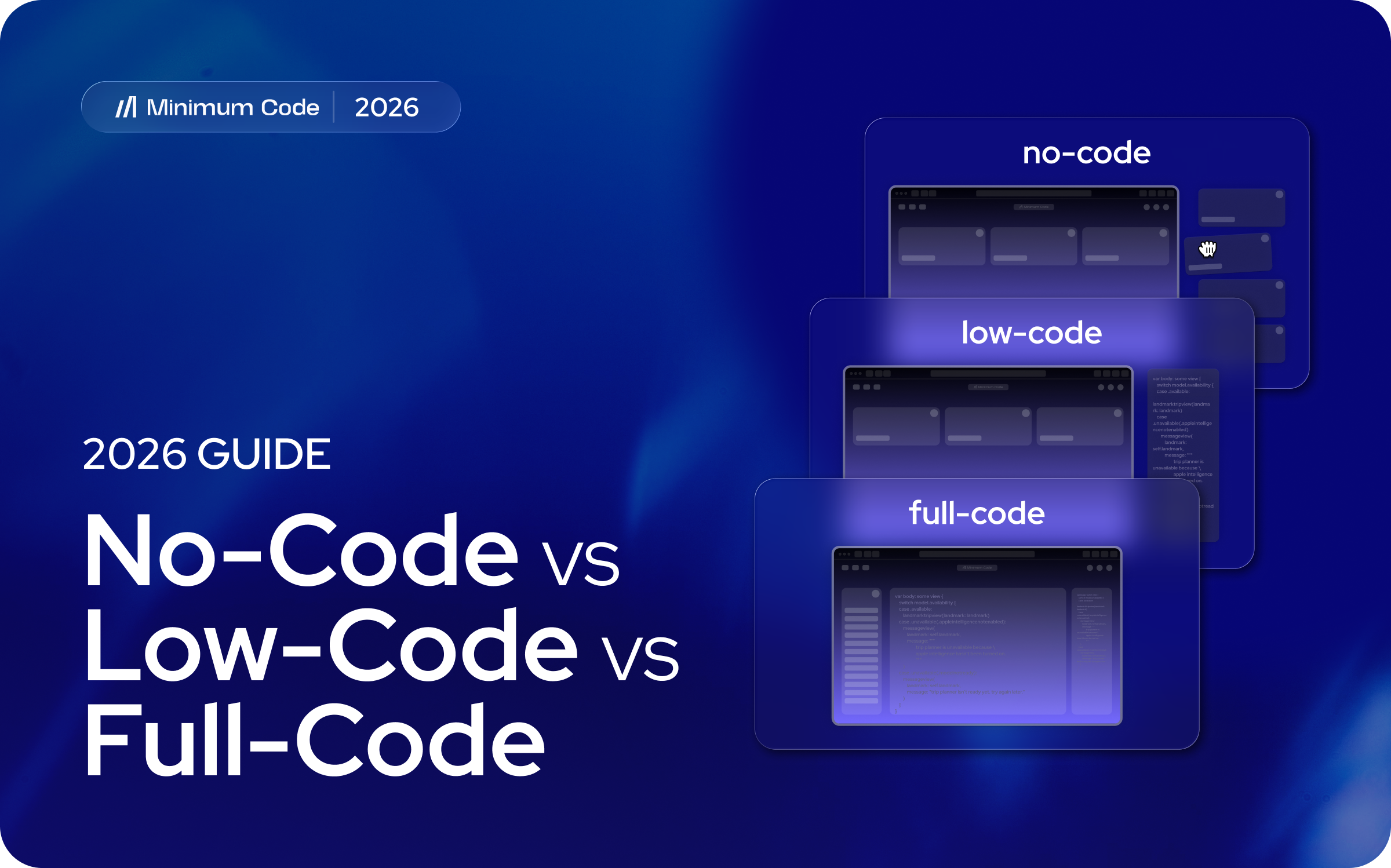
Last Tuesday, I watched a founder spend three hours debating whether to build their MVP with React or Bubble. Sound familiar? I've been there too, paralyzed by the "perfect choice" while competitors ship products and actual customers wait.
No-code platforms (especially Bubble) get you to market faster. But they're not right for every product. This guide will help you cut through the noise and make the right choice for your specific situation.
Key decision framework
Here's the reality check you need:
- Full code gives you infinite possibilities but expects 3-12+ months and $50,000-$500,000+ of your life
- No-code gets you shipping in days to weeks with $1,000-$50,000 budgets, but you play by their rules
- Choose no-code for MVPs and getting real feedback fast - choose full code when you actually need custom magic
- 80% of US businesses already use some form of low-code and automation tools because they work for real-world problems
- No-code with Bubble + Xano handles 90% of what early-stage founders need
- If you're a non-technical founder focused on business, speed, and validation → no-code is a better fit
- Stop overthinking the perfect solution and start building something people actually want
- Your team's actual skills matter more than platform features - be honest about what you can handle
Understanding the full code vs no-code battlefield
Here's the deal: full code means building everything from scratch using programming languages. No-code means using tools that already exist. Pretty simple, right?
The global low-code market is growing like crazy - from $10 billion in 2019 to a projected $187 billion by 2030. I remember when this statistic first hit me during a particularly brutal week debugging a custom authentication system. My coffee maker got more use than my bed. Meanwhile, my friend launched the same feature with a no-code platform in an afternoon. That's when it clicked, sometimes being "technically superior" is just expensive procrastination.
When you're trying to figure out what full code means for your project, understanding the real differences becomes crucial. Full code is like being a chef, you control every ingredient but need to know how to cook. No-code is like ordering from a really good restaurant, limited menu, but the food shows up fast and tastes great.
Your choice between full code and no-code isn't really technical, it's about reality. How fast do you need to move? What can you actually afford? What can your team realistically handle? These aren't abstract considerations; they're the difference between launching and staying stuck in planning mode.
Think about your actual requirements, not your dream requirements. Complex business logic and intensive processing usually need custom solutions. Simple workflows and standard functionality work great with no-code platforms. Understanding the key phases of development helps you figure out which path makes sense for your timeline and complexity needs.
Here's the thing about scalability that nobody talks about honestly: Full code can theoretically scale infinitely if you build it right. No-code platforms have limits, but most businesses never hit them. The real question isn't "will it scale?" but "will you actually get there, and when?"
Web application development showdowns
I've watched too many founders get stuck in React tutorial hell for months while their competitors launch with Bubble in weeks. Here's the thing nobody tells you: your users don't care what's under the hood. They care if your app works and solves their problem.
1. React.js/Node.js vs Bubble
React with Node.js is like having a personal chef, they'll make exactly what you want, but you need to hire them, train them, and hope they don't quit. You get complete control over everything, access to every JavaScript library ever created, and the satisfaction of building something truly custom. You also get complex setup, separate hosting headaches, and the joy of debugging at 2 AM.
Bubble flips this completely. Drag, drop, done. Their visual interface lets you build working web apps without touching code. Built-in database, user authentication, hosting, all the stuff that usually takes weeks to set up just works out of the box.
Real talk - SaaS dashboard example: Building a project management tool? React will let you create exactly what you envision, after you spend six months learning deployment, authentication, databases, and why your CSS keeps breaking. That's 4-6 months of your life wasted. Bubble? You'll have something working by Friday. It might not win design awards, but it'll get real feedback from real users.
The speed difference is brutal. React projects take months; Bubble apps go live in days. The budget gap is even worse, React development costs tens of thousands minimum, while Bubble will cost only a fraction of this due to faster development and easier maintenance.
But here's where React wins: when you need something Bubble can't do, you're stuck. Custom animations, complex data processing, or unique integrations might push you toward custom development.
2. Vue.js/Express vs Bubble
Vue.js with Express offers a gentler introduction to full-stack development. It's like learning to drive with an automatic transmission instead of manual, still requires skill, but less overwhelming than React/Node.js.
Bubble eliminates the need to learn any coding languages. While Vue/Express require JavaScript knowledge, Bubble uses visual programming that anyone can grasp with a bit of practice. For business applications, this accessibility means founders can iterate quickly without dependency on developers.
The speed advantage goes to Bubble for most business applications. Vue.js becomes necessary when you need extremely custom user interfaces or specialized integrations that Bubble can't handle. Cost considerations heavily favor Bubble for standard business functionality.
3. Angular/Spring Boot vs Bubble for internal tools
Angular with Spring Boot represents enterprise-grade web development at its most comprehensive. TypeScript's strong typing combined with Java's backend capabilities creates maintainable, scalable applications. It's like building with industrial-grade materials, incredibly solid but requires serious expertise.
Bubble excels at creating internal business tools like dashboards, admin panels, and workflow management systems. Its database integration, pre-built components, and workflow editor make it exceptionally fast for building exactly what enterprise teams need without the typical development overhead.
For internal tools, Bubble wins decisively on speed and cost. For highly specialized enterprise applications with unique technical requirements, Angular/Spring Boot provides the necessary flexibility. The maintenance difference is huge, Bubble handles updates automatically while custom applications need constant developer attention.
Mobile app development face-offs
Native development is like building a custom house, everything fits perfectly, but you need an architect, contractors, and a year of your life. No-code mobile platforms are like buying a really nice modular home, you move in next month, and honestly, most people can't tell the difference.
4. React Native vs Bubble
React Native lets you use JavaScript skills to build mobile apps that run on both iOS and Android. One codebase, two platforms, sounds perfect until you realize you still need to understand mobile development quirks and platform-specific requirements.
Bubble's mobile capabilities have grown significantly, allowing you to create responsive applications that work well on mobile devices. While not a native mobile solution, Bubble's responsive engine handles most business application needs across devices, and its progressive web app features provide mobile-friendly experiences.
Development speed strongly favors Bubble for standard business applications. React Native projects take weeks or months; Bubble applications can reach users in days. The budget difference is equally dramatic, React Native development costs thousands in developer time, while Bubble's pricing is predictable and affordable.
Performance depends on what you're building. React Native handles complex animations and intensive processing better, while Bubble excels at standard business applications and data-driven interfaces where native performance isn't critical.
5. Swift/Kotlin vs Bubble
Native development with Swift (iOS) and Kotlin (Android) gives you maximum performance and immediate access to new platform features. You're building separate applications for each platform, which doubles everything, development time, maintenance, costs, but delivers the best possible user experience.
Bubble provides a single environment that works across platforms. Instead of building twice, you build once. The platform handles responsive design and progressive web app features that make your application feel native-like on mobile devices without the duplicate development effort.
The performance gap between native and Bubble applications can be significant for demanding use cases. Native apps integrate seamlessly with platform features, while Bubble apps might feel less polished. But for many business applications, Bubble's performance is perfectly fine, and the time-to-market advantage outweighs the performance differences.
Cost and time considerations heavily favor Bubble for simple to moderate complexity applications. Native development requires specialized developers for each platform, while Bubble enables single-person app creation with cross-platform compatibility.
Database and backend development contests
PostgreSQL with custom APIs is like having a personal chef, they'll make exactly what you want, but you need to hire them, train them, and hope they don't quit. Backend-as-a-service platforms are like ordering from a really good restaurant, limited menu, but the food shows up fast and tastes great.
6. PostgreSQL/Node.js API vs Bubble
Custom PostgreSQL databases with Node.js APIs provide complete control over data structure, relationships, and access patterns. Complex queries, custom business logic, and performance optimization become possible. You also need database administration and backend development expertise, plus the joy of 3 AM server crashes.
Bubble combines database and API functionality in one visual interface. Without writing SQL or setting up servers, you can create complex data structures, relationships, and API endpoints that handle most business requirements. The platform manages database operations, scaling, and security without requiring technical expertise.
Complexity handling strongly favors PostgreSQL for intricate data relationships and custom business logic. Bubble excels at straightforward data management and team collaboration scenarios where people actually need to work together without technical barriers.
Development speed heavily favors Bubble for standard database needs. PostgreSQL becomes necessary when you need custom queries, complex relationships, or specific performance optimizations that Bubble can't handle.
7. MongoDB/Express API vs Bubble
MongoDB with Express provides flexible NoSQL database capabilities and custom REST API development. Document-based data structure and custom authentication implementation offer complete control. You'll need backend development expertise and infrastructure management skills, plus the patience to debug connection issues.
Bubble eliminates the need for separate database and API setup. Its built-in database handles document-style data storage while automatically generating API endpoints for your application. The visual workflow editor creates the business logic that would normally require custom API development, all without writing code.
Real-time features in Bubble provide automatic data synchronization similar to MongoDB/Express implementations but without the development overhead. Bubble's database handles most business applications effectively without requiring database expertise.
Vendor lock-in considerations favor MongoDB/Express for long-term flexibility. Bubble provides faster development but creates some platform dependency. However, Bubble's API capabilities allow data portability if you ever need to migrate.
8. MySQL/Laravel API vs Xano with Bubble
Traditional MySQL databases with Laravel APIs provide mature, well-documented solutions for relational data management. Custom business logic implementation and extensive ecosystem support make it powerful for complex applications. Full-stack development skills are essential.
Xano paired with Bubble offers a powerful alternative. Xano provides advanced database capabilities, custom API endpoints, and sophisticated business logic that extends Bubble's native capabilities. This combination delivers the flexibility of custom backend development with the speed of no-code frontend development.
When Bubble alone isn't enough, adding Xano provides:
- Advanced database queries beyond Bubble's capabilities
- Custom API endpoints for complex business logic
- Improved performance for data-intensive operations
- Better scalability for growing applications
- Custom security implementations for specialized requirements
This hybrid approach balances speed of development with advanced backend capabilities, giving you most of the benefits of custom code without the full development overhead.
When no-code (Bubble) works best
No-code platforms like Bubble have dramatically changed what's possible for non-technical founders. Understanding when these platforms shine brightest helps you make smart decisions about when to use them.
MVPs and early-stage B2B SaaS
The most obvious fit for no-code platforms is in the early stages of product development. Bubble excels at helping you validate ideas and get to market incredibly quickly:
- Fast initial build: Create functional MVPs in weeks instead of months
- Easy iteration: Change features based on user feedback without complex development cycles
- Visual development: See your product take shape in real-time
- Full functionality: Build complete applications with user authentication, database, and complex workflows
- Professional UX possible: Create attractive, functional interfaces through the visual editor
Bubble's strength in building B2B SaaS products comes from its ability to handle complex business logic, user roles, and data relationships that these applications typically require.
Internal tools and operational platforms
For tools that your team uses internally, no-code platforms offer exceptional advantages:
- Quick deployment: Build internal tools in days rather than weeks
- Easy maintenance: Make changes and updates without developer dependency
- User-friendly interfaces: Create intuitive dashboards and workflows
- Integration capabilities: Connect to your existing business tools
- Security and compliance: Easily implement role-based access controls and maintain GDPR compliance
Bubble particularly shines for admin panels, dashboards, CRMs, and operational tools that would traditionally require significant development resources.
Standard application patterns
Some application types follow well-established patterns that no-code platforms handle exceptionally well:
- Marketplaces: User profiles, listings, search, and messaging
- CRMs and client management: Contact tracking, pipeline management, and activity logging
- Content platforms: User-generated content, moderation, and subscription management
- Booking and scheduling systems: Calendar integration, availability management, and payment processing
These standard patterns align perfectly with Bubble's capabilities and can be implemented much faster than with custom code.
Fast validation before scaling
Even if you anticipate eventually needing custom development, starting with no-code offers significant advantages:
- Market validation: Confirm product-market fit before major investment
- User feedback: Gather real user insights on what features actually matter
- Business model testing: Verify pricing and conversion before scaling
- Investor demonstrations: Show working products to potential investors
- Revenue generation: Start earning while planning your scaling strategy
Many successful companies start with no-code to validate their concept, then transition to custom code when specific scaling needs emerge.
Non-technical founders who prioritize speed
For founders without technical backgrounds, no-code platforms remove critical barriers:
- Direct implementation: Build your vision without translation to developers
- Complete control: Make changes whenever needed without dependency
- Visual editing: Design interfaces through drag-and-drop rather than code
- Lower initial investment: Launch with minimal capital requirements
- Faster time to market: Beat competitors who are still in development
The ability to go from idea to working product without hiring a development team can be the difference between launching and getting stuck in planning.
When custom code is the better choice
While no-code platforms handle a surprisingly wide range of applications, there are legitimate cases where custom development makes more sense. Understanding these scenarios helps you make informed decisions about your development approach.
Apps with extreme performance or scale requirements
Applications that need to handle millions of users simultaneously or process massive data volumes in real-time often require custom optimization:
- Social media platforms: Applications like TikTok processing millions of video uploads daily
- Large-scale marketplaces: Platforms with millions of daily transactions like eBay
- High-frequency trading systems: Financial applications requiring millisecond response times
- Massive multiplayer games: Applications handling complex real-time interactions between many users
When performance at enormous scale is your primary requirement, custom code allows for specialized optimization that no-code platforms simply can't match.
Advanced real-time functionality
Applications requiring sophisticated real-time capabilities often push beyond no-code limitations:
- Video conferencing systems: Applications like Zoom handling complex multi-user video/audio streams
- Collaborative editing tools: Real-time document collaboration like Google Docs
- Advanced gaming applications: Complex multiplayer interactions with physics engines
- IoT control systems: Real-time monitoring and control of thousands of connected devices
These applications require specialized protocols, optimized data handling, and precise control over system resources that typically need custom development.
Complex native integrations requiring deep system access
Some applications need direct access to device hardware or system-level features:
- Music streaming services: Apps like Spotify that play audio while minimized
- Advanced camera applications: Custom filters, effects, and AR features
- Background processing tools: Applications that need to run processes when not active
- Hardware control interfaces: Direct integration with specialized equipment or IoT devices
When your app needs to control device features beyond what's available through standard APIs, custom native development becomes necessary.
Highly specialized or novel algorithms
Applications centered around proprietary algorithms or unique computational approaches often require custom code:
- AI/ML-powered applications: Custom machine learning models or novel AI approaches
- Specialized data analysis tools: Custom statistical methods or visualization techniques
- Cryptographic applications: Custom blockchain implementations or security protocols
- Research tools: Novel scientific or academic computational methods
When your core value proposition relies on algorithms that don't exist in standard libraries, custom development allows you to implement exactly what you need.
Heavily regulated industries with specific compliance requirements
Some industries have such stringent compliance requirements that custom implementation becomes necessary:
- Banking applications: Meeting specific security and transaction requirements
- Healthcare systems: Handling PHI with specialized HIPAA compliance features
- Defense/government applications: Meeting specialized security clearance requirements
- Critical infrastructure systems: Applications controlling essential services
In these cases, the specific implementation details of compliance requirements may necessitate custom development approaches.
What it really comes down to
After comparing dozens of platforms across all these categories, the decision often comes down to a few fundamental factors that matter far more than technical features.
Your team's actual technical capabilities
Be honest about your team's technical skills and capacity:
- If you're a developer or have strong technical skills: Custom code may be efficient for you, as you can leverage your existing knowledge
- If you're a non-technical founder focused on business: No-code platforms dramatically reduce barriers to entry
- If you have limited technical resources: No-code allows you to allocate developers only where truly necessary
The best technology choice aligns with your team's actual capabilities, not what you wish they were.
Your true time and budget constraints
Reality matters more than theoretical advantages:
- Tight timeline? No-code wins: Launch in weeks instead of months
- Limited budget? No-code wins: Build for thousands instead of hundreds of thousands
- Need to validate before raising? No-code wins: Get user feedback before major investment
Be honest about what you can actually afford in terms of both time and money.
Your stage in the company lifecycle
Different stages have different optimal approaches:
- Early validation: No-code excels at rapid prototyping and MVP creation
- Initial traction: No-code platforms can scale to your first hundreds or thousands of users
- Proven product with funding: Consider custom development for specific scaling needs
- Enterprise scale: Hybrid approaches often work best, with custom code for performance-critical components
Most successful companies evolve their technology approach as they grow rather than trying to build the perfect long-term solution from day one.
The complexity of your actual requirements
Not all applications have the same complexity profile:
- Standard business logic: No-code handles this exceptionally well
- Common app patterns: No-code platforms have templates and patterns for most standard needs
- Unique or novel functionality: Custom code may be necessary for truly innovative features
- Integration with existing systems: Depends on available connectors and API access
Focus on what makes your application truly unique and consider whether those elements require custom development.
Real-world application examples that matter
Here's what actually happens: You start with grand visions of building the next Facebook. Reality check, you need a landing page that collects emails. Webflow gets you there in a day. Custom React? That's a month of your life you'll never get back, and your email list is still empty.
Simple applications demonstrate no-code advantages clearly. Landing pages for product validation work perfectly with Carrd or Webflow, you need attractive design and basic functionality, not custom features. Internal company directories benefit from Bubble's database and workflow capabilities. Basic e-commerce stores leverage Shopify's built-in payment processing and inventory management.
Real estate listing platform: A local real estate agency needs property listings, search functionality, lead capture, and agent profiles. No-code solution using Bubble could be built in 1-2 weeks for under $3,000, handling 90% of requirements. Custom development with React/Node.js would take 3-4 months and cost $75,000-$150,000 but could include advanced features like mortgage calculators, virtual tours integration, and complex search algorithms with map clustering.
Event registration systems showcase hybrid approaches effectively. Bubble handles the user interface, registration forms, and basic workflows, while Xano manages complex business logic and integrations with email services. This combination provides professional results without custom development complexity.
Simple mobile-friendly applications work well with Bubble. Restaurant menus, company directories, or product catalogs don't require complex functionality, they need attractive presentation and easy updates that non-technical people can handle.
Complex applications reveal full code necessity. Real-time trading platforms demand custom React/Node.js implementations with WebSocket connections for instant data updates. No-code platforms simply can't handle the performance requirements or custom business logic.
Machine learning-powered recommendation engines require Python with TensorFlow or PyTorch frameworks. The algorithms, data processing, and model training exceed no-code platform capabilities significantly.
High-frequency data processing systems need custom Java or Go applications optimized for specific performance requirements. Generic platforms can't provide the efficiency needed for processing millions of transactions.
Complex multi-tenant SaaS platforms require custom architecture with microservices. User isolation, custom billing logic, and scalable infrastructure demand full code flexibility.
Advanced gaming applications need native development with custom engines. Performance requirements, graphics processing, and platform-specific features exceed no-code capabilities completely.
How Minimum Code bridges the decision gap
The dirty secret? Most founders don't need to choose between full code and no-code. They need someone to tell them what they actually need to build first. That's where getting real user feedback before writing a single line of code saves you from months of building the wrong thing.
At Minimum Code, we've developed a pragmatic approach to this decision that focuses on what actually matters for early-stage founders:
Use Bubble to ship fast
We've found that starting with Bubble allows founders to:
- Launch MVPs in weeks: Get to market and start gathering real user data
- Iterate rapidly: Make changes based on feedback without complex development cycles
- Validate business models: Test pricing, features, and user acquisition before major investment
- Build complete applications: Create fully functional products with all core features
- Focus on business growth: Spend time on marketing and sales rather than technical details
Our approach prioritizes speed and validation over technical perfectionism, allowing founders to confirm product-market fit before making larger technology investments.
Extend with Xano when needed
For applications requiring more backend flexibility, we pair Bubble with Xano:
- Handle complex business logic: Implement advanced workflows and data processing
- Create custom API endpoints: Build specialized functionality beyond Bubble's capabilities
- Improve performance: Optimize database operations and queries for better response times
- Scale efficiently: Manage growing data volumes and user bases without rebuilding
- Maintain flexibility: Prepare for potential future transitions to custom code
This hybrid approach provides the benefits of no-code development while extending capabilities for more demanding requirements.
Only move to code if you actually outgrow no-code
Most importantly, we recommend custom code only when specific needs genuinely require it:
- Wait for validation: Don't invest in custom development until you've proven product-market fit
- Identify specific limitations: Pinpoint exactly what no-code platforms can't handle for your use case
- Consider hybrid approaches: Often you can add custom components to no-code foundations
- Calculate real ROI: Ensure the benefits of custom development justify the significant cost
- Plan strategic transitions: If needed, migrate gradually rather than rebuilding from scratch
This approach prevents premature optimization and ensures development resources are allocated where they provide genuine value.
Remember most no-code apps include some custom code
It's not an all-or-nothing choice. We frequently enhance Bubble applications with custom elements:
- JavaScript plugins: Add specialized functionality within the Bubble framework
- Custom API integrations: Connect to services without pre-built connectors
- Performance optimizations: Improve database queries and workflow efficiency
- Advanced analytics: Implement specialized tracking and reporting
- Custom UI elements: Create unique interface components for specific needs
These targeted enhancements provide the benefits of custom code without abandoning the speed and simplicity of the no-code foundation.
Final thoughts
After watching hundreds of founders wrestle with this choice, here's what I've learned: The best code is the code that ships. Period. Whether that's Bubble or React doesn't matter if it's still sitting on your laptop six months from now.
The full code versus no-code decision isn't really about choosing sides in some technological battle. It's about matching your current reality, budget, timeline, team capabilities, and actual requirements, with the right development approach. The statistics don't lie: 80% of businesses are already using low-code tools because they work for most real-world scenarios.
Your choice should evolve with your needs. Start with no-code for validation and early traction. Migrate to custom development when scaling demands it or unique requirements emerge. The platforms and frameworks will continue improving, but the fundamental trade-offs between speed and flexibility remain constant.
Look, no-code platforms aren't perfect. You'll hit walls. Your designer friend will judge your "basic" layout. But you know what's worse than a slightly clunky interface? No interface at all because you're still "architecting the perfect solution."
The best development choice isn't the one that impresses other developers. It's the one that gets your idea in front of real people fast enough to learn if it's worth pursuing. Sometimes that's no-code. Sometimes it's custom. But it's never the choice that keeps you from starting.
No-code with Bubble + Xano handles 90% of what early-stage founders need. The truth is, most companies don't fail because their tech stack wasn't perfect, they fail because they never got to market or couldn't find product-market fit fast enough. Choose the approach that helps you solve those problems first.
Stop overthinking the perfect solution and start building something people actually want. Pick the tool that gets you to real users fastest, then worry about being technically impressive later. Your users don't care what's under the hood, they care if your app works and solves their problem.
Ready to start building your product the right way? Book a call with Tom today and let us help you navigate these decisions based on your specific needs and goals.

Ready to build your product?


.avif)