
How to Build a CRM App with Bubble: Expert Guide 2026

Imagine launching a complete CRM app in just weeks, without ever touching code. For non-technical founders, the path to a professional solution has never been clearer. This guide explains how to build a crm app with bubble, using proven strategies and 2026 best practices.
You will learn how to plan, design, automate, and scale your CRM, all with practical steps and expert insights. Discover real-world examples and actionable advice that helps you launch faster and smarter. If you want speed, simplicity, and results, you are in the right place.
Why Choose Bubble for Your CRM App?
Launching a CRM can feel overwhelming if you lack coding skills or a technical co-founder. Today, non-technical founders across Europe are turning to no-code platforms to make the process faster, cheaper, and more accessible. If you are wondering how to build a crm app with bubble, understanding why Bubble stands out is the first step toward a successful launch.

No-code and low-code development have transformed the startup landscape by 2026. Founders can now turn ideas into products in weeks instead of months. Platforms like Bubble lead this shift, making it possible to build complex apps visually, without hiring a development team. For a detailed look at these trends and their impact on startups, see No-code development trends in 2026.
Bubble’s key benefits are clear for anyone exploring how to build a crm app with bubble. The platform offers a visual editor, so you design interfaces and logic by dragging and dropping elements. Rapid prototyping lets you test ideas quickly, reducing wasted time and money. Bubble also supports easy scaling, so you can start small and expand as your user base grows.
When compared to traditional development, Bubble offers significant advantages. Building a CRM from scratch with code often requires months of work, high costs, and ongoing technical maintenance. With Bubble, you cut time-to-market dramatically and avoid the headaches of server management or backend coding. This is especially valuable for European founders who need to deliver results fast, often with limited resources.
Bubble shines when it comes to CRM-specific needs. The platform lets you manage complex data structures, automate workflows, and connect with popular tools like email providers and analytics platforms. If you want to know how to build a crm app with bubble that supports pipelines, reporting, and reminders, Bubble’s built-in features and plugin ecosystem have you covered.
Real-world success stories prove Bubble’s potential. For example, Mailead, a CRM built entirely on Bubble, now supports thousands of users and demonstrates that you do not need technical expertise to launch at scale.
Security and compliance are top concerns for European founders. Bubble provides secure hosting, SSL by default, and tools for GDPR compliance, including data export and deletion features. You can choose EU-based servers for peace of mind when handling customer data.
There are some limitations to consider. Bubble relies on plugins for advanced features, and very large apps may require careful optimisation. Custom code is possible, but not as flexible as traditional development.
No-code tools like Bubble can reduce development time by up to 70% according to Gartner (2025). If you are serious about how to build a crm app with bubble, the platform offers a practical, secure, and scalable path from idea to launch.
Planning Your CRM App: Features, Users, and Data Structure
Planning is the foundation of any successful CRM project. If you want to know how to build a crm app with bubble, it starts with a clear plan for features, user roles, data structure, and automation. This ensures your app launches quickly and scales with your business.

Defining Your CRM’s Core Features
Every CRM needs essential modules to be effective. If you want to know how to build a crm app with bubble, begin with these core features:
- Contacts: Store customer details, history, and notes.
- Deals: Track opportunities, value, and stage in your sales pipeline.
- Tasks: Assign actions, reminders, and deadlines for team members.
- Pipelines: Visualise and manage sales progress.
- Notes: Record interactions, calls, and meetings.
- Reporting: Gain insight into performance and bottlenecks.
Optional modules include email integration, automated reminders, file attachments, and granular permissions. Prioritise features for your MVP, focusing on what solves your immediate business needs and supports future growth. For example, leading CRM tools like Pipedrive and HubSpot started simple, then layered advanced features over time.
Align your feature set with your unique sales process. If your team relies heavily on outbound email, prioritise integrations. If collaboration is key, focus on sharing and permissions. For more on launching a lean MVP, see Building an MVP with No-Code.
Mapping User Roles and Permissions
A robust CRM must support multiple user types. When considering how to build a crm app with bubble, plan for at least these roles:
- Admin: Full access, can manage users, settings, and all data.
- Sales rep: Can view and edit their own contacts, deals, and tasks.
- Manager: Can oversee team performance, access reports, and manage pipelines.
- Support: Access to customer records for service and follow-up.
Bubble makes it easy to set up role-based access, ensuring each user sees only the data they need. Use Bubble’s privacy rules to restrict sensitive information, such as deal values or client emails, to authorised roles.
For example, a startup founder might want sales reps to access only their assigned deals, while managers can view the full pipeline. Bubble’s built-in privacy features help you comply with data protection regulations and keep your business data safe. This clarity is key when you learn how to build a crm app with bubble.
Designing Your Data Structure
A clear data structure underpins every scalable CRM. Begin by defining these data types:
- Contacts
- Companies
- Deals
- Activities (calls, meetings, emails)
- Users
Set up relationships between data types. For instance, a company can have many contacts, and a deal can be linked to both a company and multiple activities. Use one-to-many and many-to-many relationships to keep your data model flexible.
Plan your database with scalability in mind. Use Bubble’s Data tab to visualise and manage your data types. For example, deal stages can be a separate type connected to each deal, and activity logs can be linked to both deals and contacts. This approach helps ensure performance as your CRM grows.
Remember, how to build a crm app with bubble isn’t just about features but also about structuring your data for efficiency and future expansion.
Prepping Integrations and Automations
Think about which external tools your CRM must connect with. Typical integrations include:
- Email providers (Gmail, Outlook)
- Calendar syncing
- Analytics dashboards
- Automation platforms like Zapier or Make
Plan for future integration needs, such as API or webhook access, even if you don’t need them on day one. Automate repetitive tasks, such as sending follow-up emails or reminders for overdue deals, to save time and reduce errors.
For example, you might automate an email reminder if a deal has been in one stage for too long. This is a core benefit when you explore how to build a crm app with bubble—automation saves effort and keeps your team focused.
Step-by-Step: Building Your CRM App in Bubble
Launching your own CRM can feel daunting if you lack coding skills. With the right approach, you can master how to build a crm app with bubble quickly and efficiently. This step-by-step guide breaks down each stage, so you can confidently go from idea to working product.

Setting Up Your Bubble Project
The first step in how to build a crm app with bubble is setting up your Bubble environment. Begin by signing up for a Bubble account. Choose a plan that fits your needs—Bubble's free plan is ideal for prototyping, but for live deployments or custom domains, a paid plan is best.
Name your app clearly, e.g., "SalesCRM2026", and set your domain if you plan to go live. In Bubble’s Settings tab, configure your app’s time zone and regional settings, especially if you operate in Europe. This ensures GDPR compliance and proper date formatting.
Bubble’s editor is fully responsive, making it easier to design for mobile and desktop. Before you start building, familiarise yourself with Bubble’s interface: the Design tab for layouts, the Workflow tab for logic, and the Data tab for structuring your CRM’s information.
If your CRM will be used mainly on mobile, enable the responsive engine early. This saves time later and ensures a seamless user experience. Once your project is set up, you are ready to start designing the core features.
Designing the User Interface (UI)
When learning how to build a crm app with bubble, a clear, intuitive UI is essential. Use Bubble’s drag-and-drop editor to create your CRM’s main screens: dashboards, data tables, and forms. Start with a dashboard that gives users an overview of their sales pipeline, tasks, and recent activity.
For navigation, add a sidebar or top menu with links to Contacts, Deals, Tasks, and Reports. Use Bubble’s repeating groups to display data tables, such as lists of deals or contacts. Create forms for adding or editing records, keeping the layout simple for quick data entry.
Incorporate your brand’s colours and logo, and use Bubble’s styles to maintain consistency. For reporting features, add charts and visual summaries. To dive deeper into analytics dashboard design, see the Bubble Analytics Dashboard App Guide.
Modern UI/UX practices, like drag-and-drop pipeline stages or inline editing, make your CRM feel professional and easy to use. Test your layout on different devices to ensure a smooth experience for all users.
Building Workflows and Logic
The heart of how to build a crm app with bubble lies in Bubble’s workflow engine. Workflows automate actions such as creating contacts, updating deals, or sending notifications. Start by mapping the core actions your users need: add, edit, delete, and move records.
Set up a workflow for each button or trigger. For example, when a user adds a new deal, create a workflow that saves the data, updates the pipeline, and notifies the relevant team member. Use Bubble’s conditional logic to show or hide elements based on user roles or record status.
Automate repetitive tasks, such as sending an email when a deal moves to a new stage. You can do this by adding an action in your workflow to trigger an email, SMS, or notification. Test each workflow with sample data to ensure reliability.
For complex processes, use Bubble’s custom events to group related actions. This approach keeps your logic organised and easy to maintain. Always test workflows in preview mode before going live.
Managing Data and Privacy
A solid data structure is essential when considering how to build a crm app with bubble. In the Data tab, define your main data types: Contact, Company, Deal, Task, Activity, and User. For each, add relevant fields, such as name, email, stage, or notes.
Set up relationships between data types. For example, a Deal should link to a Company and one or more Contacts. Use Bubble’s "List of" fields to manage one-to-many or many-to-many relationships, such as a Company with multiple Deals.
Privacy is critical for CRM apps, especially for European founders. Bubble’s privacy rules let you restrict access to sensitive data by user role. For instance, only admins should see all deals, while sales reps see only their own. Enable GDPR features like data export and deletion in your workflows.
Test privacy settings thoroughly. Log in as different user roles to confirm that data visibility works as intended. This protects your business and increases trust with users.
Integrating Third-Party Tools
Integrations are a key part of how to build a crm app with bubble. Bubble’s plugin marketplace offers ready-made connectors for Gmail, Outlook, and other tools. Add the relevant plugins to your app, then follow setup instructions to authorise and connect accounts.
For calendar sync, use plugins or APIs to allow users to schedule meetings and sync events. Analytics tools like Google Analytics or Mixpanel can be integrated for tracking usage and outcomes. Use Bubble’s API Connector for advanced integrations, such as connecting to external databases or marketing platforms.
Automation platforms like Zapier or Make allow your CRM to interact with hundreds of other apps. For example, set up a Zap to send Slack notifications when a new deal is added. Plan your integrations early so you can automate key workflows and save time as your user base grows.
Testing and Iterating Your CRM
The final step in how to build a crm app with bubble is thorough testing and iteration. Invite a small group of test users, ideally from your target audience, to try the app in real-world scenarios. Provide them with sample data and clear instructions.
Collect feedback on usability, missing features, and any bugs. Use Bubble’s built-in debugger and issue checker to resolve problems quickly. Prioritise fixes that impact core workflows or data integrity.
Iterate by making small, targeted improvements. Use Bubble’s version control to manage updates safely. Before launching publicly, run a final round of user testing to ensure everything works as expected. A well-tested CRM app earns trust and adoption from the start.
Ensuring Security, Scalability, and Compliance
As a founder learning how to build a crm app with bubble, you need confidence that your app is secure, scalable, and compliant from day one. With sensitive customer data at stake, these are not just technical details—they are business essentials.
Security best practices for Bubble apps
Start by enabling SSL for all Bubble apps. This ensures all data transfer is encrypted. Set strong password policies for users and use two-factor authentication where possible. Data encryption is handled by Bubble at rest and in transit, but always review Bubble’s documentation for updates.
Limit user access with Bubble’s privacy rules. Define who can view, edit, or delete specific records. For founders focused on how to build a crm app with bubble, these privacy controls are key to meeting both business and legal requirements.
GDPR compliance for European founders
GDPR is non-negotiable in Europe. You must collect clear user consent for data processing. Offer users the ability to export or delete their data on request. Bubble supports these actions through workflows and privacy settings.
Add a privacy policy and cookie consent popup to your app. Make sure all third-party integrations are GDPR-compliant. When considering how to build a crm app with bubble, always prioritise user rights and transparency.
Hosting and data residency
For European founders, hosting your app and data on EU-based servers is vital. Bubble provides regional hosting options—select the EU region during setup to ensure compliance with local data laws.
Scaling your CRM with Bubble
Plan for growth by optimising your database structure and keeping workflows efficient. Use Bubble’s built-in analytics to monitor app performance, track user activity, and spot bottlenecks early.
If you want to see how to build a crm app with bubble that truly scales, look at Mailead's success with Bubble. Mailead scaled to over 10,000 users, proving Bubble’s capacity to handle real-world CRM adoption.
Maintenance, updates, and disaster recovery
Schedule regular updates to your app. Patch security vulnerabilities as soon as they are discovered. Perform routine data backups using Bubble’s built-in features or external tools, and test restoring from backups to ensure business continuity.
Plan for the unexpected. Set up disaster recovery protocols so you can quickly recover data and minimise downtime if issues arise.
Building security, scalability, and compliance into your process is not optional. It is integral to how to build a crm app with bubble that will win customer trust and pass any due diligence. Take these steps seriously, and your CRM will be ready for growth, investment, and long-term success.
Expert Tips for Launching and Growing Your CRM App
Launching your CRM app is a pivotal moment. For non-technical founders, the focus should be on speed, precision, and setting a foundation for future growth. If you have wondered how to build a crm app with bubble, these expert tips will guide you from initial launch through scaling and ongoing improvement.
Launch Strategies for Non-Technical Founders
Getting your CRM to market quickly is crucial. Start by building a solid MVP that covers core features. Use Bubble’s version control to test changes safely before pushing updates live. Focus on a clean onboarding flow and a landing page that communicates your value clearly.
Early marketing matters. Reach out to your network, use LinkedIn, and consider targeted email outreach. Invite a small group of users to test your CRM and provide actionable feedback. This approach allows you to iterate quickly and address real user needs.
When considering how to build a crm app with bubble, prioritise features that solve your users’ biggest pain points. Keep your initial scope narrow to launch fast, then expand based on feedback and usage data.
Scaling Up: Advanced Features and Automation
Once your CRM gains traction, it’s time to add more value. Integrate advanced features like custom reporting, AI-driven insights, and workflow automation. Bubble’s API Connector allows you to link with sales and marketing tools as your business grows. Plan for mobile expansion early by making your app responsive.
Automating repetitive tasks can save time and reduce errors. For example, you can set up automated lead scoring and email reminders for overdue deals. According to No-code workflow automation statistics, no-code platforms have helped startups reduce manual work and development time by up to 70 percent.
If you are still asking how to build a crm app with bubble at scale, focus on features that increase efficiency and provide measurable results for your team.
When to Partner with a Bubble Expert
There comes a point when expert help is the best investment. If your CRM requires complex workflows, advanced integrations, or you are facing performance issues, consider working with a certified Bubble partner. They bring experience in optimising apps, solving technical challenges, and accelerating time to market.
Choosing the right partner involves reviewing their portfolio, understanding their process, and discussing your goals. Be clear about your budget and expected outcomes. Outsourcing can lead to a faster launch and higher quality product, especially when your focus is on growth rather than technical details.
For founders serious about how to build a crm app with bubble, partnering with experts can be the difference between a good app and a market-leading solution.
Work with Bubble Experts at Minimum Code
Minimum Code specialises in helping founders build, launch, and scale CRM apps using Bubble. Their team handles every stage, from discovery through to ongoing support, ensuring your app is secure, scalable, and GDPR-compliant.
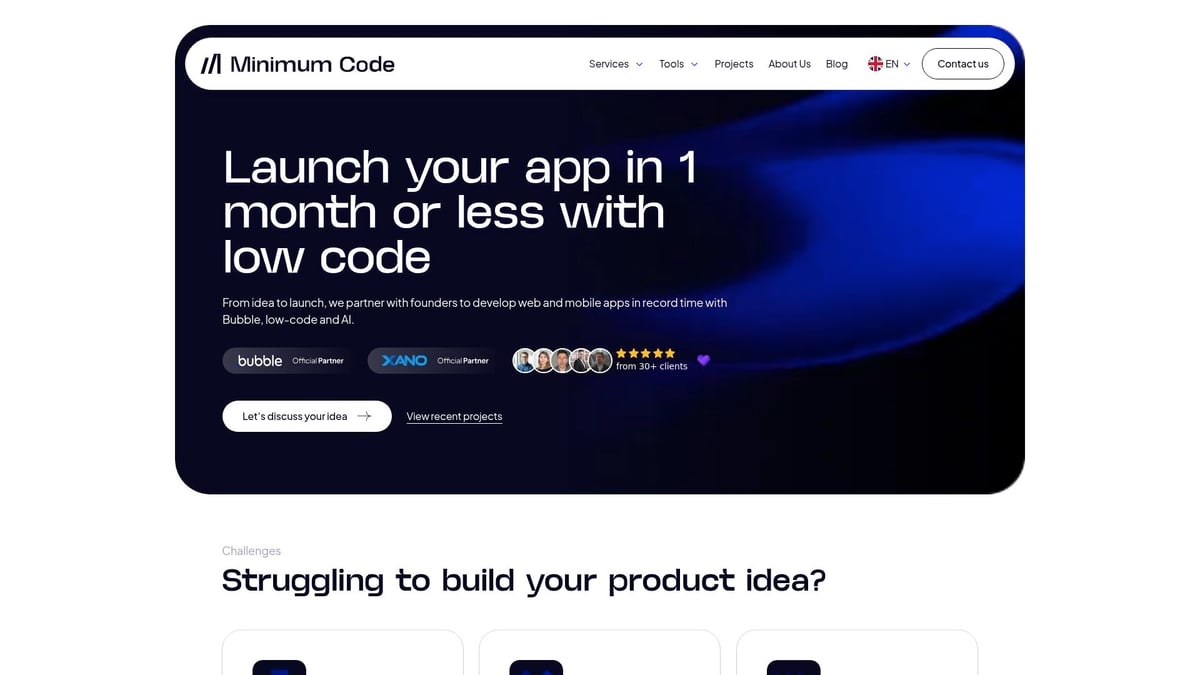
If you want to focus on growth and avoid technical headaches, working with an official Bubble partner like Minimum Code is ideal. Book a free consultation to discuss how to build a crm app with bubble and get expert guidance tailored to your project.
You've now seen how building a CRM app with Bubble empowers you to move quickly from idea to launch, even without technical skills. If you're ready to turn your vision into a secure, scalable, and GDPR-compliant product—with expert guidance every step of the way—I’d love to help you get started. Let’s talk about your goals, the features that matter most, and the best plan for your business. You don’t have to do it alone. Take the next step and Book a free discovery call to explore your CRM project together.
.avif)


Explore related articles


Ready to build your product?