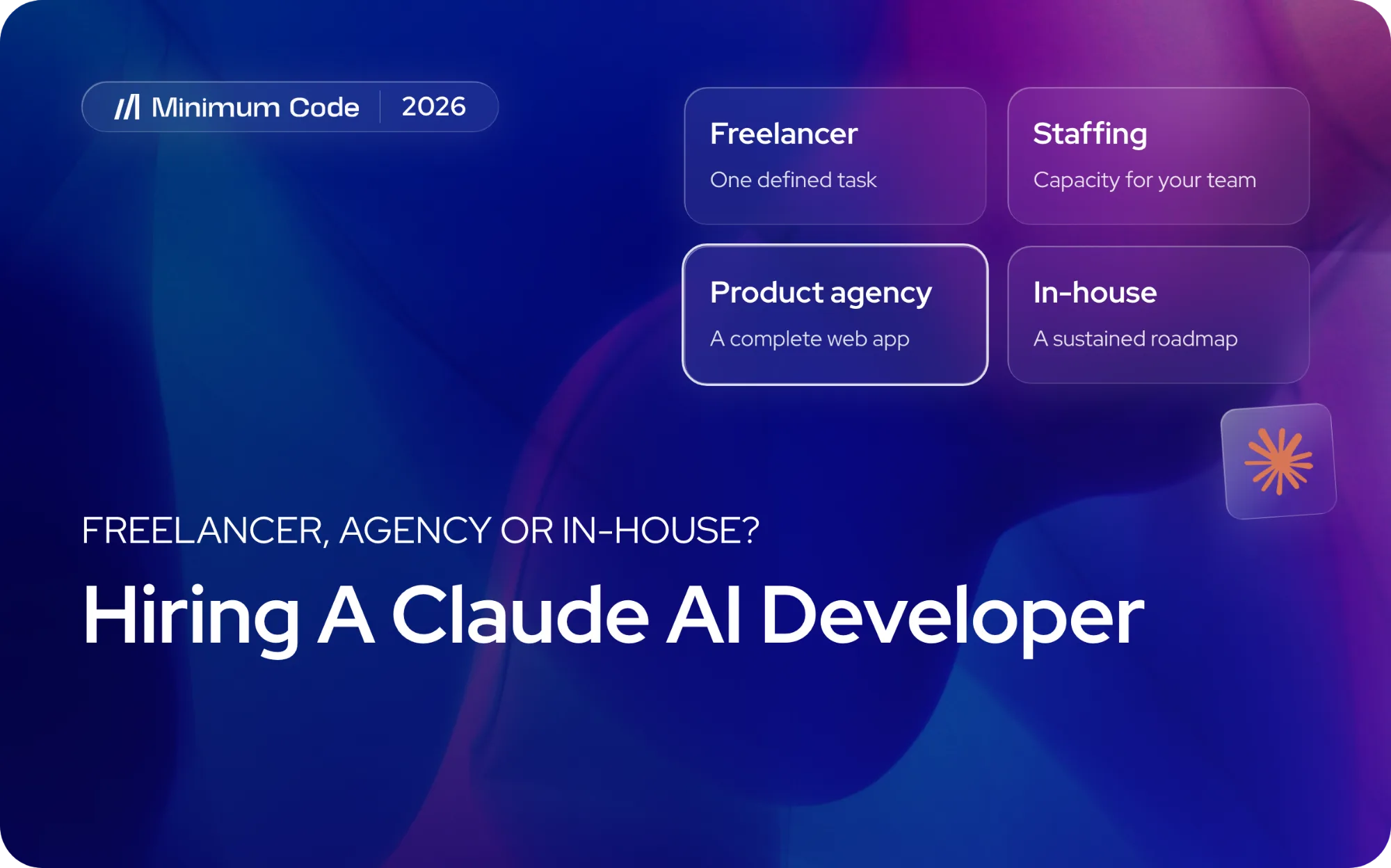

Claude Code can help build anything from a focused business tool to a full web application. But if you're considering it for your own product, examples from real projects are more useful than lists of features or impressive coding demos.
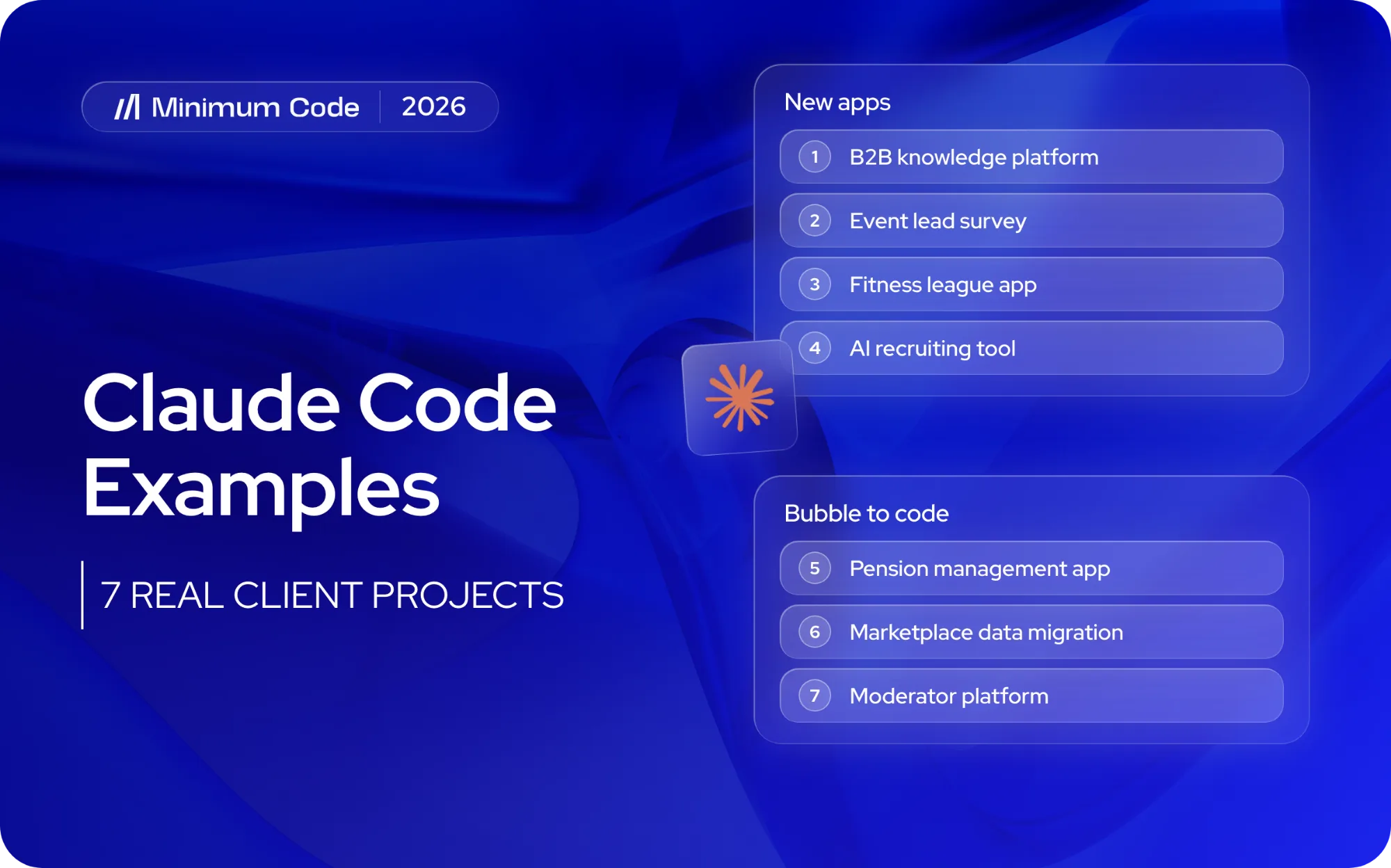
Here are seven projects from Minimum Code's work: four new applications and three engagements involving a move away from Bubble. They cover recruiting, professional directories, sports competitions, pensions and marketplaces. We'll look at what the products do, what the available project records establish and how AI-assisted development fits into the work.
Key takeaways
- The four new builds cover a specialist B2B platform, a conference survey, a functional fitness league application and an AI-assisted recruiting tool.
- The three other engagements involve existing Bubble products: pension management, a business marketplace and a research moderator platform. In one case, Minimum Code handled the data migration while the client's engineers built the new platform.
- The project overview lists Next.js, Supabase, Vercel and Claude Code across all seven projects. That does not mean Minimum Code wrote every part of every replacement application.
- An app built using Claude Code does not need AI features. The coding tool and the product's functionality are separate decisions.
- What matters is what a project needed, what the team actually delivered and how the resulting software supports its users.
What can you build with Claude Code?
Claude Code can help develop web applications, implement features in an existing codebase, investigate bugs and automate development tasks. It can read project files, make changes across several files and run commands or tests. That gives developers a way to work on an application within its actual codebase.
The examples below are products with concrete audiences and jobs to do: a research platform helps professionals find suppliers, a recruiting tool produces hiring materials, and a league application serves competitive athletes. Some started from scratch; others already had users and business data.
The coding agent can help with implementation, but the team still defines the product, reviews the output and decides what is ready to ship. That distinction is central to AI-assisted development at Minimum Code.
Four examples of new apps built with Claude Code
These four projects are listed as new builds in Minimum Code's project overview. Each illustrates a different type of web application, from a narrowly focused survey to a broader professional platform.
1. A B2B knowledge platform with a supplier directory and community
This B2B platform for the additive manufacturing sector combines real-world case studies, a supplier directory, a technology knowledge base and a professional community. It gives visitors a place to learn about 3D printing applications, research potential suppliers and connect with people in the industry.
Those features serve different needs. A visitor exploring a manufacturing technique might begin with the knowledge base and case studies; someone further along may want to compare suppliers. Bringing the resources together makes more sense than treating each as an unrelated website.
The project shows how a specialist directory can grow into a broader information product. It involves content, provider discovery and community participation rather than a single transaction or form.
For founders building a B2B platform, the useful example is the combination of resources around one specialist audience. The project overview confirms the platform's core components and its new-build status; it does not break down which features Claude Code implemented.
2. An interactive survey for event lead generation
This project was an interactive lead-generation survey for a corporate travel conference. Attendees completed it on their phones, providing information about their pain points and gaps in their current approach.
Unlike a generic contact form, the survey gives the business context for a later conversation. Someone completing it has already identified a challenge, so the follow-up can start with a more relevant question.
The conference setting matters. Participants need to answer while moving around an event, so the experience has to be direct and easy to complete on a phone. The available project description identifies the survey's purpose and setting, but does not document completion rates or conversion results.
This is a useful counterexample to the idea that AI-assisted development always means building a large SaaS platform. A single interactive assessment can be a complete, commercially relevant product.
For a founder, the starting question is what information the tool should help gather and what happens after the user submits it. Those decisions define a much more useful brief than asking for an 'AI app' in the abstract.
3. A functional fitness league app for competitive athletes
The Box League project is a league application for athletes competing in functional fitness. The public league operates around gyms, teams, fixtures and ranked divisions, making it more specific than a generic fitness or class-booking app.
The league's public website describes teams of six, home-and-away fixtures and divisions organised by ability. Its league tables also show teams, matches played, wins, losses and points. These are visible elements of the league's operating model, not a claim that every one of them was built into the private athlete app.
The project's challenge is the structured competition behind the experience: participants need to understand which division they are in and how the season works. League organisers also need dependable information about teams, fixtures and results.
It illustrates how a coding agent can be part of building software for a niche, rules-driven activity. The internal overview confirms a new league app using Claude Code, but does not identify specific code changes made by the agent.
4. An AI recruiting tool for hiring preparation
The recruiting project is an AI-assisted tool that creates job descriptions, candidate evaluation scorecards and interview questions. These are practical outputs that hiring teams use to define a role and prepare interviews.
The three outputs belong together. A job description explains the role, a scorecard sets evaluation criteria, and interview questions help assess candidates against those criteria. Keeping them in one workflow can give a recruiter a more coherent set of preparation materials.
The product has AI features, but the available project overview does not specify which model generates them. It does list Claude Code in the development stack. Those are separate facts: using Claude Code to develop an app does not mean the finished app runs on Claude.
For founders considering an AI product, this distinction matters. The development team must build the application, while the product team must decide what useful outputs look like and how recruiters will check them before use.
Three projects involving Bubble-to-code migrations
The next three engagements started with Bubble-based products. Minimum Code's project overview lists them as Bubble-to-code migrations and includes Claude Code, Next.js, Supabase and Vercel in the project stacks. The company's role was not identical in all three, so the examples below distinguish product functionality from the work delivered.
A migration starts with existing users, data and workflows. That makes the challenge different from launching a new app. The team needs to understand what must survive the change, not simply reproduce familiar screens.
5. A company pension management application
This German company pension product lets employers manage pension-related information and gives employees visibility into their retirement savings. Minimum Code's published case study describes the earlier application, while its internal project overview records a subsequent Bubble-to-code migration.
In the published Bubble version, HR teams manage and review which employees are enrolled, and employees can follow the progress of their pension plan and contribution schedule. The product also helps employees understand the current and future value of their company pension.
That makes continuity central to the migration: pension information and the views used by HR and employees are part of an existing business process. The project overview confirms the migration category but does not supply a feature-by-feature account of the replacement app.
The example is relevant to founders replacing internal management software. Even when the technology changes, the value of the application lies in the specialised information and business rules its users depend on.
6. A large data migration for a business acquisition marketplace
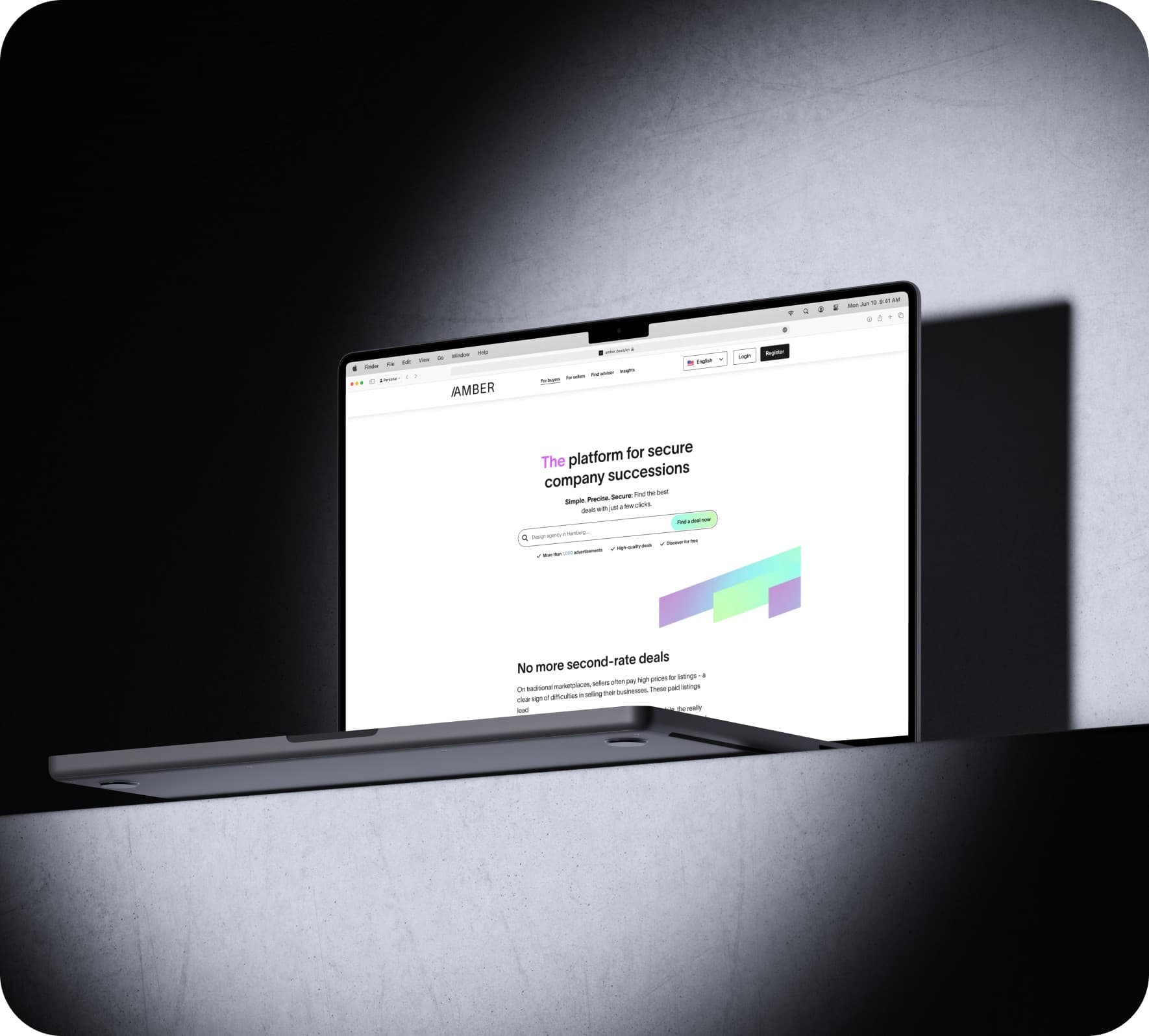
This engagement involved a marketplace connecting sellers and buyers of businesses. After an acquisition, the client had four legacy platforms to consolidate: a TYPO3 marketplace, a Bubble app, a WordPress advisor directory and a Webflow marketing site.
Minimum Code's role was the data migration, not the construction of the new platform. The client's engineers built the replacement system. Minimum Code handled moving and reconciling more than 100,000 accounts and approximately a decade of listings, deals, contacts and billing history.
That required more than copying database tables. The published case study describes account merges, transferring saved searches and other records, preserving subscriptions and rehearsing the migration twice on production data before the cutover.
The four platforms were consolidated into one live marketplace during a weekend cutover in July 2026. Users could access their existing deals, saved searches, listings and contacts afterwards; they needed to set new passwords.
This is an example of Minimum Code contributing to a complex software transition without claiming to have built the entire resulting product. The project overview includes Claude Code in the engagement's stack, but the published case does not identify which individual migration tasks used it.
7. A platform connecting research agencies with focus-group moderators
The research platform connects agencies with professional focus-group moderators. Minimum Code's published case study describes the earlier Bubble app, and the internal project overview lists a later migration to a code-based stack.
The original platform gave agencies access to a network of more than 500 verified moderators. The published case describes an interface designed to help research teams find and contact appropriate moderators without lengthy manual searching.
That is a specific professional marketplace, not a general recruitment site. Agencies need access to relevant specialists, while moderators need an effective way to be discovered and contacted.
The later Bubble-to-code migration is recorded in the project overview, but the public case study still focuses on the original Bubble build. The example therefore demonstrates the product and the migration history without claiming undocumented features or results for the new version.
The technology behind these Claude Code projects
The internal project overview lists Next.js, Supabase, Vercel and Claude Code for all seven engagements. They serve different roles, and project-level stack information should not be mistaken for a record of who implemented each component.
Next.js: the application framework
Next.js is a React framework for building web applications. It gives developers a structure for the interface and application logic. A Claude Code web app still needs that foundation: the agent works on the codebase, while the framework supports the application.
For a founder, the important point is that the application has a codebase the team can maintain and extend. The framework choice should fit the requirements and the people responsible for developing the product.
Supabase: backend services
Supabase provides a PostgreSQL database alongside services such as authentication and storage. It gives a development team backend components to build on.
Having those services available still leaves product-specific work. The team has to decide how information is organised, which users can access it and how the application uses it. Those decisions shape whether the backend fits the business.
Vercel: deployment
Vercel provides the deployment platform in these examples. It is where application changes are published through a deployment workflow.
Hosting is part of the ongoing product setup. The team needs a reliable way to release changes and understand what is running. That responsibility continues after the first version has been delivered.
Claude Code: development
Claude Code works on the development side. It can inspect files, help implement changes and run checks in the project environment. The application continues to use its own framework, backend services and hosting.
A stack list tells you which technologies were involved. It does not reveal how much code the agent wrote, which tasks it handled or how responsibilities were divided between teams. For the examples above, the project records establish Claude Code's involvement without documenting those individual actions.
How we approach Claude Code app development
At Minimum Code, Claude Code sits inside an engineering workflow. Our team remains responsible for architecture, review and testing. The purpose is to put the tool to work on a defined task while keeping ownership of the result with people who understand the product.
Give the agent enough project context
A development task needs more than a feature name. It needs context about the existing application, relevant conventions and the behaviour expected from the change. Otherwise, the agent has room to make choices the team never intended.
A CLAUDE.md file can keep project-specific rules, working commands and checks close to the code, so the agent has useful context between sessions. What matters is keeping those instructions accurate and relevant to the application.
Plan changes before accepting implementation
Some tasks touch several parts of an application. A visible change can depend on data models, permissions or behaviour elsewhere in the product. The team needs to understand those connections before accepting an implementation.
Claude Code Plan Mode gives engineers a chance to review the proposed approach before making changes. They can challenge assumptions, narrow the scope or revise the plan before the code is written.
Review the behaviour that matters to the business
Tests and code review need to connect back to the requirement. Does the user get the expected result? Are access rules respected? Does the change affect something that already works? The checks should reflect the product's actual responsibilities.
For founders, this is a useful question when evaluating a development partner: how will the team show that a feature is ready? A demonstration of the main screen provides one kind of evidence. The team should also be able to explain what was checked and who owns the release decision.
Can you use Claude Code to migrate a Bubble app?
Yes. Two examples in this selection are the pension management app and the research moderator platform, both recorded as Bubble-to-code migrations. The business marketplace is a different kind of contribution: Minimum Code migrated the data and the client's engineers built the new platform.
The decision to migrate still starts with the application. Moving away from Bubble can mean recreating workflows, permissions and business data in a new system. It can also involve a specialist contribution, such as migrating data into software built by another team.
A Bubble-to-code migration starts with the application as it exists: which features users rely on, what data needs to survive and what genuinely needs to change. The new foundation should be planned around those requirements, not treated as a screen-by-screen copy.
If your Bubble app is already doing useful work, bring that knowledge into the assessment. Explain where it supports the business, where people struggle and what the next stage requires. That gives the team a better basis for recommending a migration, a refactor or a smaller set of changes.
Which example is closest to the app you want to build?
The B2B platform combines knowledge and supplier discovery. The event survey gathers information from conference attendees. The fitness league serves athletes and organisers. The recruiting product produces hiring materials. The three migration examples involve more established products with data and workflows to preserve.
If one resembles your idea, focus on the activity you need users to complete and the information it depends on. That makes it easier to define scope, assess an existing prototype or discuss a migration with an engineering team.
Building a product takes more than generating the first screens: web app development also involves scoping, testing and launching the application. The question of whether Claude Code is worth it comes down to the team, the product and the work ahead.
Build your next application with Minimum Code
Have a web app idea, an AI-built prototype or a Bubble product that has reached its limits? Minimum Code works on new applications and existing products, from development to migration and targeted engineering work. The first step is understanding the product and deciding what the next stage actually requires.
You will speak with Tom, our founder, about your goals, technical requirements and possible next steps. For an existing app, that includes an honest discussion about whether rebuilding is the right move.
Book a free consultation with Minimum Code to discuss your project.

Written by Tom
Founder and Lead Developer

Ready to start your project?
Book a free discovery call to learn how we can build your app in 4 weeks, or less.
Book a call