
A Claude AI developer is an engineer who uses Anthropic's Claude tools to build software. That might mean integrating the Claude API into an existing product or using Claude Code to develop a web application. If you're looking to hire one, the first question isn't where to find someone who knows the tool. It's whether you need help with one feature or a team that can take responsibility for the whole product.
If you don't have an engineering team, the gap between generating code and launching a dependable product matters most. At Minimum Code, senior engineers use Claude Code and Codex in a managed process that covers architecture, review, testing and launch. You get a team accountable for the application, rather than a collection of AI-generated features left for you to maintain.
Think about the product you want to launch, not just the AI tool you want someone to use. A developer who builds Claude-powered assistants may not be the best choice to deliver a SaaS application, marketplace or customer platform. And if you don't have a technical lead, hiring one developer still leaves you responsible for a long list of engineering decisions.
Key takeaways
- A Claude AI developer may use the Claude API to add AI features or Claude Code to build ordinary software. Make sure you're hiring for the right kind of work.
- A freelancer can be useful for a defined task. For a complete web app, an agency that provides engineering leadership, development, testing and launch support may be a better fit.
- Ask to see software the developer or team has delivered, what they were responsible for and how they handled difficult technical decisions.
- Claude Code can speed up implementation, but somebody still needs to review changes, test real user journeys and decide when the software is ready to launch.
- Compare the complete cost of delivery, not just an hourly rate. Include project management, access to the code, maintenance and what happens after launch.
What does a Claude AI developer do in practice?
The title can mean two different things. Some developers add Claude-powered features to products. Others use Claude Code to build software that may not contain any AI at all. Knowing which one you need will save you from comparing people with very different skills.
Integrating Claude into the product
An integration developer connects your application to Claude through an API, the interface software uses to exchange requests and responses. The resulting feature might support a chatbot, document analysis or an agent that takes permitted actions within a business workflow.
For an AI assistant that answers questions using your business data, a developer may use retrieval-augmented generation (RAG) to supply relevant information. You should be able to ask how customer information is protected, what happens when the model gets an answer wrong and how the feature will be tested before users depend on it.
An AI feature is only valuable if it solves a real problem for the people using your product. It also needs a usable interface, sensible operating costs and a way to measure whether it works. Connecting the model is only the beginning.
Building software with Claude Code
A Claude Code developer uses Anthropic's coding agent to inspect an application, write and modify code, run development commands and help test changes. The finished product might be a SaaS platform, internal tool or marketplace with no AI feature visible to its users. The real skill is knowing how to turn that assistance into reliable, maintainable software.
For substantial changes, the developer should investigate the existing application before approving an approach. Agreeing the approach before implementation helps avoid expensive rework; Claude Code Plan Mode can support that review. The engineer still needs to judge the proposal against the product's requirements.
Giving the agent project context
A developer should give the coding agent enough context to work within the existing application. CLAUDE.md can hold the project rules and testing instructions the agent needs to follow.
You do not need to understand every setting in a CLAUDE.md file to evaluate a provider. Ask how the team keeps project instructions current and stops the agent from making unrelated changes. A good answer should describe a repeatable workflow, not just a clever prompt.
Connecting external tools through MCP
Sometimes an agent needs information outside the codebase, such as error logs or monitoring data. Claude Code MCP (Model Context Protocol) can provide controlled access to those tools.
For a founder, the practical question is simple: what systems can the coding agent access, and who approves sensitive actions? A capable development team should be able to explain its safeguards without requiring you to become an MCP expert.
What skills should a Claude AI developer have?
Knowing how to prompt Claude Code is not enough. The developer must understand the product, make sound architecture decisions, spot errors in generated code and take responsibility for the outcome. If you're hiring a team, those skills should be part of its delivery process rather than resting on one person.
Architectural judgment grounded in the product
Ask how the developer decides where a new feature belongs in an existing application. A useful answer connects the implementation to the current data model and explains the maintenance implications. It should also reveal what they need to learn before recommending a change.
You should be able to understand why a proposed feature or technical change matters to your business. Be wary of anyone who recommends a full rebuild before looking at the current product. Equally, a fast prototype is not proof that the same code is ready for paying customers.
Review and testing that challenge the output
Ask candidates to walk you through a real example: what Claude generated, what the engineer changed and why. The strongest evidence is not a polished prompt or a screen recording of an agent coding. It's an explanation of the decisions that made the result fit for use.
Passing tests can leave important mistakes undiscovered when the tests repeat the implementation's assumptions. Addressing AI-generated code vulnerabilities requires checks for prohibited behaviour and failure conditions. A reviewer should explain which risks deserve deeper investigation and why.
Security and context configuration
Ask how the team protects API keys, customer data and live systems. Claude Code instructions alone are not security controls: access rights, secrets management and deployment approvals still matter. A responsible provider should be able to explain these choices in plain English.
For an API integration, extend that discussion to the information sent to the model. Ask for a plain-language explanation of the data flow and who will approve it. For Claude Code work, ask how project guidance stays aligned with the application. Both discussions reveal how deliberately the developer configures the environment.
Where can you hire a Claude AI developer?
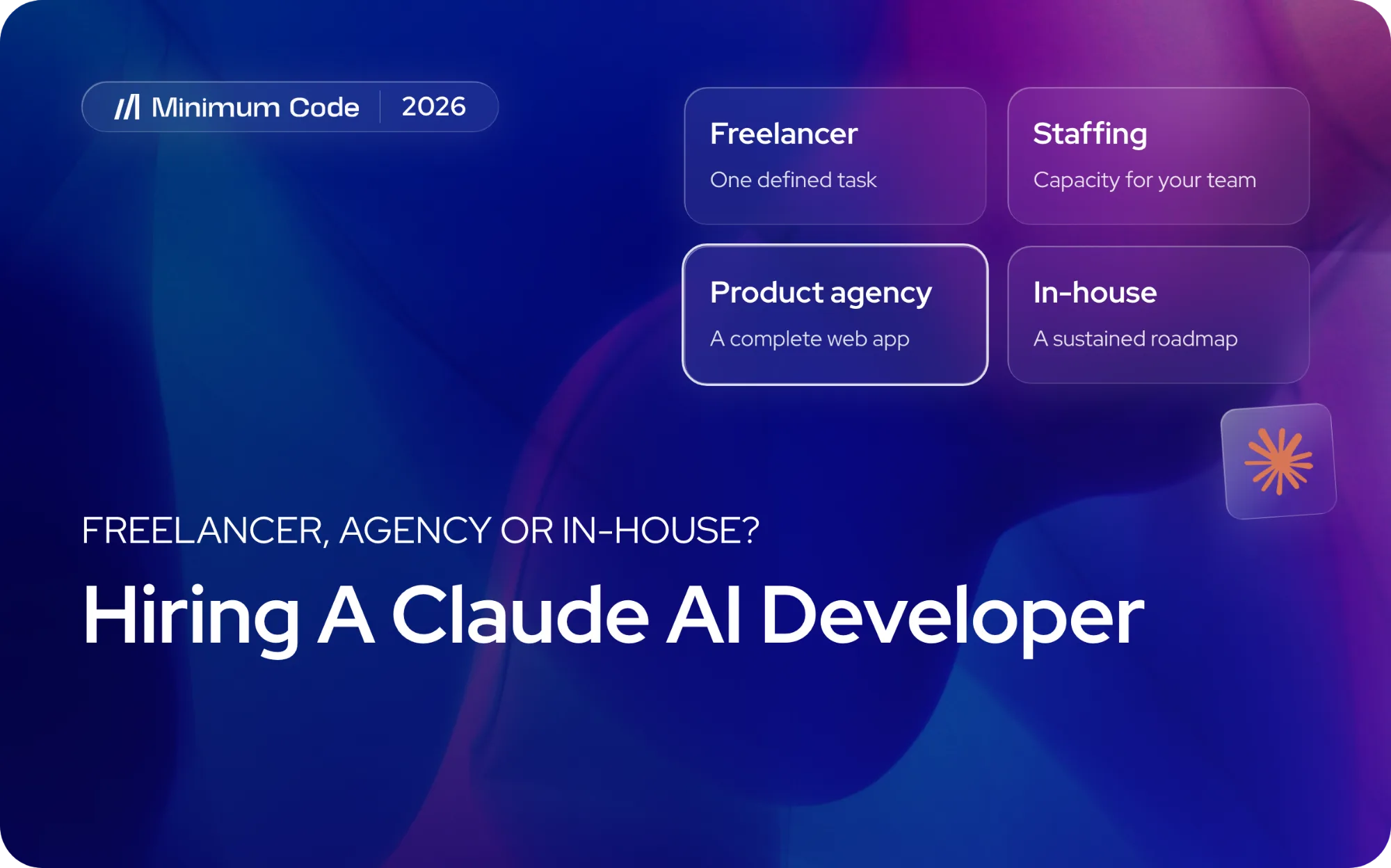
You can find developers through freelance marketplaces, staffing companies, in-house recruitment or a development agency. The best route depends on how much work you need done and whether you already have someone qualified to manage and review it. If your goal is to launch an application rather than fill a role, start by comparing delivery models.
Freelance marketplaces
Marketplaces such as Upwork and Toptal can be useful for finding an individual developer for a contained task. Search for specific experience such as Claude API integration, Claude Code, Next.js or full-stack web app development, rather than treating 'AI developer' as a complete job description.
The trade-off is management. A freelancer may be a sensible choice if you have a clear brief and somebody technical to review the work. If you're a non-technical founder commissioning a full product, you'll still need to coordinate architecture, testing, deployment and support yourself.
Staffing and outstaffing companies
Staffing and outstaffing providers add developers to your existing team, usually on an hourly or monthly arrangement. This can work well if you already have a technical lead, a backlog and a reliable way to review code. It is not the same as hiring someone to own the delivery of your product.
Clarify the management boundary before signing. Your team may remain responsible for the backlog, architecture and acceptance of work. Ask who handles replacement if the assigned developer leaves, and how project knowledge will be preserved. Extra capacity is useful only when someone has time to direct it.
Product agencies
If you need an entire application rather than extra development capacity, a product agency can own the work from scoping through launch. Minimum Code uses Claude Code and OpenAI Codex to build and improve web apps, with senior engineers responsible for architecture, code review and testing. That model is aimed at founders building a new product, turning an AI-generated prototype into production software or modernising an existing app.
For non-technical founders, that single point of delivery responsibility is often the biggest advantage. Its broader remit should be explicit in the proposal, with clear ownership and support terms. These are useful criteria when comparing MVP software development agencies, particularly when you lack the internal capacity to coordinate separate specialists.
You still make the product decisions: who it's for, which problems to solve and what matters most in the first release. The agency translates those priorities into a technical plan and manages delivery. Ask how scope changes, project access and ongoing support will work before signing.
In-house hiring
An in-house employee can accumulate deep product knowledge and support an ongoing roadmap. This becomes attractive when there is enough sustained engineering work to justify the role and the company can provide technical leadership.
For a founder without a technical team, recruitment brings an additional problem: assessing the first engineer. Allow for the time and expertise needed to evaluate candidates, as well as the continuing employment commitment. Decide who can challenge technical decisions and provide continuity during absences before making one person responsible for the whole application.
When should you hire a Claude Code development agency?
An agency is usually the more practical option when you need a complete web app but don't have an engineering team to manage freelancers. That includes a new SaaS product, an MVP ready for its first release, an AI-built prototype that needs production engineering, or an existing application that needs rebuilding or extending.
Minimum Code works in those situations. Its engineers use Claude Code and Codex to speed up implementation while handling the architecture, testing and release decisions that a founder shouldn't have to make alone. If you already have a capable technical team and only need a small integration, hiring a specialist directly may be more efficient.
How do you evaluate the developer before committing?
Treat the first conversation as a test of how a provider thinks. Explain what you're building, the stage your product has reached and the outcome you need. Ask about similar projects, the proposed team and the path from initial scope to a working release.
Establish who builds and who reviews
Ask to speak with the person who will build the application and the engineer responsible for reviewing significant changes. In a small engagement, one person may cover both roles. Make that arrangement explicit and consider an independent review for work with serious operational consequences.
Ask directly: who can stop a release, and on what grounds? The answer should identify a person and a decision process. Also establish how you can reach the builder when a requirement is unclear. A project manager can organise communication, but technical questions need access to someone who understands the implementation.
Request evidence you can verify
Look for a case study that shows what the provider actually built, where the project started and what its contribution was. A demonstration or an authorised client reference is more useful than a gallery of interfaces with no explanation of the work behind them.
Then ask how they would demonstrate completion on your project. Agree acceptance conditions before implementation and request evidence against them at review. For an AI feature, discuss how answer quality will be evaluated. For ordinary application work, ask how the team confirms that existing behaviour still works after the change.
Notice warning signs early
Warning signs are most useful when they point to an unanswered responsibility. Investigate these before committing to a larger build:
- A delivery promise made before anyone has examined the requirements or existing code.
- An inability to explain generated changes beyond saying that the agent produced them.
- No named reviewer or clear process for deciding a release is ready.
- A portfolio presented without a verifiable account of the provider's contribution.
- Unclear ownership of the repository or no practical way to obtain deployment access and a handover.
If a proposal leaves major questions unanswered, ask for a bounded technical assessment before committing to a full build. It should produce a clear recommendation, not an open-ended invitation to rewrite everything.
Which hiring option fits your situation?
A freelancer may look cheaper on paper, but only if someone can brief, manage and review their work. For a founder without technical leadership, compare the price of a complete outcome: product scope, implementation, testing, launch and ongoing support.
Your situation | A practical hiring route |
|---|---|
One defined task with a clear acceptance point | A freelancer, with a named person to verify completion. |
An established engineering team needs more capacity | Staffing or outstaffing, directed by your technical lead. |
A complete web app needs building or rebuilding | A product agency with responsibility for delivery and technical decisions. |
A sustained roadmap justifies permanent engineering capacity | In-house hiring, supported by credible technical assessment. |
For a new product, narrow the first release around the customer behaviour you need to test. That gives a provider a clearer brief and helps you evaluate progress through a disciplined MVP development process. Generating features more quickly makes scope decisions more consequential because every accepted addition becomes part of the product you maintain.
If you already have an AI-built prototype or a live application, don't assume it needs to be rebuilt from scratch. Ask what can be retained, which problems block the next release and what needs professional engineering. Minimum Code explicitly works with founders moving a prototype towards production and with teams modernising older systems.
Compare budgets on the same scope, including review and launch preparation. The factors behind web app development costs extend beyond the number of visible screens; integrations and ongoing support also require engineering time. Ask providers to identify exclusions so a cheaper proposal does not quietly transfer essential work back to you.
How Minimum Code builds web apps with Claude Code
Minimum Code is a development agency, not a marketplace for Claude freelancers. We use Claude Code and OpenAI Codex to help build new web applications, improve existing products and turn AI-built prototypes into software that can support real users. Senior engineers lead architecture, review, testing and the decisions behind each release.
From product scope to reviewed code
We start by defining the users, key workflows and scope of the product. Our engineers plan the implementation and use coding agents on defined development tasks. Changes are reviewed and tested before release, with senior engineers accountable for the technical decisions. That operating discipline underpins agentic engineering.
Claude Code can investigate a repository, help implement features and run development checks. The value of that project access becomes clearer when comparing Claude and ChatGPT for coding. Engineers remain responsible for checking that the interpretation is correct and the resulting implementation belongs in the product.
Delivery that accounts for the next change
A new product starts with the essential user journeys and a manageable first release. If you already have a working prototype, we examine what can be retained and what needs strengthening before taking it further. Either way, the goal is an application that can be launched and improved, not a one-off AI coding demonstration.
Maintenance includes correcting defects and adapting to changes in dependencies or external services. These continuing obligations are part of custom software development, so discuss support and access arrangements alongside delivery. The application should remain understandable to the engineers who will work on it next.
Frequently asked questions
These are the questions worth answering before you hire a Claude AI developer or commit to a full development team.
Does a Claude AI developer build AI features or ordinary apps?
The title can describe either. Specify if you need Claude integrated into the product, software built with Claude Code, or both. Request evidence for the particular work involved.
Can Claude Code build a complete web application?
Yes. Experienced developers can use Claude Code to help build a web app, even if the app has no AI features of its own. It can assist with writing code, investigating a codebase and testing changes. Product scope, security, architecture and deployment still require engineering decisions.
Should I hire a Claude Code freelancer or an agency?
A freelancer can work well for a defined feature when you have someone technical to review it. If you're a founder without an engineering team and need an app designed, built, tested and launched, a development agency can take responsibility for the full delivery.
How much does it cost to hire a Claude AI developer?
The cost depends on whether you're buying a developer's time or a complete project. Compare proposals against the same requirements and check whether scoping, code review, testing, deployment and post-launch support are included. AI-assisted development can reduce implementation time, but it doesn't eliminate engineering work.
Build your product with a Claude Code development team
If your aim is to launch or improve a web application, the right hire is whoever can take it from requirements to a working, maintainable product. A freelancer may be enough for one task. If you need the complete build, Minimum Code provides senior-led development with Claude Code and Codex. Tell us what you're building, or show us what you've already built, and book a call to discuss the next step.

Written by Tom
Founder and Lead Developer

Ready to start your project?
Book a free discovery call to learn how we can build your app in 4 weeks, or less.
Book a call