

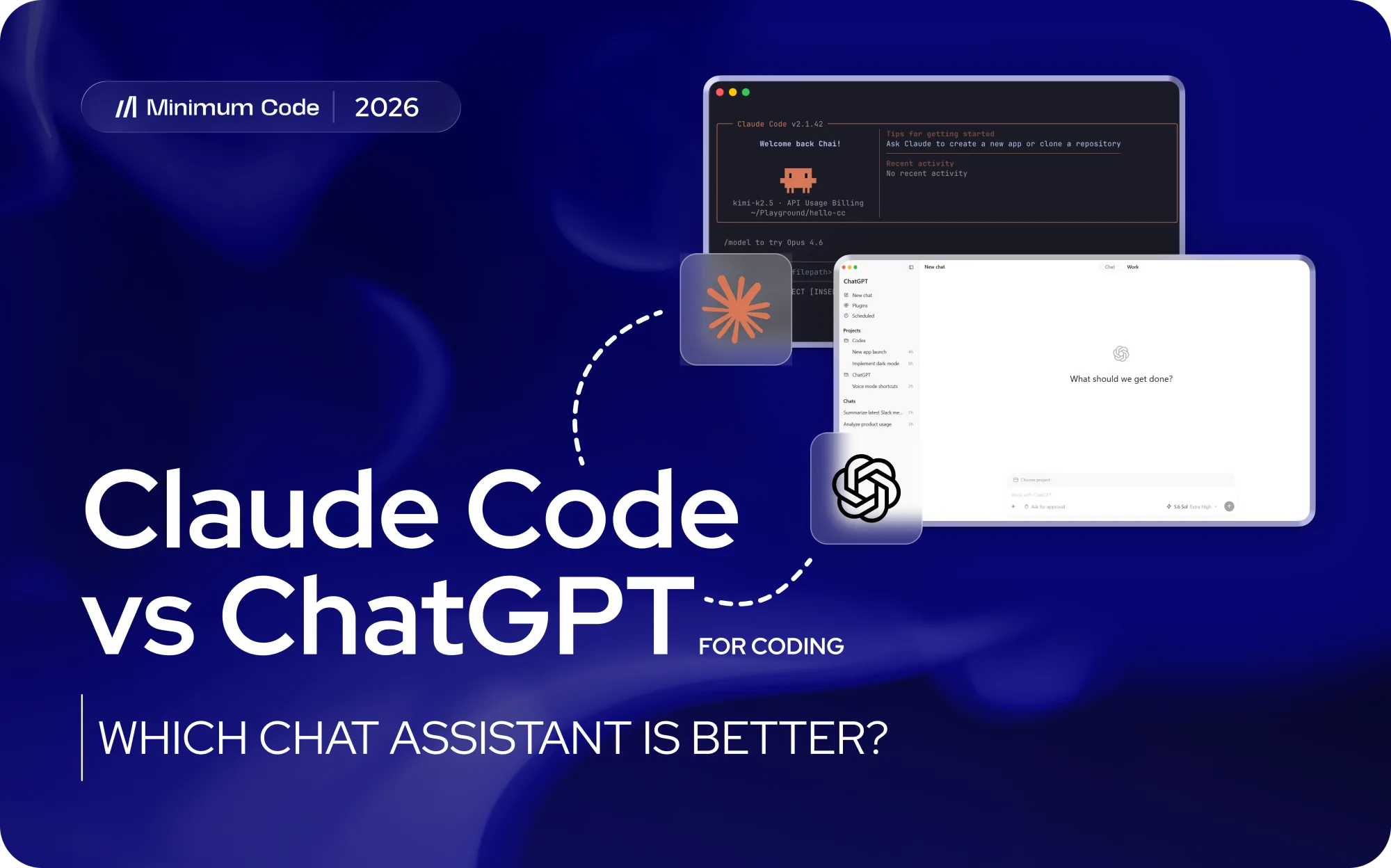
Claude and ChatGPT are both highly capable coding assistants, but they have slightly different strengths. ChatGPT is the better all-rounder for iterative debugging, explanations, and conversations that move between code and broader technical questions. Claude is particularly strong when you give it large amounts of existing code or technical context to analyze.
For smaller coding tasks, the difference between them is often marginal. The bigger limitation is shared by both: once a problem spans multiple files, dependencies, tests, or application layers, copy-pasting code into a chat quickly becomes inefficient. That is where repository-aware coding agents such as Claude Code and Codex become a different category of tool.
Key takeaways
- ChatGPT is the stronger all-round coding assistant for iterative debugging, explanations, and conversations that move between code, architecture, and product questions.
- Claude has an edge with large amounts of supplied code and technical context, especially when the task starts with understanding an existing implementation.
- For small, contained coding tasks, the difference between them is often minor. Both are strong at debugging, code generation, refactoring suggestions, and technical explanations.
- Both become less efficient when a task spans multiple files, dependencies, tests, configuration, or application layers because the user has to provide and manage the context manually.
- For repository-wide work, coding agents such as Claude Code and Codex are a different category of tool, since they can inspect codebases, modify files, run commands, and execute tests directly.
- The best choice ultimately depends less on which chatbot is “smarter” and more on whether the task belongs in a conversation or inside an agentic development workflow.
Claude vs ChatGPT for coding: the practical verdict
For everyday conversational coding, there is no enormous capability gap between Claude and ChatGPT. Both can explain stack traces, write functions, review logic, suggest tests, convert code between languages, help with database queries, and work through technical decisions conversationally.
ChatGPT gets our overall recommendation because of its versatility. A session can move from debugging TypeScript into discussing database architecture, explaining an API to a founder, drafting a technical plan, and then returning to the implementation without much friction. That breadth makes it particularly useful when coding is only part of your work.
Claude becomes especially attractive when the starting point is a substantial body of existing material. Give it a long implementation, documentation, constraints, and surrounding logic, and it tends to handle that kind of dense context very comfortably.
The distinction becomes less important as soon as you move into professional software delivery. Minimum Code’s software development statistics for 2026 reflect a wider shift in engineering: AI has made producing code faster, which puts more pressure on planning, review, testing, security, and maintainability.
That is why our own development workflow does not revolve around finding the chatbot that produces the best isolated code sample. Claude Code and Codex operate much closer to the repository and execution environment, while our senior engineers focus on the decisions and verification surrounding the generated work.
What are we comparing when we compare Claude and ChatGPT?
This comparison focuses specifically on Claude and ChatGPT as general chat assistants.
The typical workflow is familiar. You hit a problem while programming, open a browser tab, paste the error and some relevant code, then ask for help. The assistant analyzes what you supplied and returns an explanation, possible fix, or rewritten implementation. You copy the result into your editor and find out if it works.
That is a useful form of AI-assisted coding. It can dramatically shorten the distance between encountering a problem and understanding it, especially for developers working with unfamiliar libraries or founders experimenting with simple technical concepts.
The limitation sits inside the workflow itself. The assistant works from the context you decide to provide.
If an authentication problem depends on a middleware file you did not paste, neither Claude nor ChatGPT can inspect it. If a data bug originates in a database transformation three layers away, the assistant may produce a perfectly reasonable fix for the code in front of it while leaving the real problem untouched.
This is the first major difference between conversational coding and the engineering workflow Minimum Code uses. A coding agent can investigate the repository instead of depending on an engineer to reconstruct the relevant parts inside a chat.
Our Codex vs Claude Code comparison explores that second category directly. Both tools can inspect projects, make coordinated changes, execute commands, run tests, and prepare work for review. That makes them fundamentally different from using Claude or ChatGPT as a sophisticated technical Q&A window.
Claude vs ChatGPT for debugging
Debugging is probably the strongest everyday use case for both assistants. A good debugging conversation gives the model the error, the surrounding implementation, the expected behaviour, and enough technical context to infer why the program is failing.
For a small, contained problem, both perform very well.
ChatGPT is particularly good when debugging becomes an iterative conversation. You can start with one error, apply a suggested fix, return with the next result, and progressively narrow the problem. Its strength as a general conversational assistant works nicely here because troubleshooting rarely follows a perfectly linear path.
Claude often becomes more useful as the supplied implementation gets larger. If the error sits inside a lengthy service, component, or processing flow, giving Claude more surrounding material can help it trace relationships that are easy to miss when reviewing a tiny snippet.
Coding Tasks and AI Tools
Coding Task | Practical Edge / Recommended Tool |
|---|---|
Short error message or stack trace | ChatGPT (Iterative debugging conversation) |
Large pasted implementation | Claude |
Explaining an error to a non-technical user | ChatGPT |
Reviewing logic across extensive supplied context | Claude |
Mixed coding and product discussion | ChatGPT |
Repository-wide debugging | Move to an agentic coding tool |
At Minimum Code, that final row is where the workflow changes. If the bug requires understanding several files, dependencies, tests, or application layers, manually feeding those pieces into a chatbot becomes unnecessary overhead.
Claude Code or Codex can inspect the codebase itself. The engineer can define the problem and constraints, let the agent investigate likely causes, review its reasoning, and then validate the resulting change inside the development environment.
The AI gets better context and the engineer spends less time playing courier between browser tabs.
Which assistant handles existing code better?
Claude has a strong case when the task begins with reading rather than writing.
A developer might inherit a long module and want to understand how data flows through it. A founder might have code generated elsewhere and want a technical explanation of what it does. A team might want a second opinion on a complicated function before refactoring it.
Claude is very comfortable with those context-heavy conversations. It can maintain relationships between functions, types, comments, and instructions across large supplied blocks while producing a coherent explanation.
ChatGPT remains highly capable here and often becomes more attractive when the conversation moves across levels. You can ask it to explain the implementation technically, simplify the explanation for a founder, identify possible risks, suggest a new structure, and then help rewrite one part.
For contained review work, both are excellent.
Production code introduces a different problem: existing code rarely exists in isolation.
A frontend component may depend on hooks, API routes, database types, authentication logic, configuration, shared utilities, and tests. Pasting the component gives the model a view of one room while the bug may be sitting somewhere else in the building.
This is one reason Minimum Code has built its AI coding workflow around Claude Code and Codex. The agent can navigate the project directly and inspect the surrounding code before proposing a change. Senior engineers remain responsible for deciding if the interpretation is correct and if the resulting implementation belongs in the product.
The difference is subtle for a 30-line function. It becomes enormous in a mature application.
Which is better for generating and improving code?
For small code-generation tasks, Claude and ChatGPT are both strong enough that declaring a universal winner would age badly.
Give either assistant a clear description of a utility function, API handler, test case, database query, or validation rule and it can usually produce a credible starting point.
ChatGPT has an advantage when the job evolves through conversation. You might ask for a first implementation, explain why one assumption is wrong, change a requirement, request tests, then ask for a simpler alternative. The interaction feels natural and flexible.
Claude works particularly well when you can provide the complete specification and surrounding context upfront. It can reason through the constraints before producing the implementation, which suits developers who prefer a careful first pass.
In both cases, generated code still has to enter the real application.
Someone needs to place it correctly, resolve imports, account for existing conventions, execute the code, run tests, inspect failures, and verify that another workflow did not break.
Minimum Code avoids much of that transfer step through agentic development. Claude Code and Codex can handle implementation inside the project, while the engineer reviews a real diff rather than copying a code block out of a chat.
That workflow follows the same principle described in our article on building web applications in 2026: getting code onto a screen has become dramatically easier, while building software that remains dependable under real usage still requires architecture, testing, security, and disciplined implementation.
Why prompting still determines a lot of the result
Comparing Claude and ChatGPT with weak prompts can produce misleading conclusions.
An assistant given only an error message is solving a different problem from one given the error, full function, framework version, expected behaviour, recent changes, and related configuration.
Strong prompts reduce ambiguity. For coding help, useful context normally includes the language and framework, relevant code, expected result, observed result, complete error output, and constraints the solution must preserve.
It also helps to ask for a diagnosis before requesting a rewrite. An explanation exposes assumptions that may be hidden inside a polished block of generated code.
This is one reason experienced developers often get more value from general AI assistants than beginners. They know which context is likely to be relevant and can detect when the answer is heading in a technically questionable direction.
Agentic engineering reduces some of that prompting burden because the tool can gather repository context itself. It does not eliminate the need for clear instructions.
Minimum Code still defines scope, requirements, constraints, and the expected outcome before delegating work to an agent. A coding agent with repository access can investigate more efficiently than a chatbot, but vague requirements can still create vague implementation.
Our article on choosing a software development company reaches the same conclusion at project level. Strong delivery starts with understanding the problem and defining what needs to be built before execution begins.
AI makes that discipline more valuable because execution can now move extremely quickly once the direction is set.
Where Claude and ChatGPT both start to struggle
The limits of Claude vs ChatGPT for coding become obvious once the work stops fitting naturally into one conversation.
A production application may contain hundreds or thousands of files. Behaviour can cross frontend state, backend services, authentication, database logic, third-party APIs, environment variables, deployment configuration, and automated tests.
Copy-paste turns that connected system into selected fragments.
Imagine an incorrect price appearing during checkout. You paste the payment function into ChatGPT or Claude. It looks correct, so the assistant proposes additional validation.
The real issue could have entered earlier through a frontend calculation, database value, locale conversion, or shared utility that never appeared in the conversation.
You can solve this by pasting more code. Then more. Then the configuration. Then the test.
At some point, the developer is manually recreating the repository inside the chat.
The same friction appears when implementing a feature. Adding a new user permission can affect database rules, API checks, interface states, administrative workflows, tests, and migration logic. A chatbot can help with each individual piece, but someone still needs to coordinate the complete change.
This is exactly where Minimum Code switches from conversational assistance to repository-aware agentic tools.
The agent can inspect related files, follow existing patterns, modify the relevant parts of the project, run tests, investigate failures, and return a reviewable implementation. The senior engineer remains in control of architecture and acceptance.
Our explanation of vibe coding and AI-generated development makes an adjacent point: generating working code quickly can be valuable for exploration, but production work needs review, testing, maintainability, and security around that output.
Chat assistants vs coding agents
Once repository access and execution enter the workflow, we are dealing with a different category of tool.
Claude and ChatGPT in normal chat are primarily conversational systems. You provide information and they respond. Claude Code and Codex can take a defined engineering task and operate much closer to the project itself.
That changes the basic unit of collaboration.
A chat assistant may tell you which files probably need changing. A coding agent can inspect them.
A chat assistant may generate a test. A coding agent can create it, run it, inspect the failure, update the implementation, and run it again.
A chat assistant may suggest a refactor. An agent can carry the refactor through several related files and prepare the resulting diff for review.
Minimum Code uses both Claude Code and Codex because their workflows suit different engineering tasks. Claude Code is particularly effective for deep, engineer-led repository work where investigation and active intervention are important. Codex is useful when work can be separated into defined tasks and coordinated across a broader agentic workflow.
The tools provide execution capacity. Senior engineers provide the context, judgment, and accountability around that capacity.
That distinction is important for founders evaluating AI-enabled software agencies. The interesting question is no longer simply which AI model the company pays for. Ask how the team scopes agent work, reviews generated code, runs tests, handles security, and decides what reaches production.
Those operating details say much more about delivery quality than a logo on the AI subscription.
How Minimum Code uses agentic coding in practice
Minimum Code has built Claude Code and OpenAI Codex into the development workflow across prototyping, implementation, refactoring, testing, and code review.
That means AI is involved throughout delivery rather than appearing occasionally when a developer needs help remembering syntax.
The process starts with engineering context. Requirements need to be clear enough for the team to define a bounded piece of work. Architecture, user behaviour, integrations, data implications, and acceptance conditions are considered before the agent begins implementation.
The agent can then investigate the relevant repository context and execute the task. Depending on the work, that may include modifying several files, creating or updating tests, running development commands, and responding to failures found during verification.
Senior engineers review the implementation and retain ownership of the system. Minimum Code’s AI coding approach is explicit about that responsibility: AI agents can handle significant implementation work, while architecture, review, testing, and release decisions remain under senior engineering control.
This lets the team move repetitive execution away from expensive human attention without treating generated code as automatically trustworthy.
The approach also makes the development loop more coherent. With a standard chatbot, the developer repeatedly transfers context between the application and AI conversation. An agent works inside the engineering environment, so repository inspection, implementation, testing, refinement, and review can remain connected.
This does not turn software development into a one-prompt operation. It lets experienced developers operate at a higher level.
Instead of manually writing every repetitive piece of implementation, they can spend more time evaluating architecture, clarifying requirements, inspecting edge cases, reviewing generated changes, and making decisions that depend on product and engineering judgment.
That is the commercial value of agentic engineering for a founder. Faster typing is barely interesting. Reducing the time between a clearly defined requirement and a reviewed, tested, maintainable change is valuable.
Minimum Code’s broader guide to custom software development explains why this technical ownership becomes increasingly important once software supports real operations. Development speed creates value only when the resulting product can continue evolving without turning every future change into a cleanup project.
Which coding assistant should you use?
For basic conversational coding, choose according to the way you prefer to work.
ChatGPT is our default recommendation for users who want one assistant covering debugging, coding, learning, technical explanations, research, and broader product conversations. It handles changing conversational direction particularly well.
Claude deserves serious consideration if you regularly paste large implementations, specifications, or technical documents and want careful analysis of the material before changing anything.
Using both can also be useful. A second model can challenge the diagnosis of the first when a problem is ambiguous.
The more important signal is when neither chat workflow feels efficient anymore.
If you constantly paste multiple files, explain repository structure manually, copy changes back into an editor, run tests yourself, return with failures, and repeat the loop, you have started doing coordination work that modern coding agents can handle much more directly.
A founder hiring a development team should move the evaluation up another level. Ask how AI fits inside their delivery system.
Minimum Code uses agentic tools because professional development involves more than producing an answer. The code has to fit the existing system, survive testing, remain understandable, and support the next change after this one.
FAQ
Is Claude better than ChatGPT for coding?
Claude is particularly good when coding conversations contain substantial existing code or technical context. ChatGPT is the stronger all-round choice for users who want coding help alongside debugging, explanation, product reasoning, and other technical tasks. For contained programming questions, both are highly capable.
Is ChatGPT good for debugging?
Yes. ChatGPT is particularly useful for iterative debugging because you can progressively provide errors, results, and new context. Include the full error, relevant implementation, expected behaviour, and technical environment to improve the quality of the diagnosis.
Is Claude better for large code files?
Claude is strong at analyzing long code blocks and maintaining relationships across supplied technical context. A large pasted file can still omit dependencies elsewhere in the application, which is why repository-level work increasingly benefits from a coding agent.
Can Claude or ChatGPT build an application through chat?
Both can generate significant amounts of application code and guide a developer through implementation. The workflow becomes increasingly cumbersome as the project develops more files, dependencies, tests, integrations, and architectural decisions.
What is the difference between ChatGPT and Codex for coding?
ChatGPT is a general conversational assistant. Codex is designed for agentic engineering work and can operate closer to repositories, development tools, testing, and task execution. Minimum Code uses Codex for production development rather than depending on chat-based copy-paste workflows.
What is the difference between Claude and Claude Code?
Claude is the general conversational assistant. Claude Code is an engineering agent designed to interact directly with codebases and development tools. Minimum Code uses Claude Code when the task requires repository context, implementation, testing, and controlled engineering execution.
Do AI coding agents replace developers?
AI coding agents can perform a growing amount of implementation work, but production software still needs architecture, review, testing, security decisions, product judgment, and accountable ownership. Minimum Code uses agents to increase engineering execution capacity while senior developers retain responsibility for what ships.
From coding help to production engineering
For Claude vs ChatGPT for coding, ChatGPT is the stronger all-round conversational choice and Claude is particularly compelling for context-heavy code analysis. Either can be extremely useful when the job is contained inside a conversation.
The more important upgrade begins when the product outgrows copy-paste coding. Minimum Code uses Claude Code and Codex to connect AI directly to repository-aware implementation, testing, refactoring, and review while senior engineers retain technical ownership.
If your product needs more than another answer in a chat window, contact Minimum Code to discuss how agentic engineering can fit into the build.

Written by Tom
Founder and Lead Developer

Ready to start your project?
Book a free discovery call to learn how we can build your app in 4 weeks, or less.
Book a call