
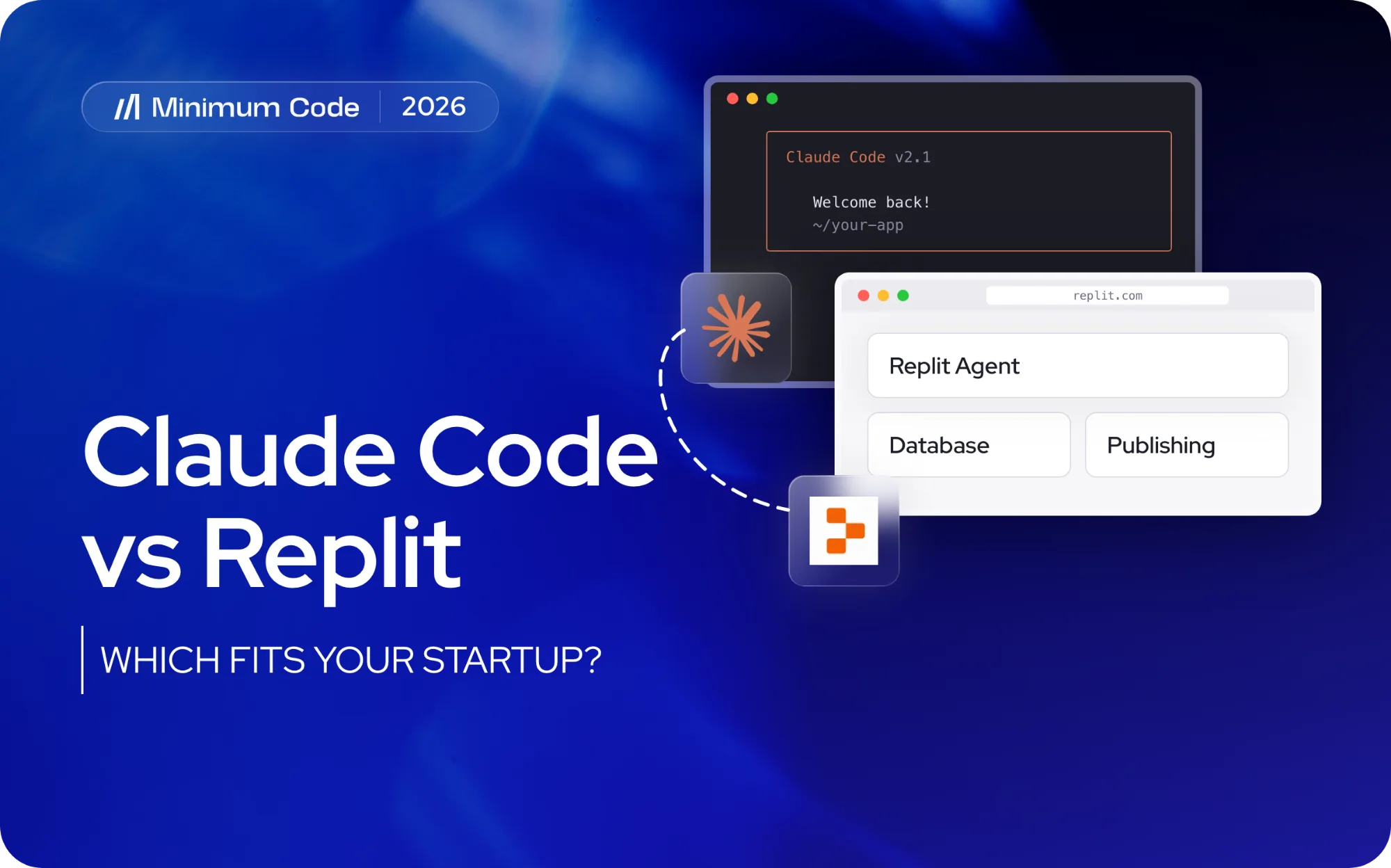
Choosing between Claude Code and Replit comes down to your workflow. Claude Code plugs right into your local repo and existing dev stack to help you write and edit code. Replit, on the other hand, gives you an all-in-one workspace—bringing the agent, development environment, and hosting together so you can go from a single prompt to a live app much faster.
For a startup, that difference affects the setup work, running costs and control over the product. Replit is worth trying when you need an integrated way to build and share a first version. Claude Code is particularly useful when you already have a repository, a chosen stack or engineering support. Neither choice determines whether the finished application is reliable.
At Minimum Code, experienced engineers direct AI-assisted development and review the implementation. This comparison focuses on what each tool provides and how to choose for the release you need.
Key takeaways
The useful question is how much of the development environment you want the platform to provide.
- Replit combines Agent, a cloud workspace and publishing. It reduces setup work but introduces platform services and usage costs to assess.
- Claude Code works across project files and developer tools. It is available in the terminal, supported IDEs, desktop app and browser.
- Compare billing models, not just subscription prices. Claude usage limits, Replit credits and hosting costs affect the real budget.
- Both agents can help with testing. Their checks still need to reflect the behaviour and permissions your product requires.
- Code portability and hosting migration are different tasks. Replit supports GitHub integration; adopting Claude Code does not automatically replace databases or hosting.
What is the difference between Claude Code and Replit?
Claude Code is Anthropic's coding agent. Replit is a development and publishing platform with its own agent, Replit Agent. Both can generate and modify code, but they package the surrounding work differently.
Claude Code reads project files, edits multiple parts of an application, runs commands and executes tests. The team chooses the repository, framework and deployment arrangement. Terminal, supported IDE, desktop and web interfaces are available.
Replit Agent sets up projects, writes code and helps test results inside a managed workspace. Replit also supplies publishing and databases. Plan Mode supports discussion before implementation; checkpoints let you inspect progress and return to earlier states. Developers can use these features too.
Founder consideration | Claude Code | Replit |
|---|---|---|
Starting a project | Work in a new or existing repository; choose the stack and services. | Agent builds inside a managed cloud workspace with integrated services. |
Making changes | Multi-file edits, commands and tests using the project's tools. | Agent edits, Plan Mode, checkpoints and testing within Replit. |
Publishing | Select an external host and establish a release process. | Built-in Static, Autoscale, Reserved VM and Scheduled deployments. |
Best initial fit | Chosen architecture, existing repositories or specific infrastructure needs. | Integrated building and sharing when platform services fit the project. |
Responsibility after launch | Your team maintains the code and selected infrastructure. | Replit runs the platform; your team maintains application behaviour. |
This is a comparison of development setups, not a claim that one agent always writes better code. A fair evaluation needs representative tasks, comparable requirements and a review of the result.
Which is easier for a non-technical founder?
Replit is usually the easier starting point when development setup is the main barrier. A founder can describe a workflow, inspect a preview and publish through the same platform rather than configure each service separately. That convenience makes an early experiment more accessible.
Claude Code's browser and desktop interfaces also reduce the need to start in a terminal. However, someone still needs to understand the repository, test commands and external services. An accessible interface does not remove those decisions from either product.
Judge the second change as carefully as the first build
The first generated screen tells you less than the first revision. Change a requirement and see whether the tool preserves the behaviour you still need.
For example, add an approval step to a request form without removing existing submissions or changing who can see them. Inspect the changes and test both the old and new paths. With Replit, evaluate how checkpoints help you recover; with Claude Code, evaluate the proposed changes and your repository's version-control process.
Measure how much explanation, debugging and review that revision requires. Repeated prompting is a cost when you cannot tell whether the latest result has fixed the problem.
Keep product judgement with the founder
You can judge whether the product solves a customer's problem, whether the wording makes sense and whether a feature deserves investment. Technical decisions need their own checks.
A form can look correct while saving the wrong data. A hidden admin button can leave its underlying API open to ordinary users. When you cannot verify those behaviours yourself, the missing ingredient is engineering support rather than another prompt.
Replit's integrated environment may delay some setup decisions. Claude Code may fit better with an existing technical team. Both eventually require a clear understanding of what the application must do.
Which should you choose for an MVP?
Start with the assumption your MVP must test, then choose a setup that can support the experiment. The following scenarios are illustrative, rather than claims about client projects.
An MVP should provide enough value to test a meaningful business assumption. Its scope also determines the engineering required: a demonstration with sample data is different from an application accepting payments and holding private customer records.
A prototype for customer interviews
Imagine a founder testing a booking idea with prospective customers. The immediate need is a working flow that people can try and comment on. Replit Agent is a sensible first option: build the screens in its workspace, use synthetic data and publish a version for the interviews.
The test should reveal whether users understand the booking process and want the proposed service. It does not require a complex deployment arrangement just to collect that feedback. Claude Code could build the same prototype, but its flexibility may add little value if nobody has an existing repository or infrastructure to use.
Keep the scope tied to the question being tested. Replit's convenience should help you reach users sooner, rather than encourage features that do not improve the experiment.
A B2B application with users and permissions
Now consider a paid B2B product with several customer organisations, account roles and an external billing integration. Claude Code is a strong option when an engineer owns the architecture and release process. It can work across the repository while the team chooses how authentication, database access and deployment should operate.
Replit can also support applications used in production. The decision should turn on whether its services, access controls and deployment options meet this product's requirements, not whether it began as a prototype. In either environment, test tenant isolation and billing behaviour before accepting real customers.
An internal tool for a small team
For an internal request tracker, Replit may make development and sharing easier if the team accepts its managed services. Claude Code may be more suitable when the tool needs to use an existing company repository, approved infrastructure or unusual integrations. Check access requirements and data sensitivity before treating “internal” as synonymous with “low risk”.
How do deployment and hosting change the decision?
Replit includes application hosting; Claude Code is not an application hosting service. Claude Code can help configure a deployment through permitted tools, but your team still selects and pays for the infrastructure that runs the product.
Replit offers Static deployments for static sites, Autoscale for request-driven applications, Reserved VM for continuously running workloads and Scheduled for tasks run at set times. Match the type to the workload rather than treating every published app alike.
Claude Code can work within your chosen hosting arrangement and release process. That flexibility helps with specific infrastructure requirements, while leaving configuration, monitoring and recovery from failed releases with the team.
Replit's preview and published application are separate environments. Publishing creates a snapshot of the app's files and dependencies; subsequent changes need to be published again. Persistent information belongs in appropriate storage or a database, rather than relying on files written to the published app's filesystem.
For either setup, check the custom domain, database connection, background jobs and deployment configuration before launch. The company should control the accounts needed to operate the product, including access when an original contributor leaves.
Assign someone to investigate failures and restore service. Integrated publishing reduces setup work, but does not transfer responsibility for the application's behaviour to the platform.
What does each approach really cost?
The comparison uses USD monthly subscriptions before applicable taxes. Annual billing can reduce the advertised monthly equivalent, and enterprise arrangements are outside this entry-plan comparison.
The headline subscription is a starting point. Check Claude's pricing, Replit's pricing and their usage documentation against your expected build activity and running application.
Plan | Monthly subscription | Allowance and additional costs |
|---|---|---|
Claude Pro | $20 | Claude Code included; usage limits apply. App hosting is separate. |
Claude Max | From $100 | Higher usage allowances; limits still apply. App hosting is separate. |
Replit Core | $20 | Free Mode allowance plus paid-service credits. Extra Agent and cloud usage can add charges. |
Replit Pro | From $100 | Higher credit tiers and collaboration capacity. Additional paid usage can add charges. |
How usage affects the bill
Claude Code is included with Pro and Max, subject to usage limits shared with Claude. API access uses a separate consumption-based billing arrangement. If the session authenticates through an API key, its charges come from that API account rather than the subscription allowance.
Replit combines subscription allowances with service credits. Free Mode supports work within its allowance, while paid Agent modes use effort-based pricing that varies with the task. Credits also cover services such as publishing, storage and databases, so building the app and running it can draw on the same budget.
A more complex Agent request can cost more than a small edit, and paid planning can consume usage even without a code change. Use spending alerts and budget controls rather than assuming a monthly subscription caps the total bill.
Budget beyond the first release
For a Claude Code project, budget separately for the selected hosting, database and external services. For Replit, estimate both Agent activity and platform usage after launch. Neither subscription pays for unlimited infrastructure or unlimited engineering work.
Include the time needed for review and maintenance in web app development costs. A cheaper subscription is a weak saving if the team spends days recovering from changes or has no budget to fix defects.
During a trial, record actual usage and the effort required to accept one feature. That gives you a more useful Claude Code vs Replit pricing comparison than applying the same flat monthly budget to two different billing systems.
Which workflow supports a maintainable product?
A maintainable product is one another qualified developer can understand and change. Both environments can produce that result, provided the code, tests and project context are kept in usable shape.
Claude Code works with the repository's existing structure and instructions. Replit also exposes project files and Git-based version control; its checkpoints do not replace the need to understand consequential changes.
Claude Code uses CLAUDE.md for persistent project instructions. Replit supports replit.md for project context and guidance. Keep these files focused on the actual application: how to run it, how to test it and which conventions or constraints matter.
Ask another developer to explain an important workflow and locate a proposed change. Difficulty doing so reveals documentation gaps while the implementation is still fresh.
Dependencies, external APIs and business requirements will continue changing. Assign maintenance separately from new feature work, with the repository and operational accounts accessible to the company.
The platform choice influences the environment in which maintenance happens. It does not establish that the code is documented, consistent or easy to change.
How should you assess security before launch?
Review the application and the access granted to its development tools. Replit offers Agent testing features, while Claude Code can run the checks available in your project. Neither approach establishes security simply because a generated test passed.
For an application with multiple customers, try the actions that must be denied as well as those that should succeed. A user from one organisation must not reach another's records by changing an identifier in an API request.
Generated tests can repeat an implementation's mistaken assumptions, leaving AI-generated code vulnerabilities undetected. Review permissions, secrets handling and sensitive operations against the intended product rules.
If data location matters to your customers, verify the services and deployment region actually used. That includes the application, its database and information sent to AI tools. A platform's general security statement does not answer every question about your specific configuration.
Agent access needs separate controls. Permission to edit project files should not automatically permit changes to live customer records or unrestricted deployment.
Use a review environment and limited credentials where practical, then review important changes before publishing. That responsibility remains with the team using either agent.
Choose specialist security input when the product's sensitivity or complexity calls for it.
Can you move from Replit to Claude Code later?
Yes. Replit supports importing and pushing code through GitHub, which provides a practical route to working on that repository with Claude Code. A developer can check out the code, install the dependencies and establish the commands needed to run and test it.
Changing the coding tool does not require changing hosting. You can use Claude Code for development while retaining the existing runtime arrangement, provided the team establishes a workable deployment process.
Moving hosting is a separate project. Inventory database connections, authentication, storage, secrets, domain settings and background jobs. Where the application depends on Replit-specific services, decide which can remain and which need a replacement.
A repository does not automatically move database records or reproduce deployment settings. Test the code and its service dependencies in the destination environment before switching users over.
A Replit build does not automatically need a rewrite. Assess the implementation and service dependencies first; the right scope may be targeted repairs, selected replacements or a larger rebuild when the evidence supports it.
Retain validated requirements and unresolved user problems through the move. They remain useful even when the tools or services change.
How to make the decision before committing your budget
Evaluate one meaningful workflow with equivalent requirements in each environment. Include a revision, because changing an existing feature is more revealing than generating an isolated screen.
For example, build a request form, then add approval while preserving access to existing submissions. Use sample data, define expected permissions and test both successful and denied actions.
Record setup time, Agent or Claude usage, review effort and the work required to publish. Note where a platform feature helped and where your team needed additional tools or expertise.
You can make the decision with four questions:
- Can the person doing the work explain the resulting behaviour and limitations?
- Can you make a revision without losing confidence in existing functionality?
- Is the route to deployment suitable for the intended release?
- Is someone available to maintain the application after the trial?
A trial may reveal that the tool is usable but the project needs a technical lead. Treat that as a staffing decision rather than evidence that another tool will solve every difficulty.
Choose for the next release and reassess when requirements change. You do not need to settle every future infrastructure decision to test a focused first version.
Frequently asked questions
These answers focus on the practical differences between the two setups.
Is Replit easier than Claude Code for beginners?
Usually, when setup is the main obstacle. Replit brings Agent, preview and publishing together. Claude Code also has desktop and browser interfaces, but using it still requires a workable project and decisions about testing and hosting.
Can Claude Code build a complete application?
It can generate and modify an application's code, execute commands and help run tests. A complete release also needs infrastructure, deployment configuration and someone responsible for checking the result.
Is Claude Code cheaper than Replit?
Claude Pro and Replit Core both have $20 monthly starting subscriptions in this comparison, but their allowances and additional charges differ. Compare actual coding usage, hosting and review costs before deciding which is cheaper for your project.
Which is better for an existing codebase?
Claude Code is worth evaluating when you want to retain a chosen stack and existing release process. Replit can also import GitHub repositories, so compare how well the project runs and how much adaptation either setup requires.
Does a Replit prototype need to be rebuilt before launch?
No automatic rebuild is required. Review the code, permissions and service dependencies. Some applications need targeted improvements; others may justify more extensive redevelopment.
Choose the workflow you can sustain
For Claude Code vs Replit, choose for the next release. Replit integrates creation and publishing; Claude Code fits work where control over the repository, tools and infrastructure matters. Developers and founders can participate in either. The project's requirements determine which setup is more useful.
If you need help choosing the approach or assessing an existing build, contact Minimum Code to discuss your product and the next release.

Written by Tom
Founder and Lead Developer

Ready to start your project?
Book a free discovery call to learn how we can build your app in 4 weeks, or less.
Book a call