
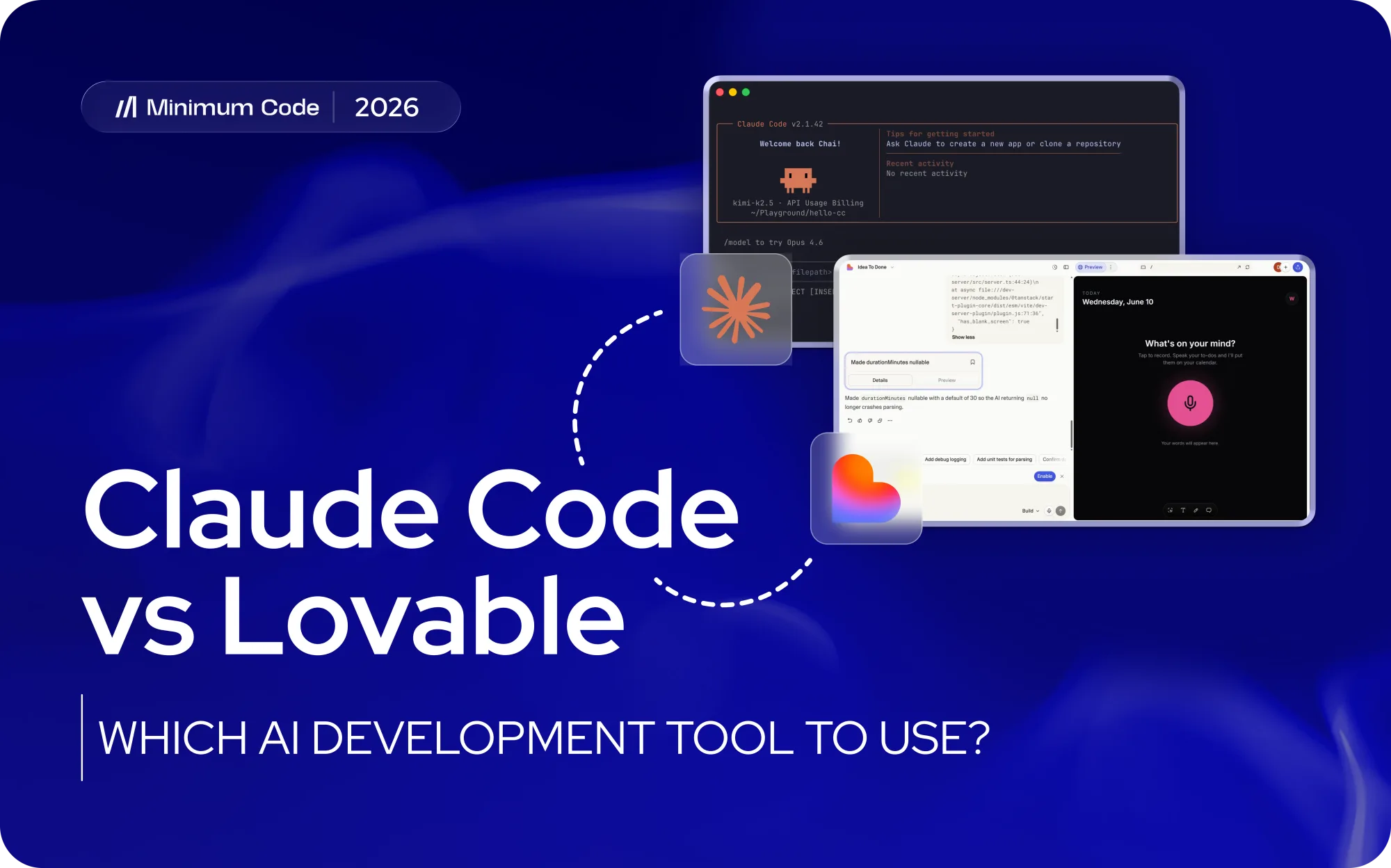
The Lovable vs Claude Code comparison looks close only from a distance. Like most attempted versus, sometimes people miss the point. Not everything can be compared 1:1 but we’ll do the trick.
When it comes to these titans, both products can turn plain-language instructions into working code, yet they serve different users and different moments in product development.
Lovable gives founders a guided browser workspace for creating and publishing web applications. Claude Code gives engineers an agent that works directly with repositories, development tools and technical constraints.
The founder-level answer is practical. Choose Lovable when the immediate goal is to make an idea tangible, explore a user journey or launch a focused web product through a highly accessible interface. Choose Claude Code when an engineer needs deeper control over architecture, testing, integrations and an existing codebase. Our software development approach can use rapid product creation and agentic engineering within the same project, with the workflow changing as the software takes on more responsibility.
Key takeaways
Lovable and Claude Code can both accelerate software creation, but they solve different delivery problems. These are the conclusions founders should carry into a tool decision.
Lovable offers the faster and more accessible route from a written idea to a working web application.
- Claude Code offers engineers deeper repository access, technical control and flexibility across complex software work.
- Lovable is well suited to product exploration, internal tools, prototypes and focused early releases.
- Claude Code is better aligned with existing codebases, advanced integrations, refactoring, debugging and production engineering.
- Lovable includes a visual preview, publishing workflow, backend options and browser-based collaboration in one product.
- Claude Code works with the development environment, commands, tests and version history already used by an engineering team.
- Lovable can sync code with GitHub, which creates a practical handover path when a project needs deeper engineering.
- Both tools still require deliberate security decisions, especially around authentication, permissions, private data and external services.
- Some teams will use Lovable for fast validation and Claude Code for the engineering work needed to strengthen and extend the resulting product.
What are Lovable and Claude Code in 2026
Lovable and Claude Code both belong to the wider shift from code suggestions toward agents that can complete multi-step implementation work. The similarity ends at the interface. Lovable starts with the product someone wants to see and use. Claude Code starts with the codebase an engineer needs to understand and change.
Lovable makes web app creation accessible from the browser
Lovable is a full-stack AI development platform for web applications. A user describes a product, and the platform generates the interface and application logic inside a browser workspace. The live preview makes progress visible immediately. Visual editing supports targeted interface changes without spending another full prompt on every colour, spacing or content adjustment.
The platform also covers important infrastructure around the build. Projects can use Lovable Cloud or connect to Supabase for backend capabilities, authentication and data. Integrations add external services. Publishing, domains and collaboration sit close to the creation workflow. Code can sync with GitHub, giving the team a version-controlled repository and a route into local development or alternative deployment.
Lovable is focused on web applications, including responsive experiences that work well on phones. Teams requiring fully native mobile software need a different build path.
Claude Code works from the repository outward
Claude Code is an agentic coding environment built around software engineering work. It can inspect a repository, trace how components relate, edit files, run commands, execute tests, diagnose failures and revise an implementation. The terminal remains central, with IDE, web and desktop surfaces supporting different working preferences.
Its configuration model is designed for technical teams. Project instructions preserve conventions. Permissions determine which tools and commands the agent may use. Hooks can trigger checks around agent actions. Specialised subagents can take focused roles, while Model Context Protocol connections bring external systems into the workflow.
That makes Claude Code powerful inside a mature delivery process. The operator still needs to understand the repository, choose acceptable trade-offs and review the result. Claude Code expands engineering capacity, while the engineer remains accountable for what enters the product.
Lovable vs Claude Code at a glance
The clearest comparison follows the work each product is designed to make easier. Lovable compresses the path between product intent and a usable web application. Claude Code compresses the path between an engineering task and a reviewable code change.
Tool Comparison
Feature | Lovable | Claude Code |
|---|---|---|
Core User | Founders, product teams and mixed-skill builders | Developers and technically led product teams |
Starting Point | A product description and visual result | A repository, engineering task and development environment |
Interface | Browser chat, live preview and visual editing | Terminal, IDE, web and desktop engineering workflows |
Technical Control | Guided full-stack web application environment | Direct repository, command, test and infrastructure access |
Best Fit | Concepts, internal tools and focused early web products | Existing systems, complex features and continued production development |
Main Strength | Short path from product intent to something usable | Deep implementation control and repository-wide reasoning |
Main Caution | Complexity can exceed what a non-technical operator can verify | Effective use depends on engineering skill and active review |
The table describes their default strengths rather than hard limits. Lovable has become more capable in professional engineering workflows, and Claude Code can contribute to early product creation. The difference is the level at which each product gives the user control.
Lovable and Claude Code pros and cons
The benefits become meaningful only when they match the operator's skills and the product's current risk. A fast workflow that nobody can maintain becomes expensive later, while a deeply technical workflow can slow learning when the idea is still unclear.
Lovable pros: Fast browser-based setup, immediate visual feedback, accessible product iteration, integrated publishing and a practical GitHub handover path.
- Lovable cons: Complex logic and debugging can outgrow the guided interface, native mobile apps are outside its scope, and production quality still depends on informed architecture and security decisions.
- Claude Code pros: Deep repository understanding, direct access to development tools, flexible configuration, strong support for testing and debugging, and broad freedom over the technology stack.
- Claude Code cons: Effective use assumes engineering knowledge, environment setup and active review; a non-technical founder can struggle to judge invisible code and infrastructure decisions.
Where Lovable has the stronger workflow
Lovable is strongest when seeing and testing the product quickly creates more value than exercising detailed control over every implementation decision. Its interface keeps product thinking close to a working result, which is useful during uncertain early stages.
The first usable version appears quickly
A founder can move from a written concept to screens, interactions and basic data flows in a single environment. That short loop encourages experimentation. Weak ideas become visible earlier, and promising ideas can be shown to customers or colleagues before the team commits to a larger build.
The speed also improves communication. A working flow exposes missing states, unclear labels and awkward steps that remain abstract in a requirements document. Stakeholders can react to behaviour instead of debating what a paragraph might mean.
The broader market now includes several products built around this experience. Our review of current AI app builders explains how these platforms differ in technical control, deployment and long-term suitability.
Visual feedback helps founders shape the interface
Lovable keeps the running application beside the conversation. The user can ask for a change, inspect the outcome and refine it immediately. Visual Edits make small presentation changes more direct, helping founders polish a layout without describing every adjustment in technical language.
This matters when the product is still becoming clear. A founder often knows that a workflow feels wrong before they can explain which component or state needs changing. A visible canvas makes that judgment useful inside the build process.
Integrated infrastructure removes early setup work
New software usually needs more than interface code. It needs a backend, authentication, data storage, deployment and a way to connect external services. Lovable brings those decisions into one guided workflow, reducing the setup burden for a small team.
Convenience still creates responsibility. The team needs to understand what data is stored, who can access it and how third-party services behave when they fail. Integrated infrastructure helps a product get moving, but it also makes architectural choices easy to accept without examining their long-term effect.
Where Claude Code has the stronger workflow
Claude Code becomes more valuable as the engineering context expands. Existing repositories, custom business rules, multiple services and strict release requirements all reward an agent that can work directly with the complete development environment.
Existing codebases need investigation before implementation
A mature application contains decisions that are absent from a new prompt. Authentication conventions, database patterns, shared components, deployment rules and historical workarounds all influence a safe change. Claude Code can search across the repository, trace related files and use the project's own tools to test its assumptions.
That investigative ability makes it useful for debugging and refactoring. The agent can follow an error through several layers, propose a plan and verify the change against existing tests. An experienced engineer can redirect the work as new context appears.
This is the working model behind agentic engineering for production software: AI completes defined implementation work inside a system of architecture, review, testing and accountable ownership.
Technical teams can define tighter guardrails
Claude Code exposes permissions and configuration at the level engineers expect. Teams can define reusable instructions, restrict commands, connect tools and use hooks to support checks. The agent works inside the repository's conventions rather than treating each request as an isolated build.
These controls improve consistency across repeated work. They can ensure that important commands run, prohibited actions stay blocked and project-specific standards remain available across sessions. Their value depends on careful setup and maintenance. Weak rules can automate weak habits just as efficiently as strong ones automate a disciplined process.
Testing and debugging stay close to the code change
Claude Code can run the same test suites, linters, build tools and development commands used by the team. When a check fails, the agent can inspect the evidence and revise its work. This creates a tighter connection between implementation and verification.
Test output is evidence, but it is rarely complete proof. A passing suite may miss a permission error, an unexpected user journey or a production-only integration problem. Human review and realistic product testing remain part of release quality.
Which tool fits each product stage
Product stage changes the value of speed and the cost of mistakes. An idea under exploration benefits from a short path to feedback. A product supporting customers and revenue needs predictable change, protected data and a clear recovery path.
Concept and early validation
Lovable is usually the stronger choice when the central question is whether the product idea makes sense. A founder can create a credible workflow, gather reactions and revise the experience without assembling a full engineering environment first.
The output should be treated according to its purpose. A clickable internal concept carries little operational risk. A public product with accounts and personal information carries far more. The transition between those states should trigger a technical review rather than another round of interface polish.
MVP approaching launch
Either product can contribute at this stage. Lovable may continue to be appropriate for a focused web application with conventional requirements and a team that understands the generated system. Claude Code becomes attractive when developers need to strengthen architecture, expand testing or implement behaviour that requires closer repository control.
The real decision is the delivery process around the tool. The MVP development process shows why scope, implementation and launch preparation need to remain connected. Agent speed helps only when the team knows what the first release must prove.
Live product and continued development
Claude Code usually has the stronger fit once the product has an established repository and a continuing roadmap. Engineers can work with the full system, manage changes through branches and review diffs before release. The workflow scales to maintenance, incidents and cross-cutting technical work.
Lovable can still support a live web product, especially when the architecture remains within its strengths and the team maintains technical visibility through GitHub. The threshold for experienced oversight rises as the product handles more users, data and business-critical workflows.
Cost and ownership comparison
The purchase price tells only a small part of the cost story. Lovable packages creation, preview and deployment into a credit-based platform experience. Claude Code usage sits inside a developer workflow and may be covered through a subscription or API-based arrangement. Plans and limits change frequently, so founders should model the complete cost of reaching a releasable result.
Lovable can lower the cost of learning
Lovable can make early product learning cheaper because a founder can create and revise a credible application before funding a full development team. That is valuable when the main risk is market uncertainty. Money saved on a premature build can be used for customer research and iteration.
Costs rise when the project needs repeated prompting, specialist debugging or a later reconstruction of fragile areas. A fast first version remains economical when it produces evidence and leaves a clear path forward. It becomes expensive when the company keeps extending a foundation that nobody can confidently explain.
Claude Code can lower engineering effort
Claude Code can reduce time spent navigating code, drafting implementations, creating tests and diagnosing failures. The economic benefit appears when an engineer can review the output faster than they could have produced the complete change manually.
Senior involvement remains a real cost and a source of value. The engineer decides what belongs in the system, catches hidden risk and protects future maintainability. Our software development statistics show why AI-supported speed moves more pressure into review, QA, security and technical ownership.
Code ownership needs an operating plan
Lovable states that creators own the generated projects and code, and GitHub sync supports external development. Claude Code works directly with repositories controlled by the team. In both cases, practical ownership requires access, documentation, deployment credentials and enough technical understanding for another qualified developer to continue.
A repository alone does not guarantee independence. The company also needs to know how the system is built, where its data lives, which services it depends on and how a release reaches production.
Which platform gives you better security control
Both platforms offer meaningful security capabilities, but they expose control at different levels. Lovable guides builders toward safer application patterns and provides built-in scanning. Claude Code gives engineers the freedom to implement security within the application's complete architecture and infrastructure.
Lovable includes useful security checks
Lovable scans for exposed API keys, database access weaknesses, code vulnerabilities and risky dependencies. It can review row-level security rules and highlight critical findings before publication. Secrets can be stored server-side instead of being placed in browser code.
These protections reduce common mistakes. Lovable's own documentation also makes the boundary clear: automated checks do not replace a thorough security review for sensitive or critical applications. The product owner remains responsible for the actual security requirements.
Claude Code gives experts more ways to enforce policy
Claude Code can work with security tools, repository checks, infrastructure definitions and organisation-specific standards. Permissions can limit agent actions, while human approval can remain attached to sensitive commands and deployments. An engineering team can evaluate the complete path from interface to database and production infrastructure.
That flexibility creates a larger configuration surface. Broad permissions, weak instructions or unreviewed changes can create risk quickly. The safest workflow starts with minimal access, isolates development work and requires evidence before release.
For founders, the decision should follow the data and operations the product carries. A public marketing utility and a multi-tenant application holding financial records need very different levels of assurance.
Our AI coding development service applies this level of engineering review when teams need to move from generated code to a reliable production workflow.
Can you use Lovable and Claude Code together?
This is where differences become compatible and effective. The short answer is yes. The combination can work well when each product has a defined role and GitHub provides the handover point. Lovable can accelerate product discovery and initial implementation. Claude Code can help an engineer inspect, test, refactor and extend the repository when the requirements become more demanding.
A sensible handover starts with an audit
Connecting the Lovable project to GitHub gives a technical team access to the generated code and version history. Before adding major features, the team should assess architecture, authentication, database access, dependencies, testing and deployment. The goal is to decide what can continue, what needs reinforcement and what would become expensive if left untouched.
The audit may conclude that most of the project is sound. It may also find that a few critical areas need rebuilding. A grounded decision protects useful work without treating every generated file as equally valuable.
Keep one source of truth
Two capable creation environments can cause confusion if the team edits the same areas without a branching and review strategy. The repository should remain the authoritative codebase, with clear ownership of changes and a controlled merge process.
This is where a development partner can help. The guide to outsourcing software development explains how founders can retain product ownership while bringing in the technical capacity needed to turn an early build into dependable software.
How should founders choose their match
Choose according to the next business decision the product needs to support. A tool trial should use a representative feature, realistic data rules and the level of quality expected after launch. Toy applications make every platform look easier than the project will feel three months later.
Choose Lovable when speed of learning is the priority
Lovable is a strong fit when you need to make an idea visible, test a user flow, build a lightweight internal tool or create a focused web application without assembling a conventional development environment. It also works well when visual feedback will improve the product brief.
Before publishing, decide who will verify authentication, permissions, data handling and operational behaviour. The answer can be an experienced internal person or an external specialist. The role should be explicit.
Choose Claude Code when engineering depth is the priority
Claude Code is a strong fit when a developer will operate the tool, the product already has a repository or the work demands advanced technical control. It suits continued feature development, debugging, refactoring, migrations and integrations that cross several parts of the system.
The agent should receive clear acceptance criteria, repository instructions and permission boundaries. Every material change should pass tests and human review before it reaches production.
Choose both when the transition is planned
A planned Lovable-to-Claude Code workflow can connect fast validation with deeper engineering. The company should define the transition point early, such as the arrival of real user data, payments, complex permissions or a continuing development roadmap.
The custom software development guide provides a useful frame for that transition because it treats architecture, release quality and maintenance as parts of a business asset rather than technical extras.
FAQs - Frequently asked questions
These answers focus on the practical differences most likely to affect a founder's budget, delivery plan and ownership after launch.
Is Lovable better than Claude Code for non-technical founders?
Lovable is generally more accessible because it provides a browser workspace, live preview, visual editing and integrated publishing. Claude Code exposes a deeper engineering environment and is most effective when operated by someone who can evaluate code, commands, tests and infrastructure.
Can Lovable build a production application?
Yes, Lovable can build and publish production web applications. Readiness depends on the product's architecture, permissions, data sensitivity, integrations, testing and operational requirements. Higher-risk applications deserve an independent technical and security review before launch.
Can Claude Code build an app from scratch?
Yes. Claude Code can scaffold and implement new applications, but it expects a development environment and gives the operator responsibility for technical choices. Lovable provides a more guided route for founders who want immediate visual feedback and integrated infrastructure.
Does Lovable let you export the code?
Lovable supports two-way GitHub sync. Teams can clone the repository, work locally and deploy through other platforms. A stable GitHub connection and a clear source-of-truth policy are important if several tools or developers will edit the project.
Which tool is safer?
Lovable provides guided security checks and common protections inside its platform. Claude Code gives an experienced team broader control over security tooling and architecture. The safer result comes from appropriate permissions, skilled review and testing against the product's real risk.
Should a founder start with Lovable and move to Claude Code later?
That can be a sensible route when Lovable is used to validate the product and the repository is reviewed before deeper engineering begins. The transition should happen before fragile assumptions become embedded across a live product with valuable data or complex operations.
The verdict for founders
In the 2026 Lovable vs Claude Code comparison, Lovable is the stronger choice for accessible web app creation and rapid product learning. Claude Code is the stronger choice for engineer-led development, existing repositories and software that needs deeper technical control.
A planned combination can preserve early speed while adding the engineering discipline required for continued growth.
If you need to decide which workflow fits your product, or you already have a Lovable build that needs a production-readiness review, talk to Minimum Code. We will give you a clear view of what can stay, what needs strengthening and the safest route to launch.

Written by Tom
Founder and Lead Developer

Ready to start your project?
Book a free discovery call to learn how we can build your app in 4 weeks, or less.
Book a call