
In technical due diligence on a Bubble app, investors and acquirers check whether the company can prove it owns the app, can keep running it without one vendor or one person, and can show the data and access are under control. A Bubble app doesn’t fail diligence by being on Bubble. It fails when the paperwork, access and evidence are missing, and in some cases the buyer will price in a planned migration.
Key takeaways
- Diligence on a Bubble app is mostly about proof: who owns the logic, who has admin access, and where the data sits.
- Platform dependency is the finding that comes up most with no-code. It’s a risk to price, not an automatic deal-breaker.
- Findings turn into three things: escrow, a price adjustment, or a condition you fix before closing.
- Most of the 90 days before diligence should go on documentation, access clean-up and security evidence, not a rebuild.
- A full migration in 90 days is realistic only for a small, well-understood app. For anything bigger, a signed plan is the better target.
What is technical due diligence, and what does it check on a Bubble app?
Technical due diligence (tech due diligence, or software due diligence) is the buyer's or investor's review of the technology behind a company before a deal. On a Bubble app it looks at eight things: code and IP ownership, platform dependency, security and data residency, scalability evidence, release and rollback process, test coverage, documentation and key person risk. Buyers rarely work through a list item by item. Advisers describe the process as organising hundreds of requests around the decisions the buyer has to make: what it will own, what it must keep paying for, and what could go wrong.
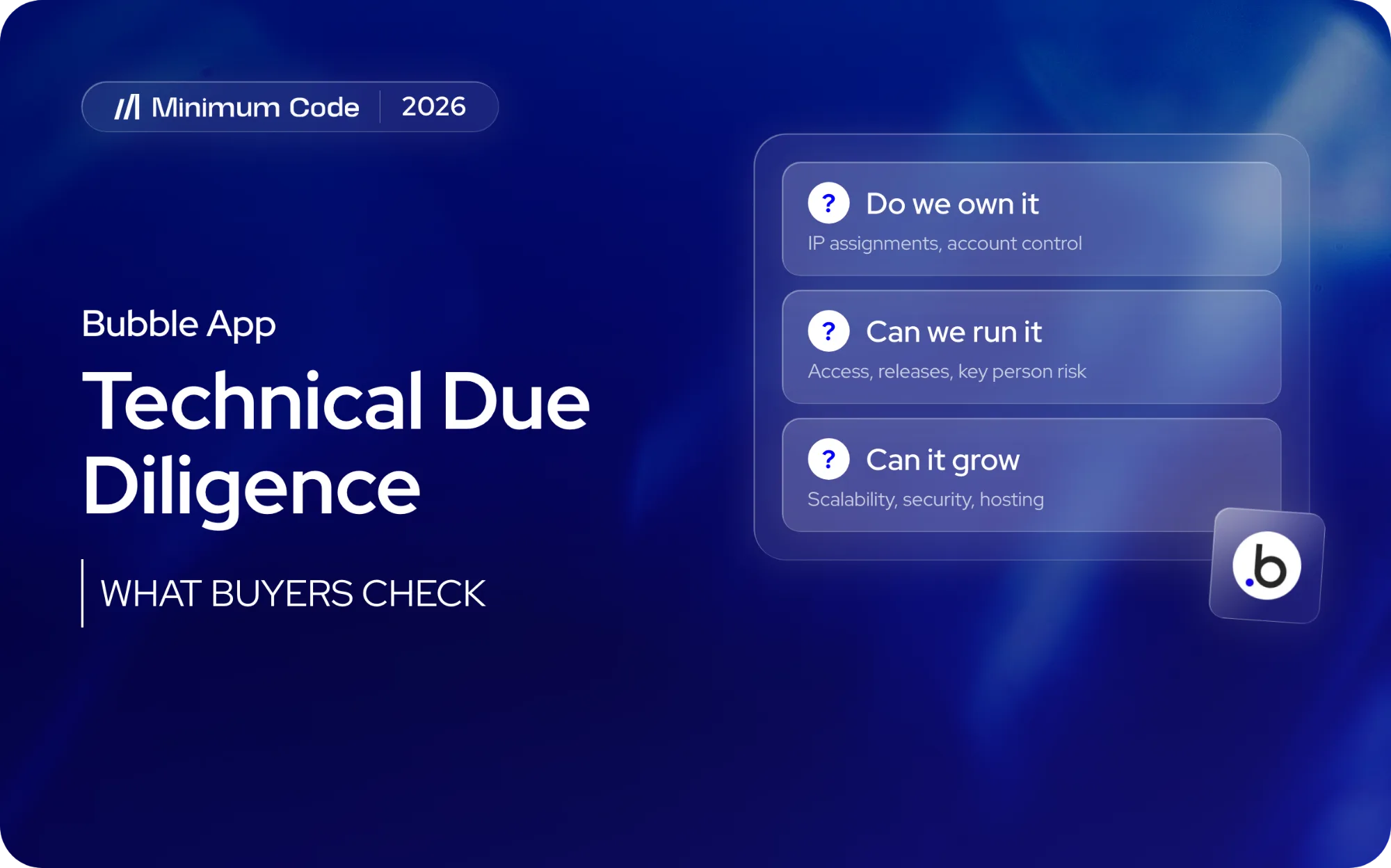
For a founder, that framing helps. Every question in the data room is really asking one of three things. Do we own this? Can we run it? Can it grow? The sections below take each area in turn and say what a reasonable reviewer wants to see.
Who owns the code and IP of a Bubble app?
You own the app’s logic and design only if you can prove it, and on Bubble the proof is a paper trail plus clean account control. Diligence teams ask for evidence of work-made-for-hire or assignment agreements for every contributor, plus proof that no agency or former developer keeps administrative access or rights.
That’s the weak point for apps built by a previous agency or freelancer. A few things to check now:
- Contracts. Do you hold signed IP assignments from every agency, freelancer and employee who built or edited the app? A verbal arrangement won’t pass.
- Account ownership. Is the Bubble app under a company account you control, or under a developer’s personal login?
- Collaborators. List everyone with editor access. Remove anyone who no longer needs it.
- Third-party components. Plugins, API connectors and paid templates each come with their own licence terms. Keep an inventory.
IP reviewers describe the goal as testing whether a company can prove it owns, controls and can transfer the software being sold. Be precise about one point: on Bubble, you own what you built, but the runtime that executes it belongs to the platform. That leads to the next question.
Is platform dependency on Bubble a red flag?
It’s a risk the buyer will note, but not a red flag by itself. Technology advisers point out that no-code platforms sit on top of third-party tools, which creates a specific risk that conventional code doesn’t carry in the same way. The question isn’t whether you depend on Bubble. It’s whether you can show what happens if Bubble’s pricing, terms or availability change.
The same advisers describe a common buyer plan: keep operating the app while carrying out a planned move to a portable codebase. If that is the likely plan, your job is to make it cheap and low-risk for them. That means:
- A data model you can export and describe, with an up-to-date schema diagram.
- A list of every Bubble-specific feature the app relies on (workflows, privacy rules, backend workflows, plugins).
- A current view of your Bubble plan, usage and cost trend.
- A written migration approach, even a short one, that shows you’ve thought about exit from the platform.
Don’t hide the dependency. A founder who has already mapped it looks organised. A founder who hasn’t looks surprised by their own product.
How is security and data residency assessed?
Reviewers check access control, privacy rules, evidence of testing, an incident response plan, and where personal data is stored and processed. Bubble runs the infrastructure, but the configuration of your app, including who can see which data, is yours.
Security-minded acquirers often measure against frameworks such as the NIST Secure Software Development Framework. You aren’t expected to certify against it, but you should be able to show comparable habits: defined security requirements, protected code and data, and a way to respond to vulnerabilities.
What to have ready:
- Documented privacy rules for every data type, and a test showing that one user can’t read another user’s records.
- A recent penetration test report, or at least a dated internal review with fixes logged.
- An incident response plan, even one page, with named owners.
- A list of all third-party services that touch personal data.
Data residency and GDPR
Bubble’s own guidance says you don’t necessarily need an EU server to be GDPR compliant, but transfers of EU residents’ personal data outside the EU must follow the rules, and Bubble includes Standard Contractual Clauses in its DPAs. For most apps, that’s enough. EU hosting on Bubble is only available on the Enterprise plan, so check whether you’re on it before a buyer asks.
Healthcare, fintech and defence buyers usually insist on EU hosting. If you sell into those sectors, expect the question to be a gating item rather than a footnote.
If your app has had no formal security review, start with our guide to Bubble privacy rules, which covers the mistakes that leak data and how to test them.
What counts as scalability evidence?
Measured data beats claims. A buyer wants to see current user and record counts, peak load behaviour, response times on your slowest screens and the cost of running at that scale. Pull these from your own monitoring: record counts per main data type, peak concurrent users, and the month-by-month platform bill.
Then add a growth case. If the acquirer plans to double your users, can the app take it, and at what cost? Bubble apps can scale a long way when they’re built well, so don’t assume the answer is no. But workload cost and heavy searches on large tables are the usual pressure points, and a reviewer will probe them. If you already know where the app strains, say so and show the fix you’d make. That’s more convincing than a clean claim that falls apart under a load test.
How do reviewers judge release, rollback, tests and documentation?
They want to see that changes are controlled, reversible and understood. These four areas are where no-code apps most often show gaps, mostly because nobody was asked for them earlier.
Area | What a reviewer asks | What good evidence looks like |
|---|---|---|
Release process | How does a change reach live users? | Separate development and live versions, a written release checklist, a change log |
Rollback | Can you undo a bad release quickly? | Saved versions, a tested restore step, a record of past rollbacks |
Test coverage | What proves the main flows work? | A test plan for sign-up, payment, permissions and key workflows, run before each release |
Documentation | Could a new engineer understand it? | Data model diagram, workflow map, plugin list, environment and access notes |
Bubble has no unit-test culture like a typical code repository, so don’t expect to match one. What buyers accept is a manual or automated test plan that is actually run and recorded. A dated record of last month’s release is worth more than a policy nobody follows.
What is key person risk, and how do you reduce it?
Key person risk is the chance that the app can’t be run or changed without one individual, often the founder or the one freelancer who built it. Advisers describe diligence as an audit of whether the business can survive without its founders or current vendors, and that applies in full to a Bubble app.
You reduce it by moving knowledge out of heads and into documents, and by sharing access properly. Two people should be able to deploy, restore and rotate credentials. Credentials should sit in a password manager owned by the company. If the only person who understands the backend workflows is a contractor on a rolling month, that’s the first thing to fix, and it’s often cheaper than founders expect.
How do diligence findings turn into deal terms?
Findings usually become one of three outcomes: a condition to fix before closing, a price adjustment, or a holdback or escrow arrangement. Common remediation conditions include signing missing assignment agreements, setting up source code escrow where it applies, and holding back part of the purchase price to pay for migration or security work.
Finding | Typical outcome | What helps you |
|---|---|---|
Missing IP assignment from a former agency | Remediation condition: get the signed assignment before closing | Contact the agency early, offer a standard assignment |
Heavy Bubble dependency, no exit plan | Price adjustment or holdback to fund migration | A costed migration plan and quotes |
Weak privacy rules or no pen test | Condition to fix and retest, sometimes a holdback | A recent test report with fixes logged |
Hosting outside required region | Condition, or price adjustment if the move is large | Written assessment of Enterprise hosting or a coded stack |
One person holds all knowledge | Retention terms for that person, or a handover period | Documentation and a second trained person |
The size of any holdback or adjustment depends on the deal and the parties, so get a figure from your own adviser or lawyer rather than assuming one. We’re engineers, not deal lawyers. Ask your corporate solicitor how escrow and warranties would be drafted in your transaction.
What we see from the engineering side
We started on Bubble in 2022 and we’re still a Bubble Gold agency, so we’re not here to tell you Bubble is a problem. Simple all-in-one tools and prototypes often should stay where they are. The founders who move to code usually do it for four reasons: development speed, SEO needs, owning the code and choosing where it’s hosted.
In diligence, the useful question isn’t “Bubble or code?”. It’s “Can a stranger understand, run and, if needed, move this app within a reasonable time?” A well-documented Bubble app with clean ownership passes that test better than a coded app with no tests, no handover notes and one developer who has left. Our experience is also that most migration time goes on planning and testing, not building, which is why a rushed migration just before a deal tends to create new findings instead of fixing old ones.
Should you migrate before diligence starts?
Only if the app is small and well understood, or if a specific finding makes staying on Bubble a deal problem. Otherwise a documented plan and a clean data room usually serve you better than a half-finished move in the middle of a deal.
The reasoning is practical. A migration changes the thing the buyer is inspecting. If it lands mid-process, the reviewer has to assess two systems, and any bug in the new one becomes a fresh finding. Migrate before diligence if:
- Your buyers or customers require EU hosting and Enterprise hosting isn’t an option.
- Your SEO needs have outgrown what the app can do.
- The app is simple enough that the plan, build and testing fit comfortably inside the window. Get a scoped estimate first; we won’t quote a duration without seeing the app.
If you do move, keep the old app live until the new one is proven. Our Bubble migration guide walks through how to avoid losing momentum, and the Next.js migration guide covers the technical path.
Technical due diligence checklist: what to fix in the 90 days before
Spend the first month on ownership and access, the second on security and evidence, and the third on documentation and the migration plan. That order puts the findings that can stop a deal at the front.
- Days 1 to 30: ownership and access. Collect signed IP assignments. Move the app to a company-owned account. Remove old collaborators. Put credentials in a company password manager.
- Days 31 to 60: security and evidence. Review privacy rules for every data type. Commission or complete a penetration test. Write the incident response plan. Confirm your hosting region and DPA position against what your buyers expect.
- Days 61 to 90: documentation and exit plan. Produce the data model diagram, workflow map and plugin inventory. Record a release and rollback checklist and run it once. Gather scalability numbers from your own monitoring. Write a short, costed plan for leaving Bubble, whether or not you’ll act on it.
Train a second person on deployment and restore during the same period, so that key person risk is already reduced when questions start.
How Minimum Code handles this
We migrate live Bubble apps to code the client owns, using Next.js, Supabase, Vercel and TypeScript. Our software engineers own architecture, code review and testing, while AI coding tools handle implementation. Engagements are fixed price and fixed scope, with no downtime during the switch and 60 days of free support after launch. Our entity is in Vienna, so EU hosting and GDPR are our default setup.
If you need a view on whether to move or stay, start with our Bubble to code migration service; technical debt in Bubble explains how we tell build problems from platform limits, and the code audit checklist shows what an audit covers. If you’re modernising an older codebase after an acquisition or ownership change, see our legacy app modernisation work.
When this isn’t right for you
Migrating for diligence is the wrong move in several cases:
- Your app is a simple all-in-one tool or prototype. Bubble suits it, and a migration adds cost without adding value.
- The deal timeline is under a few months and the app is complex. A rushed move risks new bugs and new findings. Document, then plan.
- Your ownership paperwork is the real problem. Code won’t fix a missing assignment from a former agency. Sort the contracts first.
- You’re only after advice. We work on fixed-scope engagements, so if you want a legal or valuation opinion, your lawyer and corporate finance adviser are the right people.
- Your buyer wants to keep the app on Bubble. Some acquirers prefer to operate it as is. Ask what they plan before spending money.
FAQ
What is on a technical due diligence checklist?
Code and IP ownership, platform and vendor dependency, security and data residency, scalability evidence, release and rollback process, test coverage, documentation and key person risk. For a Bubble app, add the account ownership, collaborator list and plugin inventory.
Will being on Bubble lower my valuation?
Not automatically. Buyers price the risk they can see, such as unclear ownership, no exit plan or weak security. A documented, well-run Bubble app with proof of ownership gives them little to discount. Any specific valuation effect depends on your own deal.
Do I need EU hosting for diligence?
Only if your sector or your buyer requires it. For most apps, Bubble’s DPA with Standard Contractual Clauses keeps US hosting within GDPR. Healthcare, fintech and defence buyers usually expect EU hosting, which on Bubble means the Enterprise plan.
Can a buyer ask for source code escrow on a Bubble app?
They can ask for escrow where it applies, and it’s one of the common remediation conditions in software deals. With Bubble, the practical question is what could be deposited and run. Take legal advice on how it would be drafted.
What if a previous agency built my app and I have no contract?
Contact them now and ask for a written IP assignment. This is the most common ownership gap and it can hold up a closing. If they won’t sign, tell your solicitor early, because the buyer will find it.
How long does a migration off Bubble take?
It depends on the size and complexity of the app, and most of the time goes into planning and testing rather than building. We scope each app before giving a timeline. For the 90-day window, a small app may fit, while larger ones are better served by a plan.
Do I need a penetration test before diligence?
It isn’t legally required, but security-conscious buyers expect evidence of testing, and a dated report with fixes logged answers many questions at once. If you can’t afford a full test, a documented internal review is better than nothing.
Sources
- Software Acquisition Agreement: Due Diligence for Multi-Million Dollar Deals, Contractable
- Technology Due Diligence: Evaluating No-Code / Low-Code Platforms in M&A, VeryDiligent
- Software IP Due Diligence: Ownership Risk, FoundationState
- Exit Readiness from Day One, Matchpoint Partners
- Secure Software Development, Security, and Operations (DevSecOps) Practices, NIST
- GDPR, Bubble Manual

Written by Tom
Founder and Lead Developer

Ready to start your project?
Book a free discovery call to learn how we can build your app in 4 weeks, or less.
Book a call