

Usually it’s technical debt, and only sometimes a platform ceiling. Debt that comes from a poorly built app or a wrong data design will follow you into code if you migrate without fixing it. Only a genuine ceiling, something Bubble can’t do however well you build, justifies a migration on its own.
TL;DR
- Three different problems get called “technical debt”: implementation debt (a weak build), product-model debt (the wrong data design) and a platform ceiling (a limit of Bubble itself).
- Implementation debt is fixed by cleaning up the app. Product-model debt is fixed by redesigning the data, on Bubble or in code.
- Only a platform ceiling justifies migrating by itself. The other two follow you into a new codebase if you leave them alone.
- The usual real ceilings are SEO control, code ownership and hosting choice, plus development speed for some teams.
- Some apps should stay on Bubble. We say so when it’s true.
What does technical debt actually mean for a Bubble app?
Technical debt is the cost of work you deferred: shortcuts that were sensible when you took them and now make every change slower. A systematic mapping study of the research describes it as technical compromises that give a short-term benefit but can hurt a system’s long-term health. The same literature stresses that not all debt is careless. Taking on debt to reach the market quickly can be a sound decision, as long as someone schedules the repayment.
That’s the trap with the word. When a founder says “we have tech debt on Bubble”, they might mean three quite different things, and each has a different fix and a different cost. If you lump them together, you’ll either pay for a migration you didn’t need or pay for a clean-up that can’t solve your actual problem.
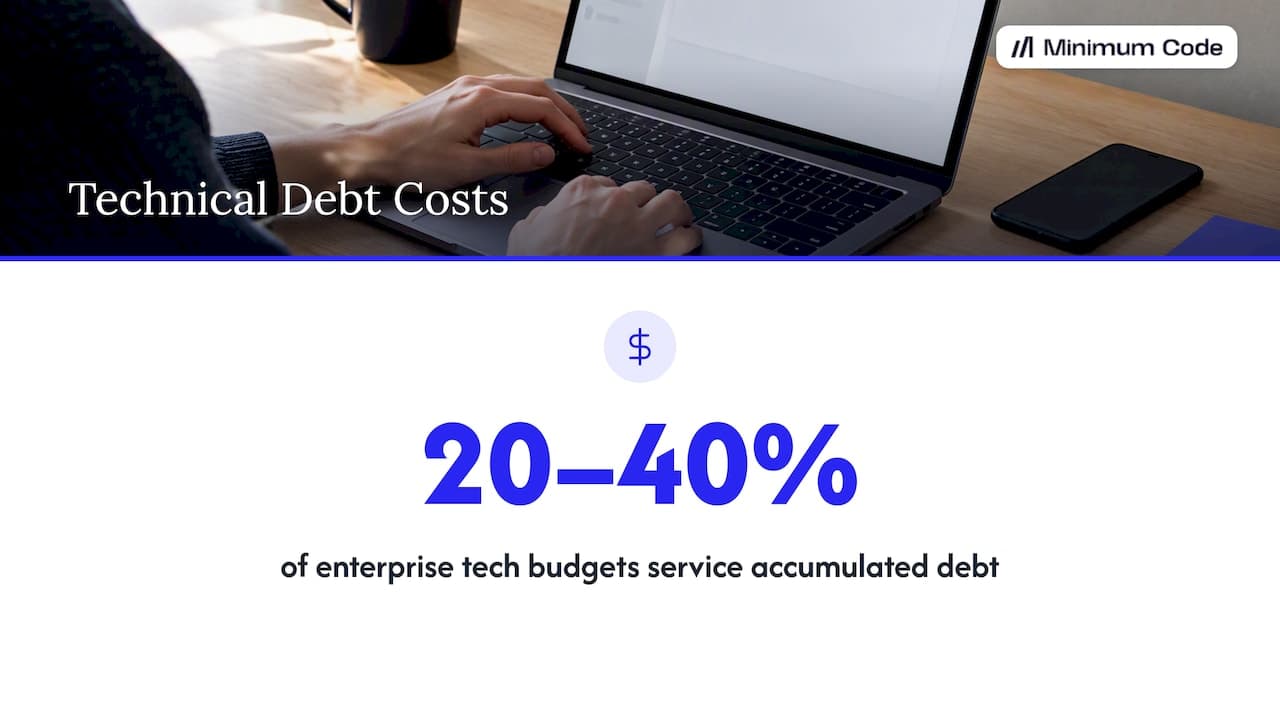
The cost of ignoring it is measurable. A 2026 cost-benefit study of enterprise systems reports that organisations often spend 20 to 40 per cent of their technology budgets servicing accumulated debt. It also links a higher debt-to-code ratio to slower delivery and more defects. These are enterprise figures, so treat them as direction, not a forecast for a ten-person company. But the pattern is familiar to anyone running a live app: the same feature takes longer each quarter.
What are the three kinds of Bubble problem?
The three kinds are implementation debt, product-model debt and a platform ceiling. They look alike from the outside (slow pages, bugs, cost creep, stalled releases), so the symptoms don’t tell you which one you have. The questions below do.
Implementation debt | Product-model debt | Platform ceiling | |
|---|---|---|---|
What it is | The app is built badly | The data and rules don’t match the business | Bubble can’t do what you need |
Typical cause | Rushed build, many hands, no conventions | Early assumptions that stopped being true | Platform design, plan limits, hosting |
Fix on Bubble | Refactor and tidy | Redesign data, migrate records | None, or only at Enterprise level |
Fixed by migrating alone? | No, it’s copied across | No, it’s rebuilt as is | Yes |
Follows you into code? | Yes, as messy code | Yes, as a messy schema | No |
The rest of this article takes each in turn.
How do you know if it’s implementation debt?
Implementation debt means the platform is fine and the build isn’t. Answer these four questions honestly, ideally with whoever maintains the app.
- Does the slowness sit on specific pages or actions, rather than everywhere? If a few screens are slow and the rest are fine, the cause is almost always how those screens query data: heavy searches, nested filters, loading whole lists to show five rows. That’s a build problem. Our own piece on measuring Bubble performance before you fix it goes through how to find the culprit first.
- Do you have duplicated workflows, unnamed elements or dozens of unused pages and fields? Clutter means nobody can safely change anything. It implies a clean-up and conventions, not a new platform.
- Does a small change break something unrelated? This suggests logic copied in several places instead of held in one. It’s fixable by consolidating, and it’s the same behaviour you’d get in a badly structured codebase.
- Did several freelancers or agencies build it, with no handover documentation? Missing documentation is a form of debt in its own right. A retrospective study of 132 maintenance tasks found documentation debt added around 47 per cent extra maintenance effort relative to the estimated project time. It’s older research on agile projects, but the mechanism is the same on any platform.
If you answered yes to most of these, you have implementation debt. The honest advice is to audit and refactor the app. Moving it to Next.js unchanged would just give you the same tangle in a different language, only now with more files.
How do you know if it’s product-model debt?
Product-model debt is the wrong shape of data. The app works as built, but the way you store users, organisations, plans, orders or permissions no longer matches how the business operates. This is the debt we see founders miss most often, because it doesn’t feel like a bug. It feels like “everything is hard”.
Ask these questions:
- Do you keep working around the same limitation with extra fields or flags? A field called something like “is_special_case_2” means the model can’t express a real situation. The implication: the data model needs redesigning, and that’s a decision about your business, not about the tool.
- Can a user belong to more than one company, team or plan? If the honest answer is “yes, but we hacked it”, expect permission bugs and awkward reporting. Fix the relationship design before anything else.
- Do your numbers disagree between screens or exports? Duplicated data stored in two places drifts apart. It implies you need a single source of truth for each fact.
- Does adding a new customer type or pricing tier mean touching ten workflows? Rules are hard-coded in the interface instead of living in the data. That makes every commercial change a development project.
- Would you design the database differently today, knowing what you know? If yes, in detail, you’ve already diagnosed it. The question is just when to pay for it.
Product-model debt is independent of platform. You can fix it on Bubble by restructuring data types and migrating records. You can fix it during a move to code, because a rebuild is the cheapest moment to redesign a schema. But you can’t skip it: if you migrate and copy the old structure across, you’ll get the same limitations in a Postgres database.
How do you know it’s a real platform ceiling?
A platform ceiling is a requirement that Bubble can’t meet even when the app is built well and the data is sound. It’s narrower than people think. These questions test for it.
- Do you depend on organic search, and are your pages falling short? If acquisition relies on search, you need fine control over rendering, metadata and page speed. Bubble apps can rank, but if you’ve done the on-page work properly and still can’t get the control you need, that’s a ceiling. You can check what search and AI crawlers actually see with a free AI crawlability check before you decide.
- Do you need to own the application code? Bubble doesn’t export your app as runnable code. You can export your data, but the workflows, UI and privacy rules stay inside the platform. If an investor, acquirer or regulator needs you to hold the source, that’s a ceiling by definition.
- Do you need to choose where the app is hosted? EU hosting on Bubble is available on the Enterprise plan, through a dedicated instance on AWS. If you’re on a lower plan and your sector needs EU hosting, you’re blocked. This matters most in healthcare, fintech and defence.
- Is your development speed now limited by the platform? AI-assisted coding has changed this. For many teams, building in code is now as fast as Bubble or faster. If your roadmap needs custom logic, integrations or background processing that you keep fighting Bubble to do, the platform is setting your pace.
The implication of a yes is different from the other two categories. A ceiling can’t be refactored away. It’s the only one of the three where migration solves the problem by itself.
What about GDPR and EU hosting?
Most Bubble apps don’t need EU hosting to be GDPR compliant. Bubble’s documentation describes a data processing agreement that covers US hosting for most apps, and it notes that compliance is a shared responsibility between the platform and the app owner. An EU server doesn’t make an app compliant on its own, either. Regulated sectors are the exception, since healthcare and fintech buyers often require EU hosting. A coded stack handles that more easily than a Bubble front end with an external back end. If this is your trigger, speak to your data protection officer or legal adviser before you decide, because the requirement comes from your contracts and regulator, not from Bubble.
Why does only the platform ceiling justify migrating?
Because migration moves your problems unless you fix them first. Implementation debt becomes messy code. Product-model debt becomes a messy schema. You’d pay for a rebuild and still have the original slowdown, and you’d have less time to notice, because the new app feels fast for the first few months.
There’s a second reason. A migration is a fixed amount of work, and most of that work is planning and testing, not building. Spend that effort on a model you already know is wrong and you’ve paid twice. The order that makes sense is:
- Diagnose which of the three you have, using the questions above.
- Fix the model, because it’s needed on any platform.
- Clean up the implementation if you’re staying, or let the migration rewrite it if you’re going.
- Migrate only if a ceiling remains.
The reverse also holds. If you have a genuine ceiling and a clean app, delaying only makes the move bigger as your data and user count grow. Industry due diligence work from PwC UK shows how hidden architectural problems tend to surface when a system has to scale, integrate or absorb a deal. Founders preparing for investment or acquisition should expect that question.
Can you see an example from a real project?
Here’s an anonymised case from our own delivery. A founder came to us wanting to leave Bubble because the app was slow and releases kept breaking things. [Details to confirm: industry, user count, plan, timeline, outcome. [data needed]]
Our audit separated the symptoms. [data needed: share of issues that were implementation debt, such as heavy searches and duplicated workflows.] [data needed: the data-model issue found, for example a user-to-company relationship that couldn’t represent real accounts.] [data needed: whether a ceiling existed, and which one.] The client’s decision followed from that split rather than from the symptoms. [data needed: what was fixed on Bubble, what was rebuilt, and what the client decided.]
We won’t present figures here that we haven’t confirmed. For a published account of a different situation, our project write-up on consolidating four legacy platforms into one after an acquisition shows how we approach a rebuild when ownership changes.
Which Bubble apps should stay on Bubble?
Simple, all-in-one tools and prototypes often should. If the app does a defined job, a small team can maintain it, search traffic isn’t your acquisition channel and you don’t need to hold the code or pick the host, Bubble is a sensible place to stay. We’ve been on Bubble since 2022 and are still a Bubble Gold agency, so we’re not saying that to be polite.
What tends to trigger a move, in our experience:
- Development speed. Your roadmap is outrunning what the platform lets you do.
- SEO requirements. Search is a real channel and you need more control.
- Code ownership. You or an investor want the source.
- Hosting choice. Your sector or customers require a specific region or setup.
Hiring difficulty, downtime and a growing Bubble bill are real frustrations, but they’re rarely the reason on their own. If cost is your main concern, our breakdown of Bubble pricing plans shows where the bill comes from, and often a clean-up cuts it more than a rebuild would.
What should you compare before choosing a route?
There are four realistic routes. This table is a guide for the decision, not a quote.
Route | Best when | Main risk | Rough effort |
|---|---|---|---|
Stay and clean up | Implementation debt, no ceiling | Underlying model stays wrong | Smallest |
Stay and redesign the data | Product-model debt, no ceiling | Data migration mistakes | Moderate |
Migrate to code | A genuine platform ceiling | Copying old debt across | Largest, mostly planning and testing |
Rebuild from scratch | App is too tangled to preserve | Losing behaviour users rely on | Large |
We don’t publish fixed prices because they depend on app scope. For a general sense of cost ranges, see our guide to what a web app costs to build in 2026.
When this isn’t right for you
Migration to code is the wrong call in several situations:
- Your app is a prototype or an early test. Validate demand first. Rebuilding something nobody uses yet is expensive.
- Your problem is implementation debt only. A clean-up costs less and fixes the actual issue.
- You have no one to own the code afterwards. Owning code is valuable, but only if somebody maintains it, whether that’s an internal team or a partner on a maintenance arrangement.
- Your data model is still changing every month. Settle the product first. Bubble is good at rapid change.
- You’re hoping the new stack removes the need to make product decisions. It doesn’t.
If you recognise yourself here, a discovery or audit step is the better first move. We’d rather tell you that than start a migration that doesn’t fit.
How Minimum Code handles this
We start with an audit that sorts your problems into the three categories above, then give you a fixed price and fixed scope for whatever follows. Our team of software engineers works on a Next.js, Supabase, Vercel and TypeScript stack. Senior engineers own architecture, code review and testing, while AI coding tools handle implementation. Migrations run with no downtime during the switch, you own the code and choose the hosting, and we include 60 days of free support after launch. Our legal entity is in Vienna and the team works across Europe, so EU hosting and GDPR are defaults.
If you’ve confirmed a ceiling, see how we migrate Bubble apps to code. If the app is older or isn’t on Bubble at all, legacy app modernisation covers that. For a longer walkthrough of the process, read our Bubble to Next.js migration guide.
Our view: debt is a decision, not a verdict
We’ve worked on Bubble apps for years, and the pattern is consistent. Founders arrive convinced the platform is the problem, and about half the time the problem is a decision made in the first month of the build that nobody revisited. We’d rather you spent a week finding that out than a quarter migrating around it.
The research agrees with the idea that debt isn’t inherently bad. The trouble starts when nobody schedules its repayment. A Bubble app that got you to revenue in eight weeks did its job. What matters now is whether you’re paying it down.
The other thing we’d say plainly: AI coding has moved the line. Writing code is no longer the slow part of building software, so the old argument that Bubble is always faster doesn’t hold for every team. What still takes time is deciding what to build and testing that it works. That’s where a migration’s hours go, and why a clear diagnosis up front saves the most money.
— Tom
FAQ
Is technical debt the same as bad code?
No. Bad code is one source of it, but debt also covers wrong data design, missing documentation and outdated architecture. Some debt is deliberate, taken on to reach the market quickly, and that can be a reasonable trade if you plan to repay it.
Will migrating from Bubble to code remove my technical debt?
Only the part that comes from the platform. Implementation debt and product-model debt get carried across unless you fix them during the move. That’s why we diagnose first and design the new data model before building.
Can a Bubble app rank well in search?
Some do, and for many apps it’s good enough. If search is your main acquisition channel and you need tighter control over rendering and page performance, that’s one of the reasons founders move to code. Test what crawlers see before you decide.
Do I need EU hosting for my Bubble app?
Usually not for GDPR alone, since Bubble’s DPA covers US hosting for most apps. Healthcare, fintech and defence often do need it, and Bubble offers EU hosting only on the Enterprise plan. Check your contracts and regulator requirements with a legal adviser.
How long does a migration take?
It depends on the size of the app, and we won’t quote a figure without seeing it. Most of the time goes into planning and testing rather than building, which is why a proper audit comes first.
Sources
- Technical Debt Quantification and Its Impact on Software Delivery Performance (2026)
- Impacts of agile requirements documentation debt on software projects (2016)
- A systematic mapping study on technical debt and its management
- Demystifying Technical Debt for Deals, PwC UK
- GDPR, Bubble Docs
- Dedicated instance, Bubble Docs
- Bubble won’t export my code: what are my real options?
Recommended

Written by Tom
Founder and Lead Developer

Ready to start your project?
Book a free discovery call to learn how we can build your app in 4 weeks, or less.
Book a call