

Updated October 2026. For the wider picture beyond the web, see our software development statistics.
Ninety percent of technology professionals now use AI at work, and the median developer spends about two hours of the workday interacting with it, roughly a quarter of an eight hour day (DORA, Sep 2025). Among developers who use AI coding tools at all, 73% use them every day (Stack Overflow, Oct 2026). The argument about whether AI belongs in web development is over. What replaced it is a harder question: what is it actually doing to the code, the sites, and the jobs.
This page answers that with primary sources only. Every number below was traced to the organisation that produced it, fetched from the source page, and dated. No roundups, no republished figures, no statistics whose trail dead ends at somebody else's listicle. Where two credible sources disagree, both appear with their methodology attached, because that disagreement is usually the most useful thing on the page.
The short version: adoption is near total, measured productivity gains are far smaller and far noisier than the marketing suggests, code quality signals are moving the wrong way, and the web that all this code produces is heavier and less accessible than it was a year ago. Meanwhile the audience for a website has quietly changed. More than half of the traffic hitting it is not human any more.
Key Takeaways
- The US Bureau of Labor Statistics projects just 5% growth for web developers and digital designers from 2025 to 2035, and names improving web development tools and increasing use of AI as factors that "may soften the employment growth of these workers" (BLS, Aug 2026).
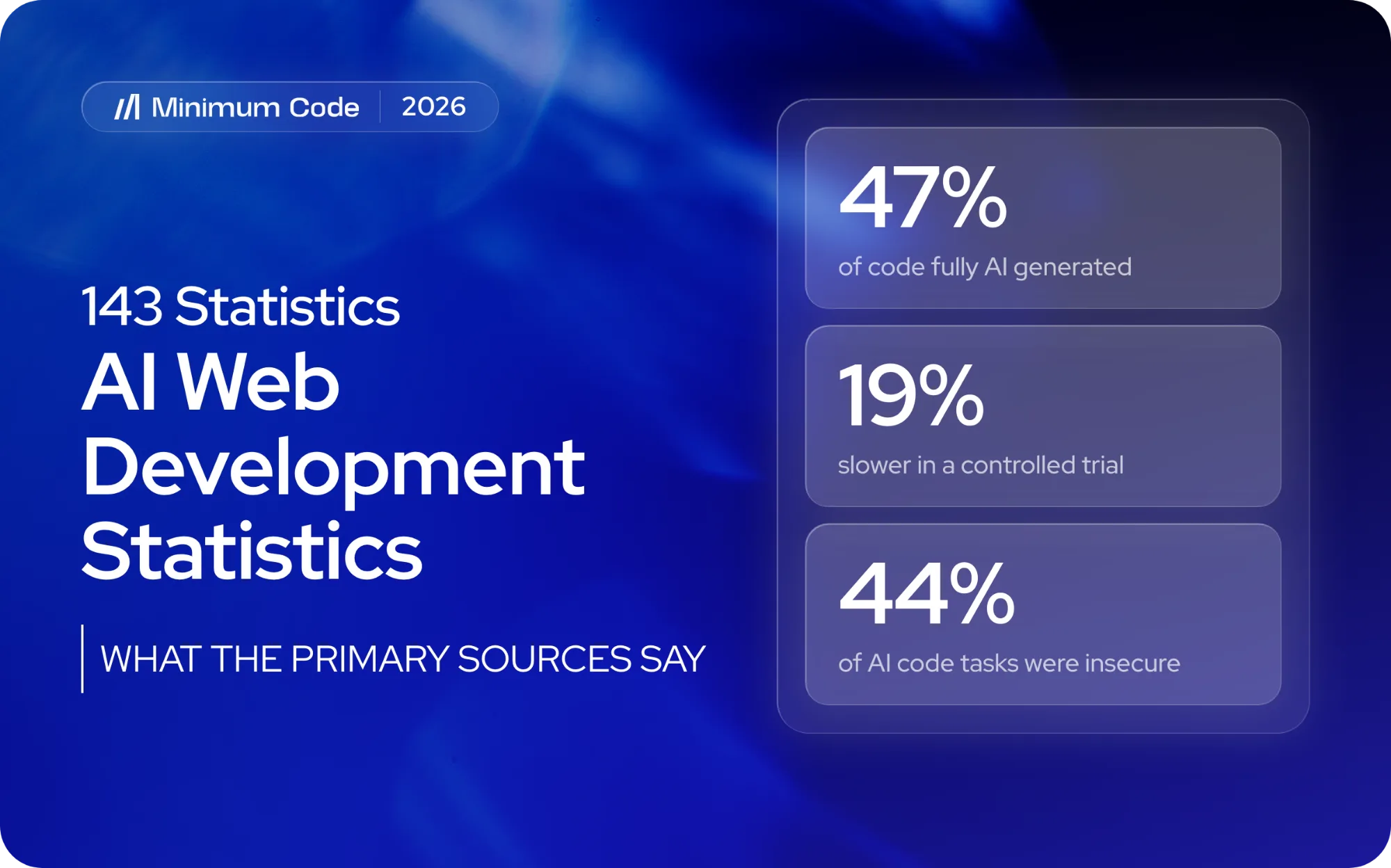
- In a randomised controlled trial, experienced open source developers took 19% longer to complete real issues when allowed to use AI, having predicted beforehand that it would make them 24% faster (METR, Jul 2025).
- Roughly 44% of AI code generation tasks produced code carrying a risky security vulnerability, and the average security pass rate across models has moved only from 55% to 56% in a year (Veracode, Jul 2026).
- Professional developers report that an average of 47% of their code is now fully generated by AI agents, against 27% written entirely by hand (JetBrains, Jul 2026).
- 52% of crawler requests on Cloudflare's network are now for AI training, up from 22% in spring 2025 (Cloudflare, Jul 2026).
- For the first time, more than half of internet traffic is not human, and daily requests from AI agents grew more than 1,700% in a year (Cloudflare, Sep 2026).
- 95.9% of the top one million home pages had detectable WCAG 2 failures, and the average home page grew 22.5% more complex in a single year, to 1,437 elements (WebAIM, Mar 2026).
- Code block duplication rose 81% between 2023 and 2026, while refactoring fell from 21% of changed lines in 2022 to 3.8% (GitClear, Jun 2026).
- More developers actively distrust the accuracy of AI tools (46%) than trust them (33%) (Stack Overflow, Jul 2025).
- Nearly 80% of new developers on GitHub use Copilot within their first week on the platform (GitHub, Oct 2025).
- Senior roles account for 69.3% of US software development job postings, against 4.5% for entry level, the lowest entry-level share of any sector measured (Indeed Hiring Lab, Jul 2026).
- About six in ten ChatGPT referrals now land on a brand's homepage, up from roughly 26% to 29% before May 2026, which changes what a site's front door has to do (Similarweb, Jul 2026).
- Only 2.13% of desktop pages publish a valid llms.txt file, so the standard everyone discusses is close to nonexistent in the wild (HTTP Archive, Jul 2025).
- Security debt now affects 82% of organisations, up from 71% two years earlier, and critical security debt affects 60% (Veracode, Feb 2026).
The market and the platform layer
The money in web development did not move to AI. It is still overwhelmingly spent on people building things on a platform layer that has barely shifted in a decade, which is exactly why the AI story matters: it is arriving into an enormous, slow-moving installed base.
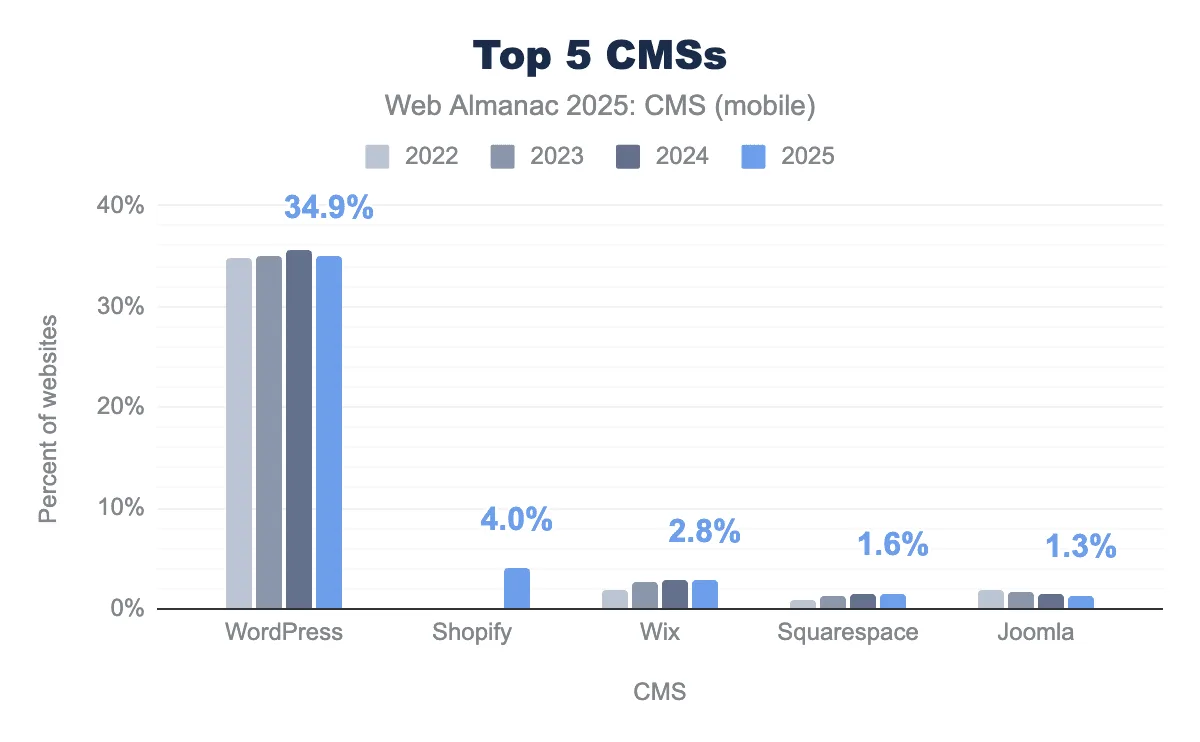
Figure 1: WordPress still sits on roughly a third of the measured web and has not moved in four years, which is the real constraint on how fast AI can change how sites get built. Source: HTTP Archive, Web Almanac 2025: CMS, Jul 2025. Chart published by the source, captured 19 Oct 2026.
How big is the web development market?
US revenue for computer systems design and related services, the official category that contains most professional web and software work, reached $194.9 billion in the second quarter of 2026 alone.
- US computer systems design and related services revenue was $194.9 billion in Q2 2026, up 3.3% year over year (US Census Bureau, Sep 2026).
- First half 2026 revenue for the sector reached $387.9 billion, against $369.7 billion in the first half of 2025, a 4.9% increase (US Census Bureau, Sep 2026).
- GitHub passed 180 million developers, with more than 36 million joining in a single year, a 23% increase (GitHub, Oct 2025).
- The platform now holds 630 million total repositories, with 121 million created in 2025 (GitHub, Oct 2025).
Which platforms does the web actually run on?
WordPress remains the single largest piece of infrastructure in web development, and the two measurement systems that track it disagree by about five percentage points.
- WordPress runs 39.6% of all websites and 58.4% of sites with a known content management system (W3Techs, Oct 2026).
- Measuring actual crawled pages rather than domains, HTTP Archive puts WordPress at 34.9% of mobile pages, a reminder that "market share" depends entirely on what you count (HTTP Archive, Jul 2025).
- 32.1% of websites use no content management system that W3Techs monitors at all (W3Techs, Oct 2026).
- Shopify holds 5.3% of all websites, Wix 4.2%, and Squarespace 2.4% (W3Techs, Oct 2026).
- Webflow and Duda, the two builders most associated with professional agencies, sit at 0.8% and 0.7% of all websites (W3Techs, Oct 2026).
- Elementor runs on 31.6% of WordPress sites and WooCommerce on 19.8% (W3Techs, Oct 2026).
What are the platform companies earning?
- Wix reported Q2 2026 revenue of $563.1 million, up 15% year over year, with total annual recurring revenue of $1.963 billion (Wix, Aug 2026).
- Wix revenue from partners, meaning agencies and resellers, grew 17% to $213.8 million, faster than the company overall (Wix, Aug 2026).
- Shopify grew revenue 34% year over year in Q2 2026 at an 18% free cash flow margin (Shopify, Aug 2026).
How many developers build with AI
Adoption is no longer the interesting number, because it has essentially maxed out. The interesting numbers are frequency, tool churn, and the fact that trust has gone in the opposite direction to usage.
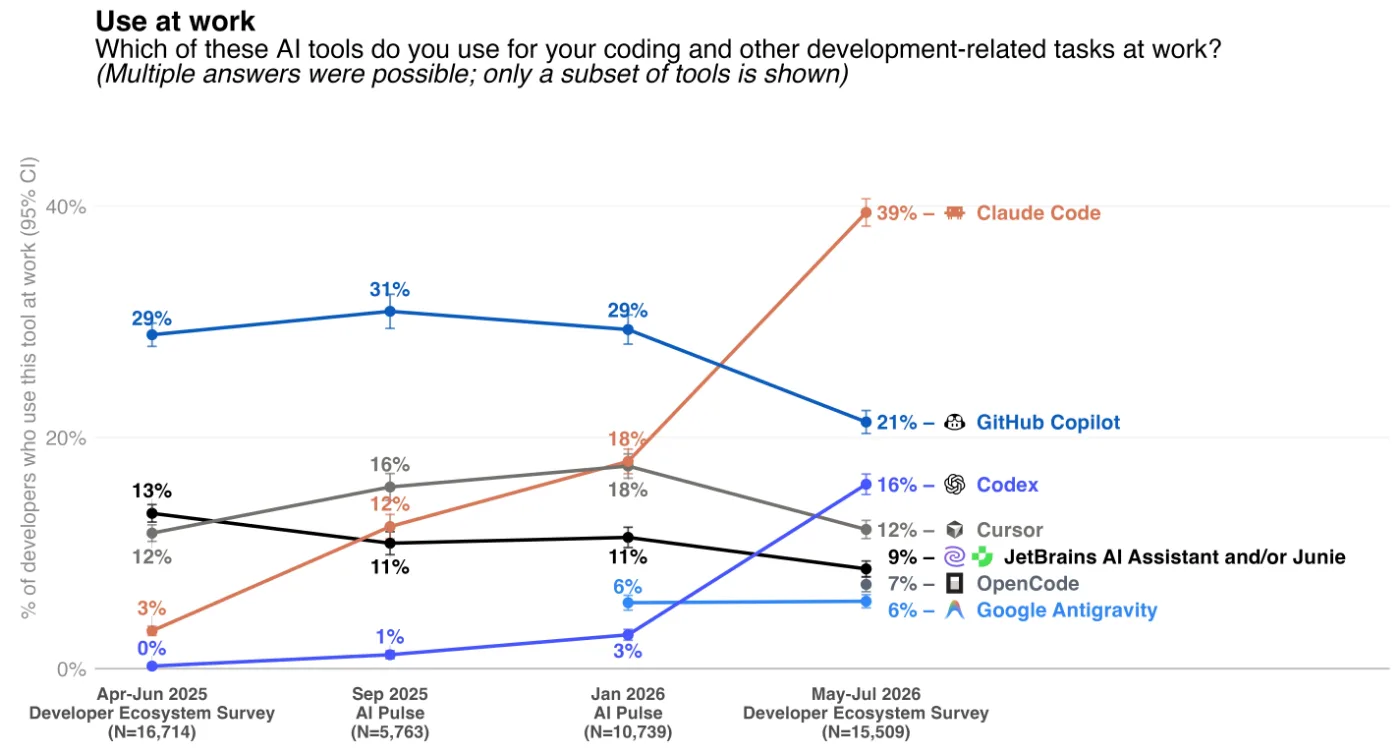
Figure 2: Claude Code went from 3% to 39% workplace adoption in roughly a year while GitHub Copilot fell from 29% to 21%, which is the fastest reversal of a developer tool market in recent memory. Source: JetBrains, AI Coding Agents: Adoption Trends, Developer Ecosystem Survey 2026, Jul 2026. Chart published by the source, captured 19 Oct 2026.
How many developers use AI coding tools?
Essentially all of them, on at least a weekly basis, and roughly two thirds reach for one every day.
- 90% of professional developers used AI coding agents at work at least weekly, and 68% used them daily, in a survey of more than 15,000 professional developers fielded May to July 2026 (JetBrains, Jul 2026).
- 84% of developers were using or planning to use AI tools in their development process, up from 76% the previous year (Stack Overflow, Jul 2025).
- 31% of daily AI users spend four or more hours a day working with AI tools (Stack Overflow, Oct 2026).
- Respondents had a median of 16 months of experience using AI tools, placing the median adoption date around April 2024 (DORA, Sep 2025).
- Despite near-universal adoption, only 7% of AI users say they "always" reach for AI when facing a problem (DORA, Sep 2025).
- Computer and mathematical occupations account for roughly 30% of Claude usage against about 4% of US employment, the sharpest occupational skew in AI usage data (Anthropic, Jun 2026).
Which AI coding tools do developers use?
The market leader changed twice in eighteen months, which should temper any claim about a durable winner.
- Claude Code reached 39% adoption among professional developers worldwide, up from 18% in January 2026, and 47% in the United States (JetBrains, Jul 2026).
- GitHub Copilot fell from 29% adoption a year earlier to 21%, while retaining 79% awareness (JetBrains, Jul 2026).
- Codex grew roughly fivefold, from 3% in January 2026 to 16% by mid-2026, with awareness rising from 27% to 65% (JetBrains, Jul 2026).
- Among developers using coding agents, Claude Code was used by 66% and GitHub Copilot by 59% (Stack Overflow, Oct 2026).
- 25.1% of developers switched AI tools in the past year specifically for better output quality (Stack Overflow, Oct 2026).
How fast are autonomous agents being adopted?
- Workplace agent use nearly doubled in a year, from 31% to 59% (Stack Overflow, May 2026).
- Daily agent use rose from 14% to 37% over the same period (Stack Overflow, May 2026).
- 63% of technologists rarely or never let agents run entirely on autopilot, and 60% block agents from making unapproved system changes (Stack Overflow, May 2026).
- 68% prefer predictable single-agent setups over multi-agent configurations, and 69% currently run a single agent (Stack Overflow, May 2026).
How much of the web's code AI actually writes
This is the most misquoted statistic in the industry, because "percentage of code written by AI" means something different in every mouth that says it. Accepted completions, committed lines, merged pull requests and self-estimates are four different measurements, and they produce numbers ranging from 27% to 47%. Both of the figures below are survey-based self-reports, and both say so.
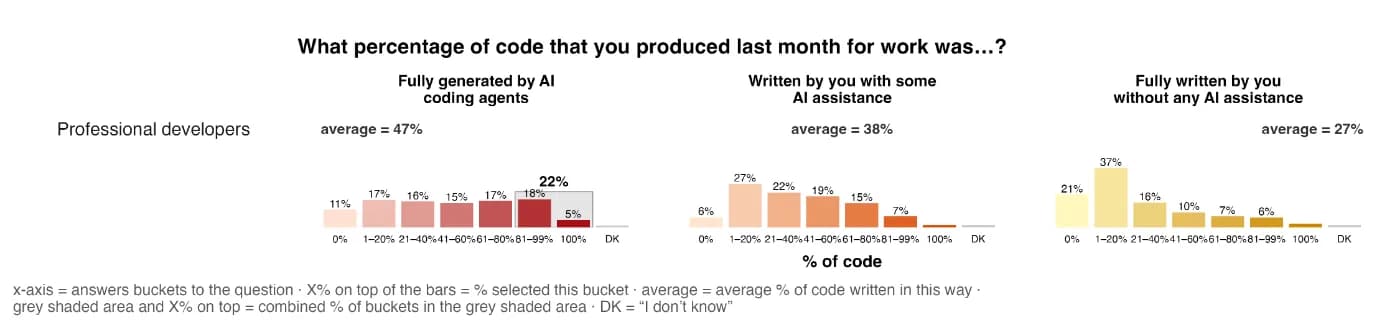
Figure 3: The averages hide a bimodal reality: 22% of developers let agents write more than 80% of their code, while a stubborn 21% still report zero agent-generated code. Source: JetBrains, How Much Code Do Developers Really Let Agents Write? Developer Ecosystem Survey 2026, Jul 2026. Chart published by the source, captured 19 Oct 2026.
What share of code is AI generated?
Two serious attempts to measure this disagree by twenty percentage points, and the gap is methodological rather than a contradiction.
- Developers at more than 500 organisations estimated that 27.4% of their merged code was authored by AI, up from 22% the previous quarter (DX, Apr 2026).
- Among daily AI users specifically, that share rose from 24.1% to 30.8% in a single quarter (DX, Apr 2026).
- Professional developers report 38% of their code is written by them with some AI assistance, the largest single category (JetBrains, Jul 2026).
- 22% of developers say agents generate more than 80% of their code, and one in five writes no code at all without AI help (JetBrains, Jul 2026).
- The DX measure is self-reported, and DX states it plans to add a telemetry-based measure because of that limitation (DX, Apr 2026).
Which languages and stacks get the most AI-generated code?
Web languages are the most heavily automated, which is the single most relevant finding on this page for anyone building websites.
- Developers whose main language is Go, JavaScript or TypeScript report the highest share of agent-generated code, averaging 54% to 55% (JetBrains, Jul 2026).
- C and C++ developers remain least automated, writing 38% of their code manually (JetBrains, Jul 2026).
- TypeScript finished 2025 as the most used language on GitHub with 2,636,006 monthly contributors, overtaking both Python and JavaScript in August 2025 (GitHub, Oct 2025).
- Developers in East Asia are roughly twice as likely to be heavily agentic as those in Europe and the UK, at 32% to 35% against about 16% (JetBrains, Jul 2026).
How much AI code is in the open source ecosystem?
- AI-related repositories on GitHub exceeded 4.3 million, nearly doubling in under two years (GitHub, Oct 2025).
- More than 1.1 million public repositories now import an LLM SDK, a 178% year-over-year increase (GitHub, Oct 2025).
- Developers merged a record 518.7 million pull requests in 2025, up 29% year over year (GitHub, Oct 2025).
- Nearly 986 million commits were pushed in 2025, a 25% increase, with almost 100 million in August alone (GitHub, Oct 2025).
Does AI make building faster
Here is where the marketing and the measurement part company. The only randomised controlled trial run on experienced developers in their own repositories found AI made them slower, and the developers could not tell. Every number in this section is reported with its uncertainty, because the uncertainty is the finding.
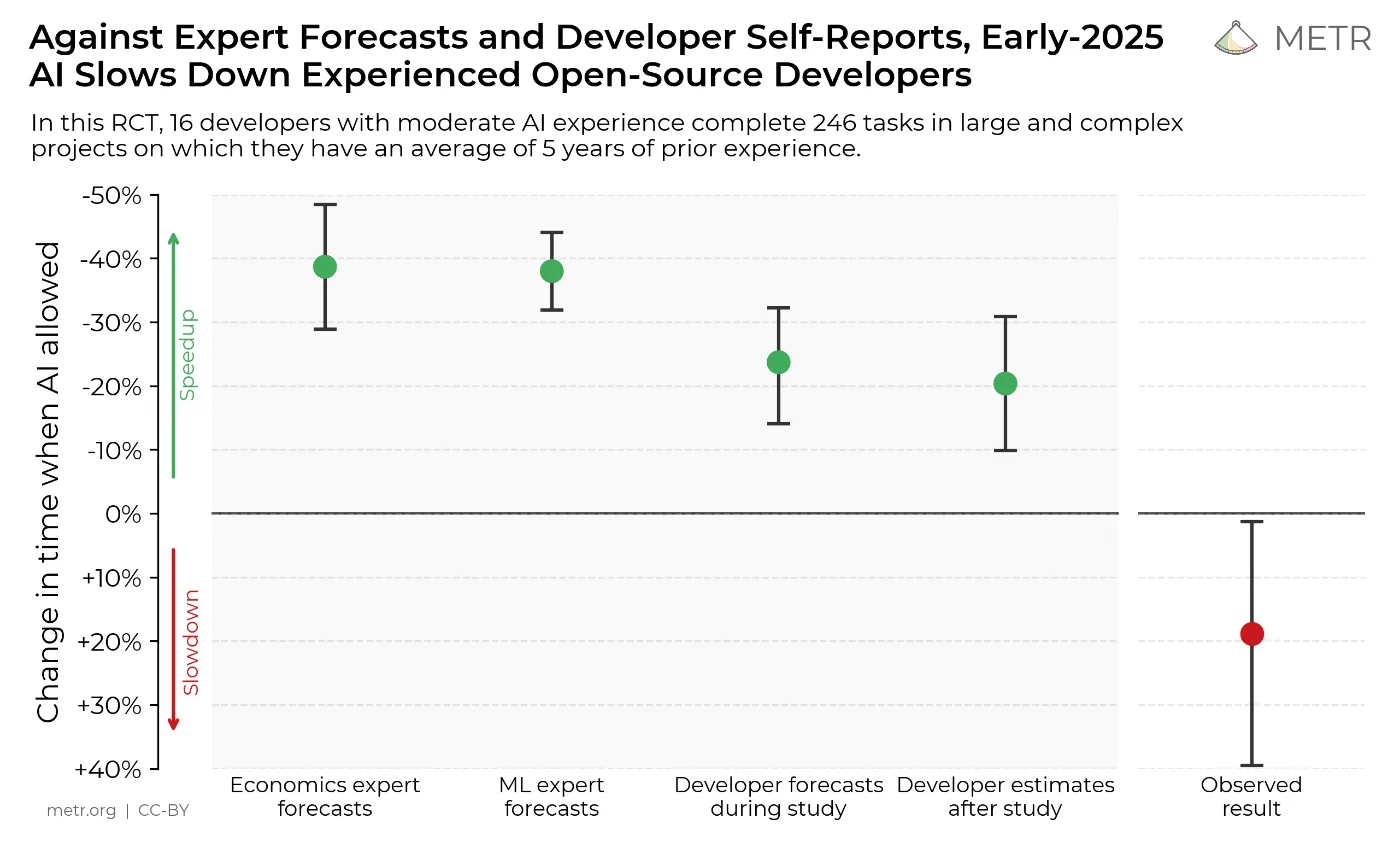
Figure 4: Economists, ML experts and the developers themselves all forecast a 20% to 40% speedup. The measured result was a 19% slowdown, and the developers still believed they had been sped up afterwards. Source: METR, Measuring the Impact of Early-2025 AI on Experienced Open-Source Developer Productivity, Jul 2025. Chart published by the source, captured 19 Oct 2026.
What does the controlled evidence say?
- The METR trial used 16 experienced open source developers working on 246 real issues in repositories where they averaged five years of prior experience (METR, Jul 2025).
- After the study, developers still estimated AI had made them about 20% faster, in the same trial where it had slowed them by 19% (METR, Jul 2025).
- A follow-up with 57 developers across 143 repositories and over 800 tasks estimated an 18% speedup for returning developers, with a confidence interval running from 38% faster to 9% slower (METR, Feb 2026).
- For newly recruited developers in that follow-up, the estimate was a 4% speedup, confidence interval 15% faster to 9% slower (METR, Feb 2026).
- METR described its own follow-up data as "an unreliable signal of the current productivity effect of AI tools", with 30% to 50% of surveyed developers admitting they withheld tasks they did not want to do without AI (METR, Feb 2026).
Where has AI measurably increased output?
The positive evidence is real, and it comes from different conditions: large organisations, less experienced developers, and task counts rather than task time.
- Pooled across three field experiments at Microsoft, Accenture and a Fortune 100 company covering 4,867 developers, access to an AI coding assistant increased completed tasks by 26.08%, with a standard error of 10.3% (Microsoft Research, Jun 2025).
- In the same research, less experienced developers showed both higher adoption and larger productivity gains (Microsoft Research, Jun 2025).
- In a controlled task asking developers to implement an HTTP server in JavaScript, the group with GitHub Copilot finished 55.8% faster than the control group (Peng et al., Feb 2023).
- More than 80% of DORA respondents believe AI has increased their productivity, against the measured evidence above (DORA, Sep 2025).
What is the hidden cost of AI assistance?
- 66% of developers named "AI solutions that are almost right, but not quite" as their single biggest frustration (Stack Overflow, Jul 2025).
- 45.2% said debugging AI-generated code is more time-consuming than debugging their own (Stack Overflow, Jul 2025).
- 20% of developers report becoming less confident in their own problem-solving ability (Stack Overflow, Jul 2025).
- DORA found AI adoption positively related to software delivery throughput but still negatively related to delivery stability, meaning teams ship faster and break more (DORA, Sep 2025).
Shipping faster than your review and release process can keep up? Our web app development team builds with AI every day and keeps the reviews, tests and staged releases that make that speed safe.
Code quality, security and the new technical debt
Speed is not free, and the bill is arriving in two places at once: vulnerabilities that models reproduce at a stable rate no matter how good they get at syntax, and maintainability signals that have been sliding for four consecutive years.
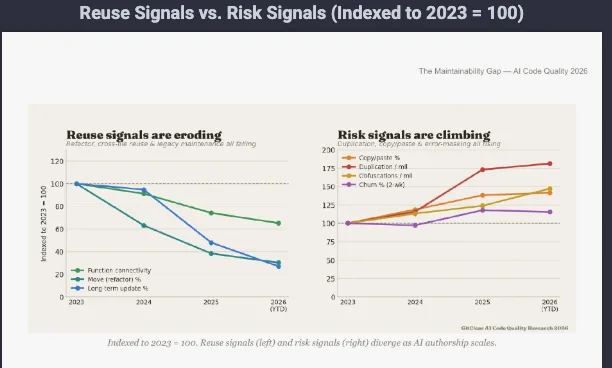
Figure 5: Reuse signals and risk signals have diverged steadily since 2023. Refactoring and legacy maintenance are collapsing while duplication and copy-paste climb, which is what accumulating technical debt looks like in aggregate. Source: GitClear, The Maintainability Gap: AI Code Quality in 2026, Jun 2026. Screenshot of the source page, captured 19 Oct 2026.
How secure is AI-generated code?
Models have solved syntax and have not touched security, and that gap has stayed open across a full generation of model releases.
- Modern models now produce syntactically correct code nearly 100% of the time, while the average security pass rate sits at 56% (Veracode, Jul 2026).
- On cross-site scripting, models passed just 15% of the time, and on log injection 12% (Veracode, Jul 2026).
- The same models handled SQL injection at an 83% pass rate and cryptographic algorithm choice at 87%, so the failure is specific rather than general (Veracode, Jul 2026).
- The best-performing model tested reached a 68% security pass rate, and more than half of all tested models fell between 50% and 53% (Veracode, Jul 2026).
- Larger models did not help: large models averaged 53% while medium and small models each averaged 51% (Veracode, Jul 2026).
- Reasoning models showed a modest edge, averaging 56% against 51% for non-reasoning models (Veracode, Jul 2026).
Is AI making codebases harder to maintain?
Every reuse signal is falling and every risk signal is climbing, across 623 million analysed code changes.
- GitClear analysed 623 million code changes from 2023 to 2026 across customer and corporate open source repositories (GitClear, Jun 2026).
- Duplicated code blocks rose from 40.3 to 73.0 per million changed lines (GitClear, Jun 2026).
- Copy-paste rose from 9.4% of new code in 2022 to 15.7% in the first half of 2026 (GitClear, Jun 2026).
- Function connectivity, a proxy for whether new code reuses what already exists, fell 35% since 2023, from 343 to 223 method calls per thousand changed lines (GitClear, Jun 2026).
- Long-term maintenance of older code fell 74%, from 1.7% of changes in 2023 to 0.46% (GitClear, Jun 2026).
- GitClear sells developer analytics and draws on its own customer base, so these figures should be read as a large but non-random sample (GitClear, Jun 2026).
How much security debt are organisations carrying?
- Critical security debt, meaning high-severity flaws left unfixed for more than a year, rose from 50% of organisations in 2025 to 60% in 2026 (Veracode, Feb 2026).
- High-risk vulnerabilities, those both high severity and highly exploitable, rose 36% year over year (Veracode, Feb 2026).
- 30% of DORA respondents report little or no trust in the code AI generates, while 24% report "a lot" or "a great deal" (DORA, Sep 2025).
Built an app with AI and not sure what is in the code? Start with our vibe coding security checklist, or have us run a code audit before your users find the gaps.
AI website builders, vibe coding and who builds sites now
The vibe coding narrative is far ahead of the measured footprint. Platforms genuinely are being used to build real things, and those things are still a rounding error on the live web. The more interesting story is what serving AI-built sites does to the economics of the companies offering it.
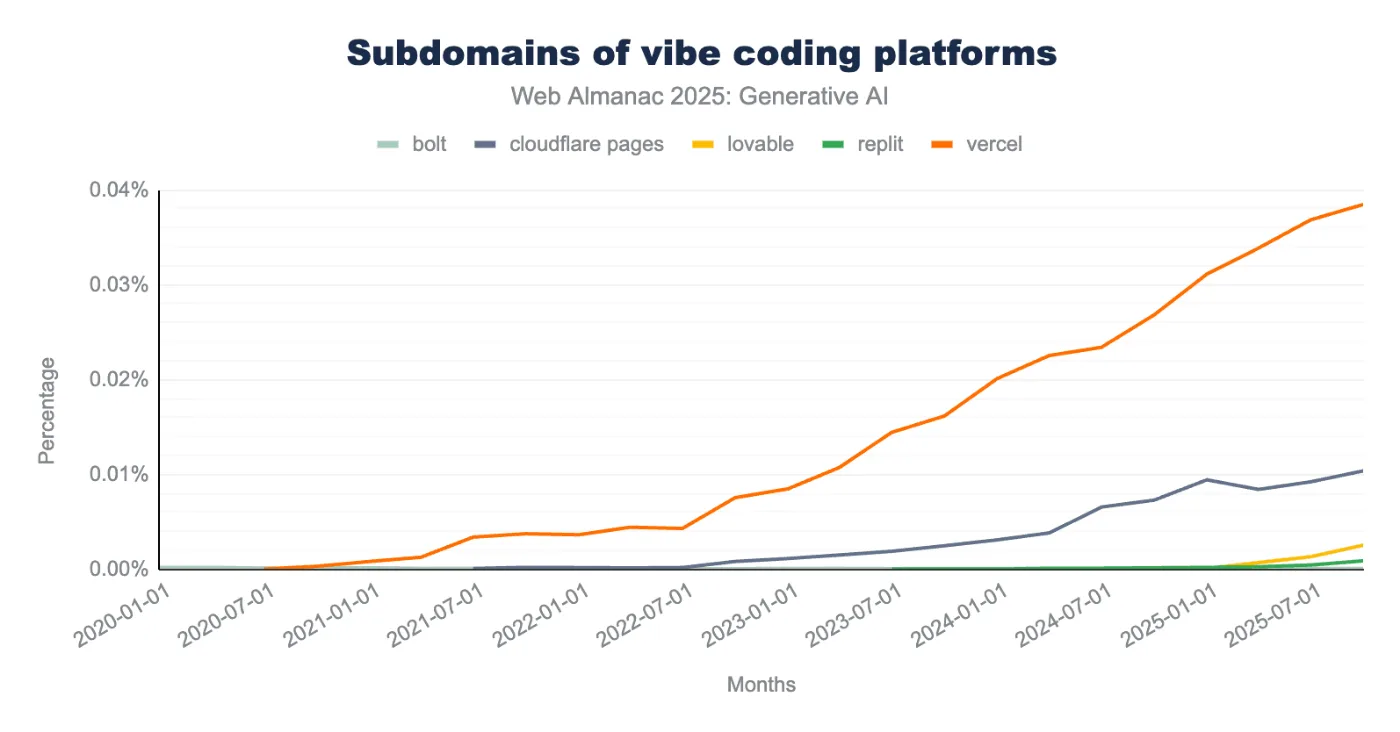
Figure 6: Measured rather than claimed. Every vibe coding platform combined accounts for well under a tenth of one percent of websites, and Vercel, which predates the category, is most of it. Source: HTTP Archive, Web Almanac 2025: Generative AI, Oct 2025. Chart published by the source, captured 19 Oct 2026.
How many sites are actually built by AI platforms?
Very few, by the only independent measurement available.
- Vercel subdomains reached nearly 0.04% of all websites by October 2025, the largest share of any platform in the category (HTTP Archive, Oct 2025).
- Lovable subdomains grew from 10 in early 2025 to 315 by October 2025, a steep curve from a tiny base (HTTP Archive, Oct 2025).
- Lovable states that 100,000 new projects are built on its platform daily, a vendor claim rather than an independent measurement, and one that sits oddly beside 315 measured live subdomains (HTTP Archive, Oct 2025).
- Sites on .ai domains in the top one million rose from 273 in 2022 to 1,606 in 2025 (HTTP Archive, Oct 2025).
- Signals of AI-generated styling are becoming detectable: the "AI colors" purple and indigo-500 rose from 0.02% and 0.03% of pages in late 2022 to 0.49% and 0.54% by late 2025 (HTTP Archive, Oct 2025).
What does AI site building cost the platforms?
This is the under-reported half of the story. Generating sites on demand is expensive to serve, and it shows up directly in margin.
- Wix's non-GAAP operating margin fell from 22% to 12% year over year as it scaled its AI app-creation platform (Wix, Aug 2026).
- Wix posted a GAAP net loss of $76.4 million in Q2 2026, against operating income of $44.3 million in the same quarter a year earlier (Wix, Aug 2026).
- Base44's non-GAAP gross margin is expected to reach roughly 60% in the second half of 2026, up from near zero entering the year (Wix, Aug 2026).
- To control inference costs, Wix shipped its own proprietary model for the platform rather than buying tokens from a frontier lab (Wix, Aug 2026).
- Shopify's platform facilitated $216.3 billion of gross merchandise volume in the first half of 2026, up 33% year over year (Shopify, Aug 2026).
Is AI changing who builds software for a living?
- Respondents describing themselves as an "organisation of one" rose from 4% to 10% in a single year (Stack Overflow, Oct 2026).
- Among developers who avoid AI, the most common reason given is losing job skills, at 17.1%, ahead of moral or ethical concerns at 15.2% and privacy or security at 13.0% (Stack Overflow, Oct 2026).
- 41.3% of developers say they do not avoid AI for any reason (Stack Overflow, Oct 2026).
Have a Lovable, Bolt or Base44 app that needs to run in production? Our guides to Lovable export code and Base44 export code show what you get out, and our team can take it the rest of the way.
Talk to us about your AI-built app
Web development jobs, hiring and skills
The US government has quietly put the thing everyone else hedges about into its flagship labour publication. Web development and software development are now projected to diverge sharply, and AI is named as the reason.
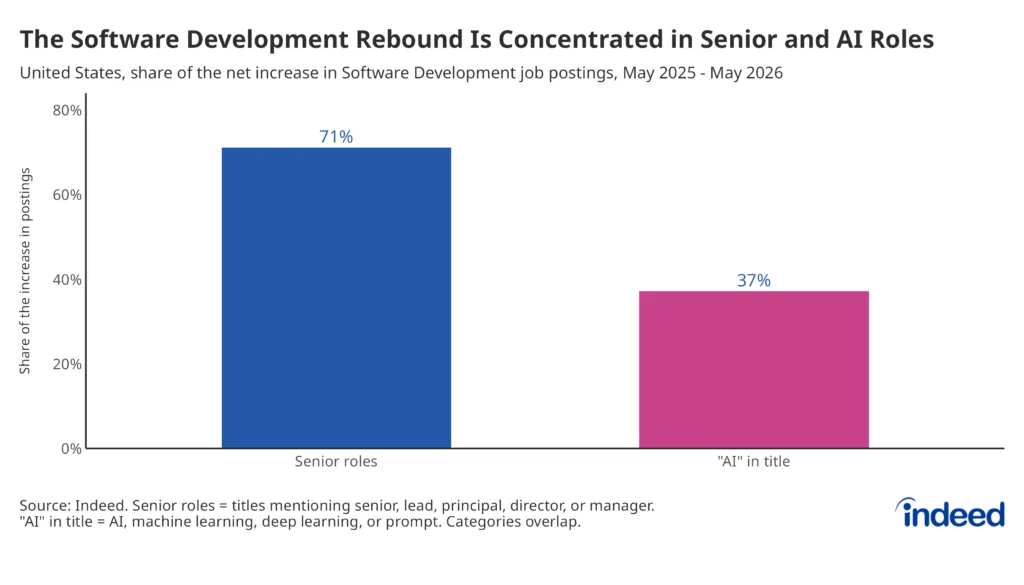
Figure 7: The software hiring rebound is real but narrow. Almost three quarters of the net increase went to senior roles, which is the opposite of what a healthy entry-level pipeline looks like. Source: Indeed Hiring Lab, AI and Job Postings: From Destruction to Creation?, Jul 2026. Chart published by the source, captured 19 Oct 2026.
What do official projections say about web developer jobs?
The gap between web developers and software developers in the same BLS publication, measured on the same cycle, is the clearest official signal that AI is hitting web work hardest.
- Employment of web developers and digital designers stood at 220,100 in 2025, with about 13,600 openings projected each year on average (BLS, Aug 2026).
- Median pay for web developers and digital designers was $99,520 per year as of May 2025 (BLS, Aug 2026).
- Software developers, QA analysts and testers are projected to grow 10% from 2025 to 2035, double the rate projected for web developers, from a base of 1,905,400 jobs (BLS, Aug 2026).
- Median pay for software developers was $134,040, about 35% above the web developer figure (BLS, Aug 2026).
- On the earlier 2024 to 2034 projection cycle, BLS put software developer growth at 15.8%, the largest numeric gain of any AI-exposed occupation at 267,700 jobs (BLS, Jul 2026).
- Against total projected employment growth of 3.1% across all occupations, BLS states that AI productivity gains "are expected to dampen labor demand in a variety of fields" (BLS, Jul 2026).
What is happening to developer hiring right now?
- US software development job postings rose almost 15% after Claude Code launched in late February 2025, while overall job postings fell 7% (Indeed Hiring Lab, Jul 2026).
- Despite that rebound, software development postings remain about 27.5% below their pre-pandemic level (Indeed Hiring Lab, Jul 2026).
- 71% of the increase between May 2025 and May 2026 came from senior roles and 37% from roles with AI in the title, categories that overlap (Indeed Hiring Lab, Jul 2026).
- Senior-level postings across the US rose 14.7% year over year as of May 2026, while entry-level postings fell 7.5% (Indeed Hiring Lab, Jul 2026).
- Between 2019 and 2025 the senior share of tech postings rose nine percentage points while the mid-level share fell 7.7 points (Indeed Hiring Lab, Jul 2026).
Which skills are developers prioritising?
- 79% of developers want to build AI skills, while 52% are still focused on general coding skills (Stack Overflow, Oct 2026).
- JavaScript remains the most used language at 62%, with SQL, HTML/CSS and Python each at 58%, and SQL overtaking HTML/CSS for second place (Stack Overflow, Oct 2026).
- 64% of developers now visit Stack Overflow less often for simple questions, a direct measure of AI displacing the reference layer developers grew up on (Stack Overflow, Oct 2026).
Building for machines: AI crawlers and the second audience
A website now has two audiences, and the non-human one is larger. This is the part of the AI shift that changes requirements rather than workflow: what you publish, how you structure it, who you let read it, and whether any of it comes back as traffic.
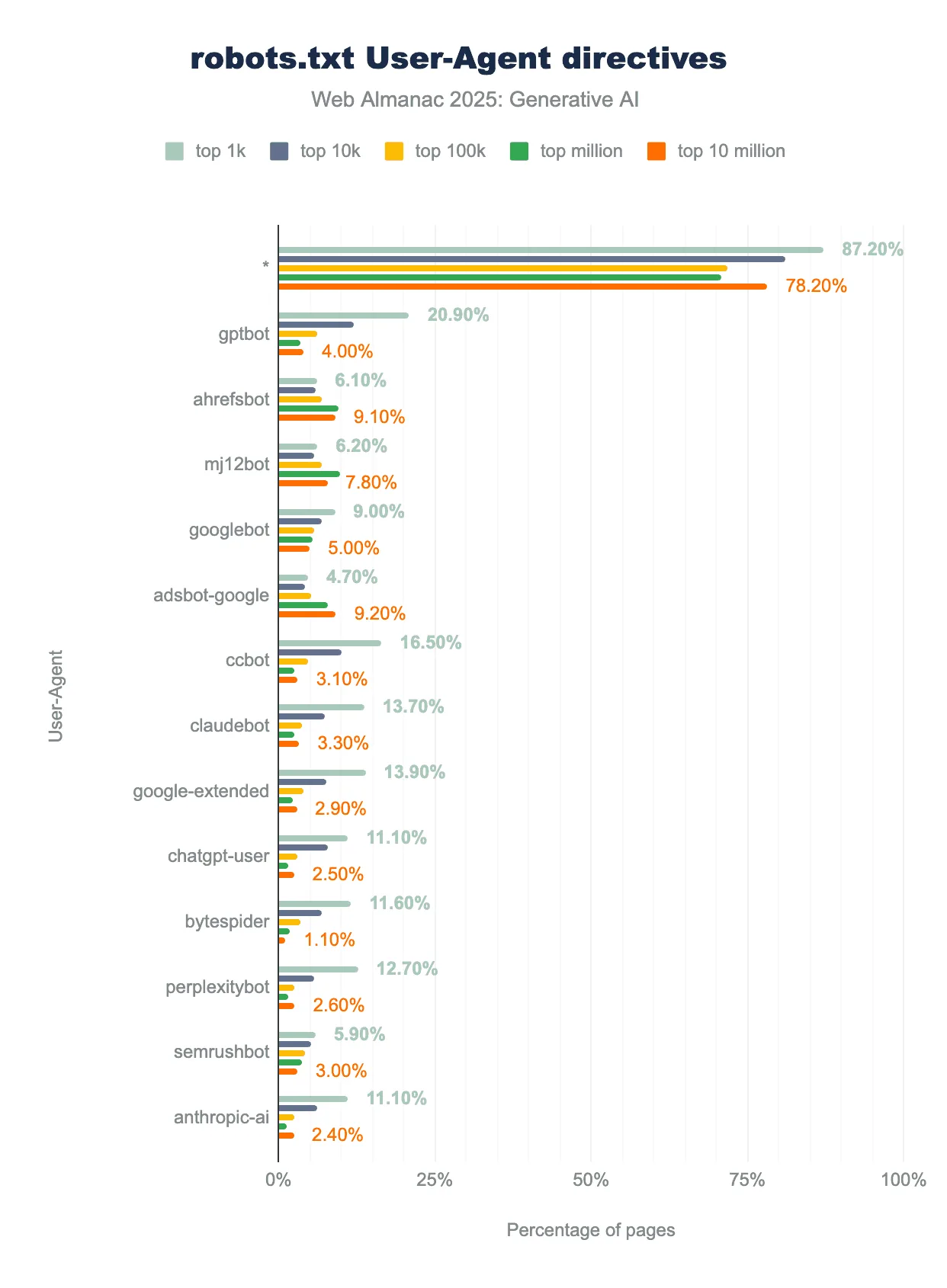
Figure 8: AI crawler directives are overwhelmingly a large-publisher behaviour. GPTBot appears in the robots.txt of 20.9% of the top 1,000 sites but only 4% of the top 10 million, so the typical site has made no decision at all. Source: HTTP Archive, Web Almanac 2025: Generative AI, Jul 2025. Chart published by the source, captured 19 Oct 2026.
How much web traffic is now AI crawlers?
- Mixed-use crawlers, which blend search, agent use and training in one user agent, account for more than 36% of crawler activity, making them impossible to block selectively (Cloudflare, Jul 2026).
- Cloudflare now sees more than 500 billion verified bot requests each week (Cloudflare, Sep 2026).
- Average request volume on the network almost doubled from 63 million per second at the end of 2024 to 115 million, with peaks above 150 million (Cloudflare, Sep 2026).
- Fewer than 1% of sites on Cloudflare block search crawlers, while 17% block AI training crawlers (Cloudflare, Sep 2026).
- In an earlier measurement window, training traffic accounted for nearly 80% of all AI bot crawling, with user actions and undeclared purposes under 5% combined (Cloudflare, Aug 2025).
What is AI doing to the traffic websites receive?
- For every hour a person spends online searching for information, only 15 minutes is now spent on the open web (Cloudflare, Jul 2026).
- Some of the most heavily crawled categories have seen human traffic decline as much as 40% in under a year (Cloudflare, Jul 2026).
- Google still accounts for approximately 88% of referral traffic, so the AI referral economy remains small next to search (Cloudflare, Jul 2026).
- Generative AI platforms drew an average of 9.5 billion monthly web visits worldwide between June 2025 and May 2026, up 70% year over year (Similarweb, Jul 2026).
- Citation presence in US ChatGPT prompts rose from about 1.6% in June 2025 to roughly 6.8% by May 2026, meaning most answers still cite nothing (Similarweb, Jul 2026).
- ChatGPT's share of generative AI website visits fell from about 76% in June 2025 to roughly 53% by May 2026, with Gemini rising from under 9% to around 27% (Similarweb, Jul 2026).
- Traffic from generative AI tools to retail sites rose 693.4% year over year across the 2025 holiday season, and 670% on Cyber Monday alone (Adobe, Jan 2026).
How are websites responding to AI crawlers?
- 94.1% of roughly 12.9 million analysed sites serve a robots.txt file with at least one directive (HTTP Archive, Jul 2025).
- GPTBot directives rose from 2.6% of sites in 2024 to about 4.5% in 2025, and nearly all of them disallow access (HTTP Archive, Jul 2025).
- About half of US adults now use AI chatbots, up from a third in 2024, which is the demand-side reason any of this matters (Pew Research Center, Jun 2026).
- 44% of US adults report using ChatGPT, up from 34% the previous year, with Gemini at 24% and Copilot at 17% (Pew Research Center, Jun 2026).
The quality baseline: what the AI-era web actually ships
This is the control group for everything above. More code, written faster, by more people, with more assistance than at any point in the history of the web. The question is whether the resulting web got better. On the two measures that have been tracked consistently for years, performance improved slightly and accessibility got worse.
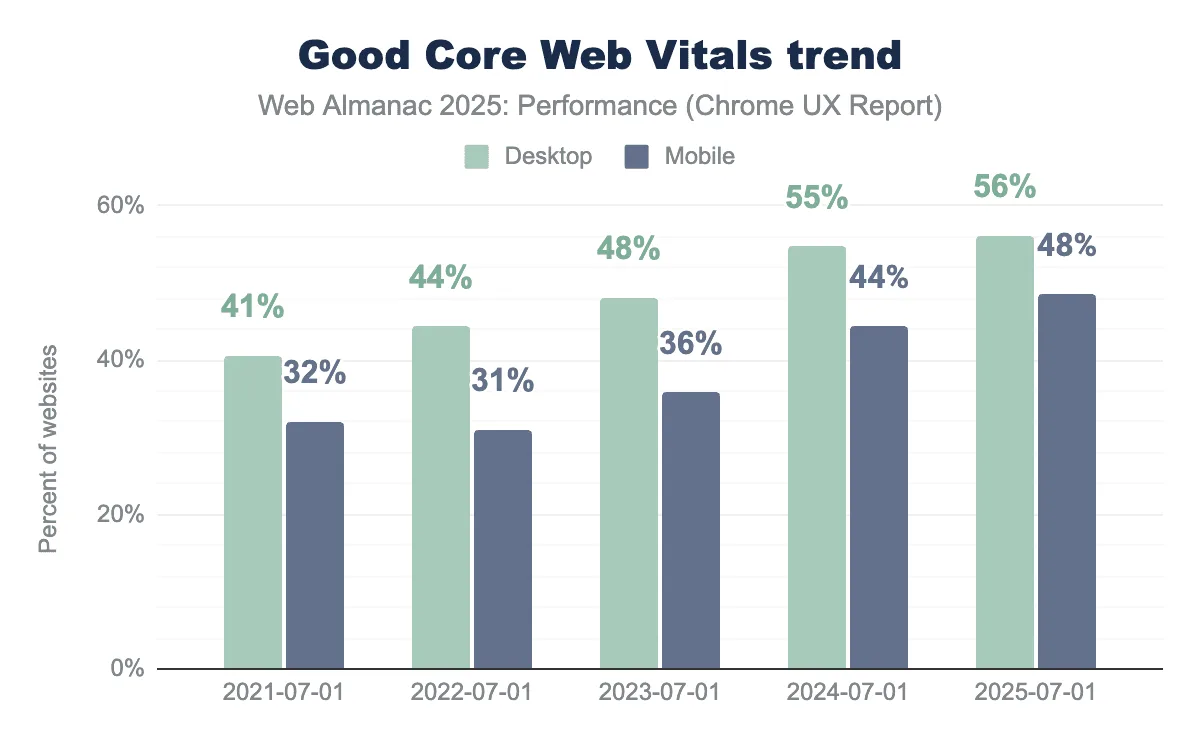
Figure 9: Mobile Core Web Vitals pass rates have climbed steadily to 48%, but 2025 was the smallest annual gain in four years and desktop barely moved, suggesting the easy wins from framework and platform defaults are exhausted. Source: HTTP Archive, Web Almanac 2025: Performance, Jul 2025. Chart published by the source, captured 19 Oct 2026.
Is the web getting faster?
Slowly, and the rate of improvement is flattening.
- 48% of mobile sites passed all three Core Web Vitals in 2025, up from 44% in 2024 and 36% in 2023 (HTTP Archive, Jul 2025).
- Desktop reached only 56%, a marginal gain on 2024's 55% (HTTP Archive, Jul 2025).
- On mobile, 62% of sites achieved good Largest Contentful Paint, 77% good Interaction to Next Paint, and 81% good Cumulative Layout Shift (HTTP Archive, Jul 2025).
- Mobile Interaction to Next Paint pass rates rose from 74% in 2024 to 77% in 2025 (HTTP Archive, Jul 2025).
Are pages getting heavier?
Yes, and JavaScript is the fastest growing part of the payload on the exact stacks that get the most AI assistance.
- The median mobile home page weighs 2.6 MB, growing 8.4% from 2.4 MB in 2024, while desktop grew 7.3% to 2.9 MB (HTTP Archive, Jul 2025).
- JavaScript accounts for 632 KB of the median mobile home page and images 911 KB (HTTP Archive, Jul 2025).
- The median mobile page now makes 22 JavaScript requests against 12 image requests, inverting the historical ratio (HTTP Archive, Jul 2025).
- Overall request counts grew 9% year over year on mobile and 8% on desktop (HTTP Archive, Jul 2025).
Is the web getting more accessible?
No. It got measurably worse in the year that code generation got cheap.
- The average home page carried 56.1 accessibility errors, up from 51 the year before (WebAIM, Mar 2026).
- Low contrast text appeared on 83.9% of home pages, missing alternative text on 53.1%, and missing form input labels on 51% (WebAIM, Mar 2026).
- Empty links appeared on 46.3% of home pages and empty buttons on 30.6% (WebAIM, Mar 2026).
- Only about 30% of sites have sufficient text contrast by automated test, an improvement of roughly one percentage point year over year (HTTP Archive, Jul 2025).
- 24.93% of mobile form inputs have no accessible name at all, unchanged from the previous year (HTTP Archive, Jul 2025).
- 67% of sites now remove default focus outlines, a 14% rise year over year and a direct regression for keyboard users (HTTP Archive, Jul 2025).
- Accessibility overlay widgets, which research consistently finds do not deliver conformance, appear on 2.1% of desktop sites, more than double the 1.0% of 2021 (HTTP Archive, Jul 2025).
Accessibility and performance are checked on every product our web app development team ships, not added after launch.
Methodology and Sources
Every statistic on this page was traced to the organisation that produced the data, and the cited URL points at that organisation's own report, filing, dataset or release rather than at coverage of it. Each source page was fetched and read before the figure was committed; where a number could not be confirmed on the primary document it was dropped rather than softened. Two widely circulated claims were cut for exactly this reason: the "75% of Google's code is AI-generated" figure, which does not appear in Alphabet's Q2 2026 earnings call transcript, and the various "25% of Y Combinator startups have 95% AI-written code" numbers, which exist in several mutually contradictory versions and could not be traced to a Y Combinator statement.
Freshness is matched to how fast each metric moves. Adoption, tool share, crawler and AI-referral data are drawn from the last one to four months. Structural data such as employment projections, market size and platform share use the most recent annual or quarterly release. Two foundational studies are older and retained deliberately: the METR randomised controlled trial from July 2025 and the GitHub Copilot experiment from 2023, both of which remain the authoritative controlled measurements in their lane. Vendor-published research is labelled as such in the text. Survey self-reports are distinguished from telemetry throughout, because on the question of how much code AI writes, that distinction accounts for most of the disagreement between sources.
This page is refreshed at the start of each month: at least one new primary-sourced statistic covering the previous month, newer editions swapped in where sources have published them, and all month markers advanced.
Glossary
- AEO: Answer Engine Optimization, optimising content to be surfaced in direct AI answers
- ARR: annual recurring revenue
- CLS: Cumulative Layout Shift, a Core Web Vitals metric measuring visual stability
- CMS: content management system
- CWV: Core Web Vitals, Google's set of user-experience performance metrics
- CWE: Common Weakness Enumeration, the standard taxonomy of software weakness types
- GEO: Generative Engine Optimization, optimising to be cited by AI engines
- GMV: gross merchandise volume
- INP: Interaction to Next Paint, a Core Web Vitals metric measuring responsiveness
- IR: investor relations
- LCP: Largest Contentful Paint, a Core Web Vitals metric measuring loading speed
- LLM: large language model
- llms.txt: a proposed file standard for telling AI systems how to read a site
- NAICS: North American Industry Classification System, the US statistical industry taxonomy
- RCT: randomised controlled trial
- SDK: software development kit
- WCAG: Web Content Accessibility Guidelines
- XSS: cross-site scripting, a web vulnerability class
Sources
- Adobe, Holiday Shopping Season Drove a Record $257.8 Billion Online, January 2026
- Anthropic, Anthropic Economic Index report: Cadences, June 2026
- Cloudflare, A deeper look at AI crawlers: breaking down traffic by purpose and industry, August 2025
- Cloudflare, Content Independence Day, one year on, July 2026
- Cloudflare, The Internet has a second audience, September 2026
- DORA, State of AI-assisted Software Development 2025 (full report), September 2025
- DORA, Announcing the 2025 DORA Report, September 2025
- DX, AI-generated merged code holds steady at ~30%, April 2026
- GitClear, The Maintainability Gap: AI Code Quality in 2026, June 2026
- GitHub, Octoverse 2025, October 2025
- HTTP Archive, Web Almanac 2025: Accessibility, 2025
- HTTP Archive, Web Almanac 2025: CMS, 2025
- HTTP Archive, Web Almanac 2025: Generative AI, 2025
- HTTP Archive, Web Almanac 2025: Page Weight, 2025
- HTTP Archive, Web Almanac 2025: Performance, 2025
- Indeed Hiring Lab, AI and Job Postings: From Destruction to Creation?, July 2026
- Indeed Hiring Lab, The Labor Market Is Tilting Toward Seniority, July 2026
- JetBrains, AI Coding Agents: Adoption Trends, August 2026
- JetBrains, How Much Code Do Developers Really Let Agents Write?, August 2026
- METR, Measuring the Impact of Early-2025 AI on Experienced Open-Source Developer Productivity, July 2025
- METR, We are Changing our Developer Productivity Experiment Design, February 2026
- Microsoft Research, The Effects of Generative AI on High-Skilled Work, June 2025
- Peng, Kalliamvakou, Cihon and Demirer, The Impact of AI on Developer Productivity: Evidence from GitHub Copilot, February 2023
- Pew Research Center, Americans' Views on AI Chatbots, Smart Devices and AI's Impact, June 2026
- Shopify, Q2 2026 Financial Results, August 2026
- Shopify, Form 10-Q for the quarter ended June 30, 2026, August 2026
- Similarweb, AI Search Stats 2026, July 2026
- Stack Overflow, 2025 Developer Survey: AI, July 2025
- Stack Overflow, 2026 Developer Survey: AI, October 2026
- Stack Overflow, The results of the 2026 Developer Survey are here, October 2026
- Stack Overflow, Agents on a leash, May 2026
- US Bureau of Labor Statistics, Occupational Outlook Handbook: Web Developers and Digital Designers, August 2026
- US Bureau of Labor Statistics, Occupational Outlook Handbook: Software Developers, QA Analysts and Testers, August 2026
- US Bureau of Labor Statistics, Artificial intelligence, information technology, and employment, 2024-34, July 2026
- US Census Bureau, Quarterly Selected Services Estimates, Second Quarter 2026, September 2026
- Veracode, 2026 GenAI Code Security Report, July 2026
- Veracode, 2026 State of Software Security, February 2026
- W3Techs, Usage Statistics and Market Share of Content Management Systems, October 2026
- W3Techs, Usage Statistics and Market Share of WordPress, October 2026
- WebAIM, The WebAIM Million 2026, March 2026
- Wix, Form 6-K, Second Quarter 2026 Results, August 2026

Written by Tom
Founder and Lead Developer

Ready to start your project?
Book a free discovery call to learn how we can build your app in 4 weeks, or less.
Book a call