
Rebuilding a Bubble app with Claude Code can work well, but only with engineering controls that most teams skip. The usual failure is not bad code, it’s confident code that assumes how Bubble behaves instead of verifying it. Speed is real, but so is the risk of plausible-looking logic that quietly breaks permissions, data integrity or edge cases nobody tested.
Key takeaways
- Claude Code adds genuine speed to a rebuild, but it misleads when it infers business logic instead of reading the actual Bubble configuration.
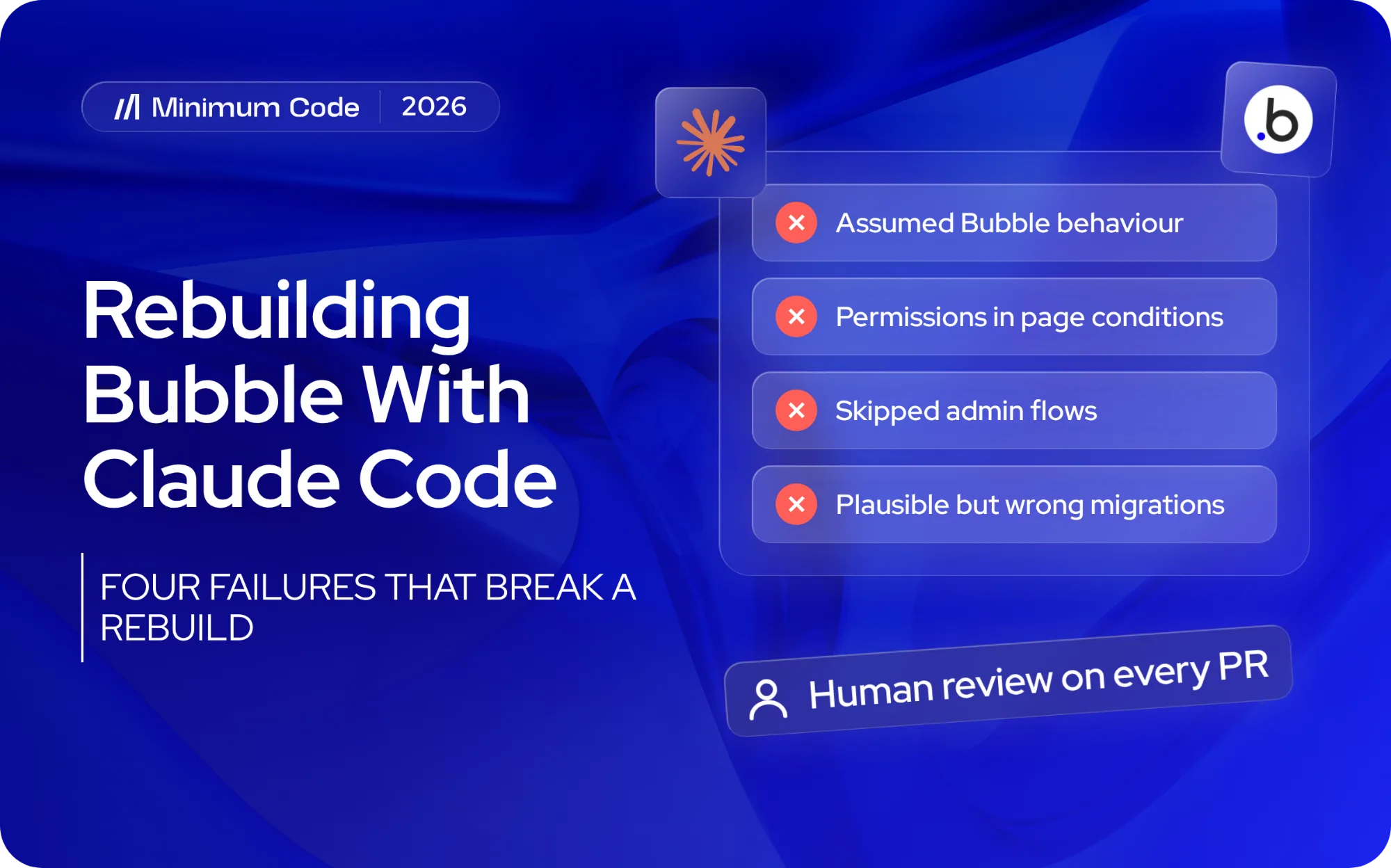
- The four failures to ask any team about upfront: unverified platform assumptions, permission logic hidden in page conditions, missing admin flows and data migrations that run but don't reconcile.
- Insist on a written system inventory, a staging environment separate from production, and a human reviewing every pull request before merge.
- Migration usually makes sense when you need faster development, SEO that Bubble cannot deliver, or full code ownership, not simply because Bubble frustrates you.
- Most of the actual migration timeline goes into planning and testing, not writing code.
- A full cutover without a parallel build and a rollback window is the single riskiest way to migrate.
What are the 4 failures in Claude Code rebuilds of Bubble apps?
Agent-driven rebuilds fail in recognisable ways once you’ve watched a few goes sideways. Four patterns show up again and again.
- Assuming Bubble behaviour instead of verifying it. An agent reads a workflow and guesses what a Bubble action does rather than checking the actual configuration, then writes code that matches the guess, not the app.
- Missing permission logic buried in page conditions. Bubble developers often control access through conditional visibility on page elements rather than a central permissions table, and an agent working from exported data alone will not reconstruct that logic.
- Skipping admin and correction flows. Rebuilds tend to cover the main user journey and leave out the admin panel, refund flow, or manual override screen that the business depends on weekly.
- Writing plausible but wrong data migrations. A script that runs without errors is not the same as one that reconciles correctly against production data, and agents rarely flag the difference on their own.
Industry practitioners report the same pattern: agents commonly fail by assuming platform-specific behaviour, and the fix is a documented system inventory paired with human review gates rather than faster prompting.
Pro Tip: Before any rebuild starts, ask for a written list of every page condition, privacy rule and admin flow in the current app. If nobody can produce one, the project isn’t ready to start.
Why does Claude Code produce plausible but wrong results?
Claude Code and similar agents generate the most likely continuation of the pattern they’re given, which is exactly why they fill gaps with assumptions rather than flagging them as unknowns. That’s efficient for boilerplate and dangerous for business rules that live only in someone’s head or in a Bubble workflow nobody documented.
- Agents infer intent from surrounding code and naming conventions, so an ambiguous field name produces a confident but wrong guess.
- Without environment rules, an agent can run commands against a live database instead of a sandboxed copy.
- Generating a convincing user interface is a different task from correctly implementing authorisation and business rules, and agents are far better at the first.
Claude Code’s own best-practice guidance recommends configuring environment rules, lint and test hooks before letting an agent touch a codebase, precisely because unconstrained agents default to assumption over verification.
How do you rebuild safely? In parallel, module by module
The lowest-risk way to move off Bubble is the strangler fig pattern (more in refactor vs rewrite): build the new system alongside the old one and replace features gradually instead of attempting one big cutover. Martin Fowler’s description of the strangler fig approach frames it as a controlled replacement strategy, not a shortcut, and it produces visible, frequent releases rather than one high-stakes launch day.
In practice that means picking one module, say the billing flow, rebuilding it in the new stack, verifying its data and behaviour against the Bubble original, then cutting that one module over while the rest of the app stays on Bubble. Repeat module by module until nothing is left.
A hybrid approach, where some modules stay on Bubble long term, makes sense when those modules are stable and low-complexity. A full cutover is justified when SEO, performance or server-side logic needs outgrow what Bubble can support across the whole app.
Approach | Risk profile | Best suited to |
|---|---|---|
Full rewrite, single cutover | Highest, one failure point | Small apps with light logic |
Strangler Fig, module by module | Lower, staged verification | Apps with real users and revenue |
Permanent hybrid | Lowest disruption, ongoing complexity | Apps where some modules are stable and low-risk |
Across these approaches, planning and testing consistently take up more time than writing the new code itself.
How do you rebuild authorisation and security in code?
Authorisation has to be rebuilt deliberately, not translated line by line from Bubble’s privacy rules. Start from your Bubble privacy rules. Supabase’s Row Level Security documentation describes RLS as a Postgres primitive: policies are written in SQL, enforced at the database level, and should be tested with dedicated test files that assert allow and deny behaviour for each operation.
- Write RLS policies per table and per operation rather than one broad rule covering everything.
- Declare endpoint authorisation explicitly in an OpenAPI contract so every route states who can call it.
- Couple authorisation regression tests to that contract so a changed endpoint without an updated test fails the build automatically.
Authorisation testing should run continuously and gate every pull request, according to the OWASP Authorization Regression Testing Cheat Sheet, which recommends including these checks in CI specifically to prevent access control from breaking silently as code changes over time.
How do you migrate the data safely?
Preventing a bad cutover is mostly about discipline before launch day, not heroics on the day itself.
- Set up two synced databases, staging and production, from day one, and enforce a rule that nothing reaches production without passing through staging first.
- Run the data migration script repeatedly against staging and reconcile the output row by row before trusting it anywhere near live data. Our Bubble to Supabase database migration post shows how we made those runs fast enough to repeat.
- Re-host every file and asset off Bubble’s CDN before cutover, since dependencies on Bubble’s file storage tend to surface only once traffic is live.
- Keep the Bubble app running for a short rollback window after cutover, rather than decommissioning it the same day.
Practitioner discussion on the Bubble community forum echoes this: handing an exported Bubble JSON file to an agent as a complete specification, without staging discipline or careful reconciliation, is a common source of technical debt in self-run migrations.
Should you stay on Bubble, go hybrid or migrate to code?
Work through these before committing either way.
- Do you need SEO performance, EU hosting outside Bubble’s Enterprise plan, or full code ownership? These are genuine reasons to migrate.
- Is your app simple, stable and growing slowly? It may be better left on Bubble rather than rebuilt for its own sake.
- Does your logic rely on complex row-level permissions or server-side integrations Bubble struggles with? That points towards code.
- Do you have in-house engineering capacity to run a migration, or do you need a team that owns the process end to end?
- Is your current frustration about hiring, downtime or a rising Bubble bill rather than a genuine technical ceiling? That’s rarely, on its own, a reason to rebuild.
Our own view, outlined in more depth in our analysis of Bubble’s pros and cons, is that simple tools and early prototypes often belong on Bubble for longer than founders expect.
How Minimum Code handles Claude Code rebuilds and Bubble migrations
We run Claude Code as our primary coding agent, but senior engineers own architecture, code review and testing on every project, so the agent handles implementation inside boundaries a person has already set. Every migration starts with a written system inventory from our audit, covering page conditions, privacy rules and admin flows, which becomes the context the agent works from rather than guesswork. We break work into small, scoped tasks with a human review gate before anything merges, and QA is owned by a person, not automated away. Our migration service runs on fixed price, fixed scope, with no downtime during the switch and 60 days of free support after launch.
Lessons from our own rebuilds
In our own projects, the failure modes that cost the most time were always the quiet ones: a page condition nobody mentioned, a data migration that reconciled on sample rows but not on the full dataset. What saved those projects was the system inventory catching the gap before it reached production, not a faster rewrite afterwards. If you’re evaluating a migration, start by listing every admin flow, request a staging environment before any code is written, and ask whoever you hire how they test permissions, not just features.
Want help with a Claude Code rebuild?
If you’ve read this far, you already know the risk in an agent-driven rebuild isn’t the agent, it’s the absence of the controls around it. That’s the gap we built our process to close: a Claude Code-driven build with senior engineers setting the boundaries, reviewing every change, and owning QA personally rather than trusting the agent’s own tests.
For founders weighing the decision itself, our product strategy work helps clarify whether migration is the right call before any code gets written. When you’re ready to move, our Bubble-to-code migration service runs on a fixed price and fixed scope, with no downtime during the switch and 60 days of free support once you’re live. You can also read our fuller migration guide, what AI can and can't migrate from Bubble, and seven client projects built with Claude Code.
FAQ
What is a Claude Code rebuild of a Bubble app?
It means using Claude Code as an AI coding agent to help write the code for a new, usually faster-performing stack such as Next.js and Supabase, while migrating off Bubble. The agent handles implementation tasks, but reliable results still depend on human engineers defining the system inventory, reviewing output and owning testing.
Is Claude Code reliable enough to rebuild a Bubble app on its own?
Not on its own. Claude Code performs well on scoped, well-specified tasks, but it tends to assume platform behaviour it hasn’t verified and skip permission logic buried in page conditions unless a documented system inventory and human review gates are in place.
What’s the safest way to migrate a Bubble app to code?
The strangler fig pattern, building the new system in parallel and cutting over module by module, consistently reduces risk compared with a single full rewrite. Most of the time in a well-run migration goes into planning and testing each module, not writing the new code.
Does my Bubble app need EU hosting?
Only if your sector requires it: healthcare, fintech and defence usually do, and EU hosting on Bubble is only available on its Enterprise plan. For most other apps, Bubble’s data processing agreement keeps US hosting compliant with GDPR.
How much does a Bubble to code migration cost?
Pricing depends on the size and complexity of the app, and our Bubble to code migration service runs on a fixed price and fixed scope agreed before work starts rather than a published rate card. Get in touch for an estimate based on your specific app.
Sources

Written by Tom
Founder and Lead Developer

Ready to start your project?
Book a free discovery call to learn how we can build your app in 4 weeks, or less.
Book a call