
Leave a no-code tool when one of two things happens: the metered unit you pay for (CMS items, app users, workload units) crosses a price step your business cannot carry, or you need something the platform will not let you take with you, such as your code, your logic or your users' logins. Until then, most no-code pain comes from how the app was built, and fixing the build is cheaper than leaving. This page shows where Webflow, Softr and Bubble hit their walls, what each lets you export, and the general path to code, with a guide for each platform below.
All prices and limits on this page were read on the platforms' own pricing pages on 6 October 2026, in US dollars before tax, with monthly billing.
Not sure which side of the wall you are on? Our team will look at your app and your plan and tell you whether moving is worth it.
When to move from no-code to custom code
These are the walls we found when we went through Webflow, Softr and Bubble for the platform guides. Each one comes from a pricing page, the docs or a test run, with the date.
- The metered unit outgrows the plan. Webflow counts CMS items (20,000 on Premium), Softr counts app users (500 client users on Business), Bubble counts workload units (WU) on every search, write and workflow.
- The next plan is a cliff, not a step. Webflow goes from Premium at $39 a month to Team at $2,500 on an annual contract. Softr goes from Business to Enterprise, which has no public price.
- The feature you need sits two plans up. On Softr, custom code, API calls and CSV export start on Pro at $119 a month. On Webflow, code export needs a paid Workspace plan on top of the site plan.
- The limits have moved under you before. One Softr builder wrote in November 2025 that the Business user limit went "from 2,500 to 500 with no price change".
- You cannot take the app with you. Softr and Bubble have no code export. Webflow's export leaves your CMS content, forms and other languages behind.
- Your users' passwords can never leave. On all three, a move means every user sets a new password or gets a magic link.
- The product needs things the editor cannot express: server-rendered pages for search, engineers who expect Git and code review, or rules that blocks and workflows cannot model.
Who should stay. If your problem is speed or cost and it traces back to a few workflows or searches, stay and fix them. Our own view on Bubble, from the Bubble migration service, is that "a lot of the pain founders blame on Bubble comes from how the app was built, not the platform itself". The evidence agrees. One Bubble user's bill spiked to "1,004,305" WU "in a single day" because of one weekly clean-up workflow, and Bubble's manual shows an agency taking an app from 6 million WU to 900K by making one API call run only when it was needed. Stay too if you are under the plan caps above, non-technical people change the app every week, and nobody would own a codebase. The wider trade-offs are in our custom code versus no-code comparison and the no-code, low-code and full-code breakdown.
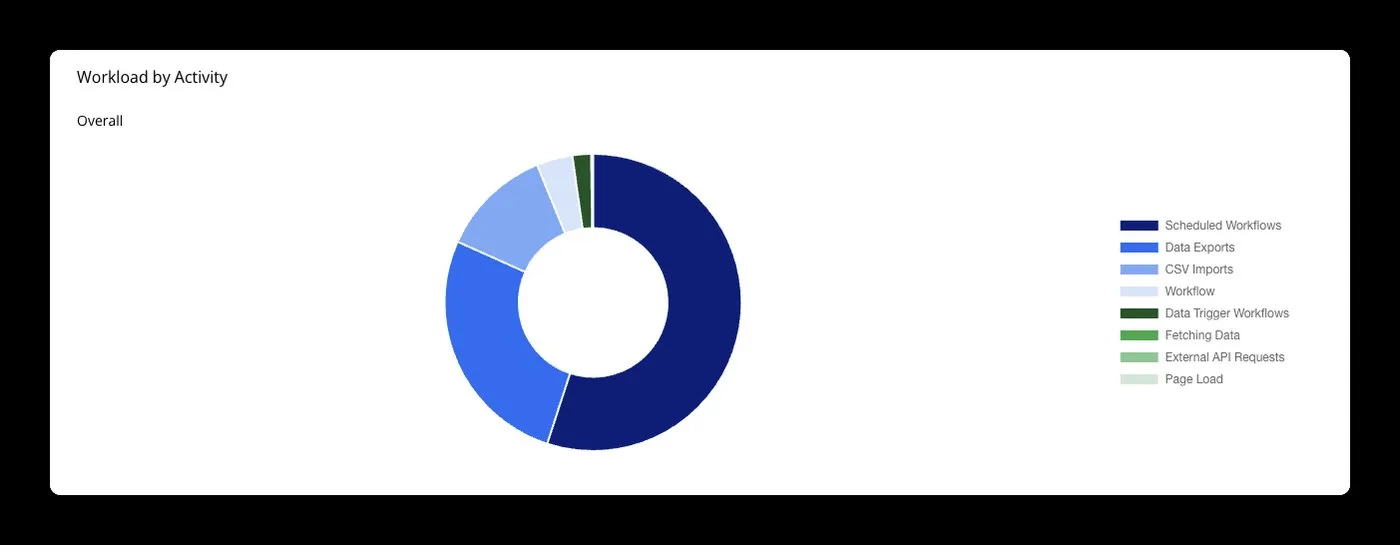
Before you leave Bubble, App Metrics shows which activity uses your workload units. Screenshot: Bubble manual, manual.bubble.io (Using App Metrics).
Where each platform hits the wall, and what you can take
Webflow | Softr | Bubble | |
|---|---|---|---|
What hits the wall first | CMS items: 20,000 on Premium | App users: 250 client users on Pro, 500 on Business | Workload units: 175K on Starter, then $0.30 per 1,000 |
The price step | Premium $39 to Team $2,500 a month (annual contract) | Business $395, $795 at 300 client users, then Enterprise (no public price) | No forced jump; 1.5M WU a month is $429.50 on Starter or $699 on Team |
Can you export the app? | Yes, as static HTML on a paid Workspace plan (Core, $28); CMS lists come out empty | No | No |
Can you export the data? | CMS as CSV per Collection, or the Data API; redirects as CSV | Database API on every plan; table CSV from Pro | CSV, JSON or NDJSON on paid plans, or the Data API |
Users and passwords | Plan a password reset | Names and emails as CSV, no passwords | No passwords |
What stays behind | CMS functionality, forms, search, other languages, hosting | Pages, user groups, visibility rules, workflows, hosted login | Pages, workflows, privacy rules, plugins, option sets |
Guide | In progress |
What to take from the table: Webflow is the only one of the three that exports code, and even there the content comes out separately. On Softr and Bubble the move is always data out, then a rebuild. On all three the password reset email is part of the plan, so budget a week of user communication for it.
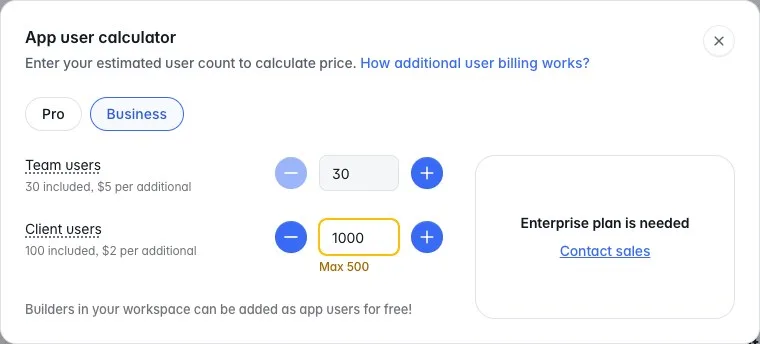
Softr Business tops out at 500 client users. Screenshot: Softr pricing page, app user calculator, softr.io/pricing, 6 October 2026.
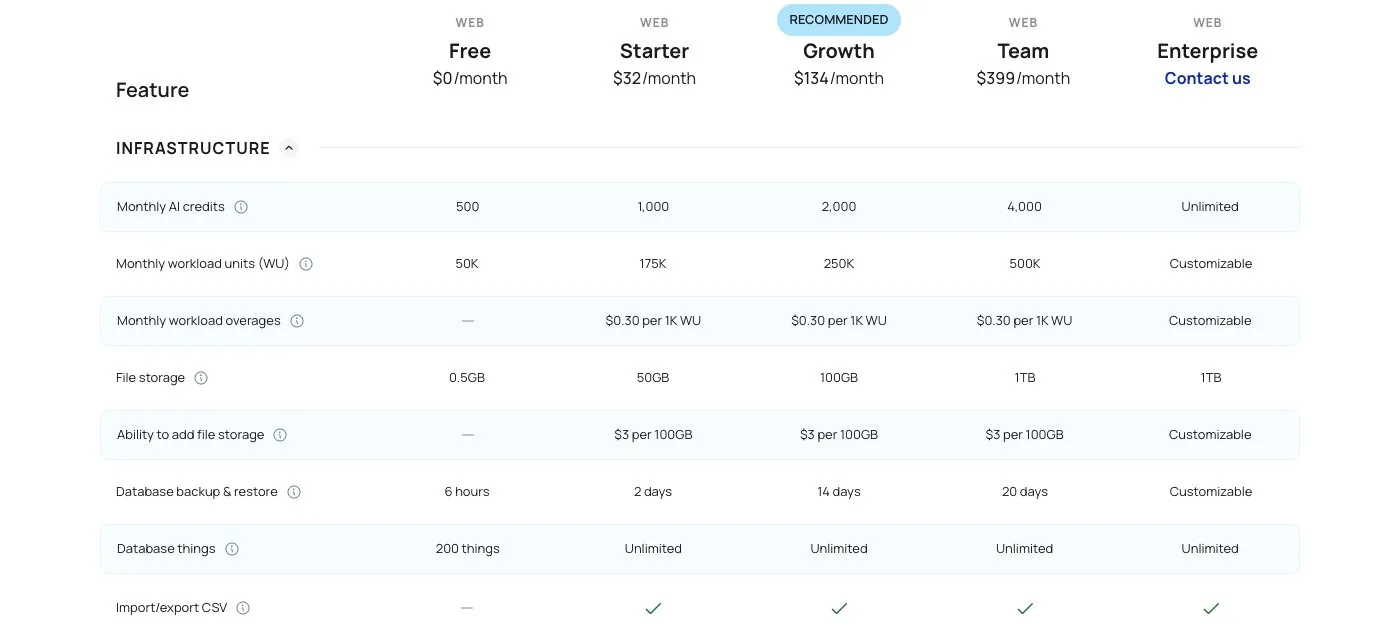
Bubble web plans compared, monthly billing. Screenshot: Bubble, bubble.io/pricing, 6 October 2026.
Pick your platform
- Webflow: for teams whose marketing site has outgrown its plan or its speed and who want a codebase with every URL kept. Our Next.js development team does this move.
- Softr: for client portals and internal apps past the user caps, or fighting the blocks to build what clients need. Softr limits and the move to your own app.
- Bubble: for apps whose workload unit bill grows with real use, not one bad workflow. Read the Bubble to Next.js guide and our planning guide for leaving Bubble.
Guides for Airtable, Retool, Glide, AppSheet, Adalo, WordPress, and the enterprise platforms OutSystems, Power Apps and Mendix are in progress. For the enterprise three, our legacy application modernisation service covers the move today.
The path to code, on any platform
The guides follow the same order, with details that differ by platform.
- Count what you have before you plan. Take the numbers from the platform itself (pages, tables, records, users), not from memory; estimates are usually low.
- Get the data out in its richest format. An API usually keeps more than a CSV. On Softr, a 56-line script against the Database API moved all 460 records of our test portal, every project still linked to its client.
- Move your users by email, with a reset or magic link on first login.
- Put the rules in the database, not the screens. Softr's "clients see only their own records" rule became row level security in Supabase, tested per role.
- Rebuild the screens people use, one module at a time, while the old app keeps running.
- Cut over with a rollback. Before switching DNS, request every old URL against the new build, and keep the old platform live in case you have to go back.
How we do it with Claude Code
Every guide runs the rebuild with Claude Code and a short CLAUDE.md of rules, and prints the prompt verbatim. On the Softr run it wrote and tested the access rules as Postgres policies in 97 seconds. Each time it left decisions for a person: which users still get access, what happens to files still on the old platform, which features to drop. Those calls stay with a person on our team.
Two projects
- Diggy App: fixed on Bubble first, moved to code later. A mining operations app the client had built on Bubble ran into performance bottlenecks and bugs just as new companies were about to onboard. We audited it, fixed the critical issues, refined the backend logic and kept building features, at 20 hours a week. That bought the client time to grow on Bubble; when they later outgrew it, their own team moved the app to custom code. The Diggy App project.
- Palabra stayed on Softr. A speech-therapy workplace app on Softr looked dated within Softr's visual constraints. We redesigned the structure and interface inside Softr in two weeks rather than rebuild it. The Palabra project.
Things to consider
- Should we leave at all? Only if a metered limit, a price step or a missing export blocks the business. If a few workflows cause the cost, fix those first; on Bubble, our workload unit tips are the place to start.
- What does it cost? A one-off build, then hosting. Compare it with what the wall costs you: $795 a month for Softr Business at 300 client users, or $2,500 a month for Webflow Team.
- How long does it take? It depends on the app. For Bubble apps we quote roughly 6 to 8 weeks for an MVP-sized app and 3 to 6 months for a live app with users and integrations.
- Who maintains it afterwards? Someone has to merge changes and keep dependencies current. Decide who before you start.
- Can we do it in stages? Yes. Data and users first, then the screens people use, with the old platform live until cutover.
Who should book a call
If you have hit one of the walls above and fixing the build will not get you past it, book a call. We will tell you honestly whether to move, refactor where you are, or leave it alone. Bubble apps go through our Bubble migration service; Webflow, Softr and other no-code apps through our web app development team. Or contact us with a link to your app and your current plan.
Frequently asked questions
When should you move from no-code to code?
When the unit you pay for (items, users or workload units) crosses a price step your business cannot carry, or you need to own the code, the logic or the data in a way the platform does not allow.
What are the main limitations of no-code?
On the three platforms we checked: metered limits with large price steps, features locked to higher plans, no code export on Softr and Bubble, and passwords that can never be exported.
Can you export a no-code app to code?
Webflow exports static HTML, CSS and JavaScript on a paid Workspace plan, without CMS content. Softr and Bubble export data only; the app is rebuilt.
What happens to user passwords when you leave a no-code platform?
They stay behind on every platform we checked. Users set a new password or log in with a magic link on the new system.
Is it always better to move to custom code?
No. Many apps are slow or expensive because of how they were built, and a refactor on the same platform fixes that for less.
Sources
What we read:
- Webflow pricing and the Webflow help centre on code export and Workspace plans. Read 6 October 2026.
- Softr pricing, Compare plans table and app user calculator, read 6 October 2026, source of the calculator screenshot; Softr community thread Business Plan User Limits, November 2025; Exporting users to leave Softr, February 2023.
- Bubble pricing, read 6 October 2026, source of the plan comparison screenshot; Bubble manual on workload activity types, App Metrics (source of the App Metrics screenshot), user accounts and an agency WU showcase, read 6 October 2026; Bubble forum WU pricing thread, October 2024.
- Our own Bubble migration service page and project pages, read 6 October 2026.
What we ran ourselves:
- A Softr Database API export and Postgres rebuild on a test client portal, 6 October 2026, with the Claude Code run described in the Softr guide.

Written by Tom
Founder and Lead Developer

Ready to start your project?
Book a free discovery call to learn how we can build your app in 4 weeks, or less.
Book a call